
Article Sidebar
Published
Mar 5, 2025
Download
Statistic
Read Counter : 0
Download : 86
Main Article Content
Abstract
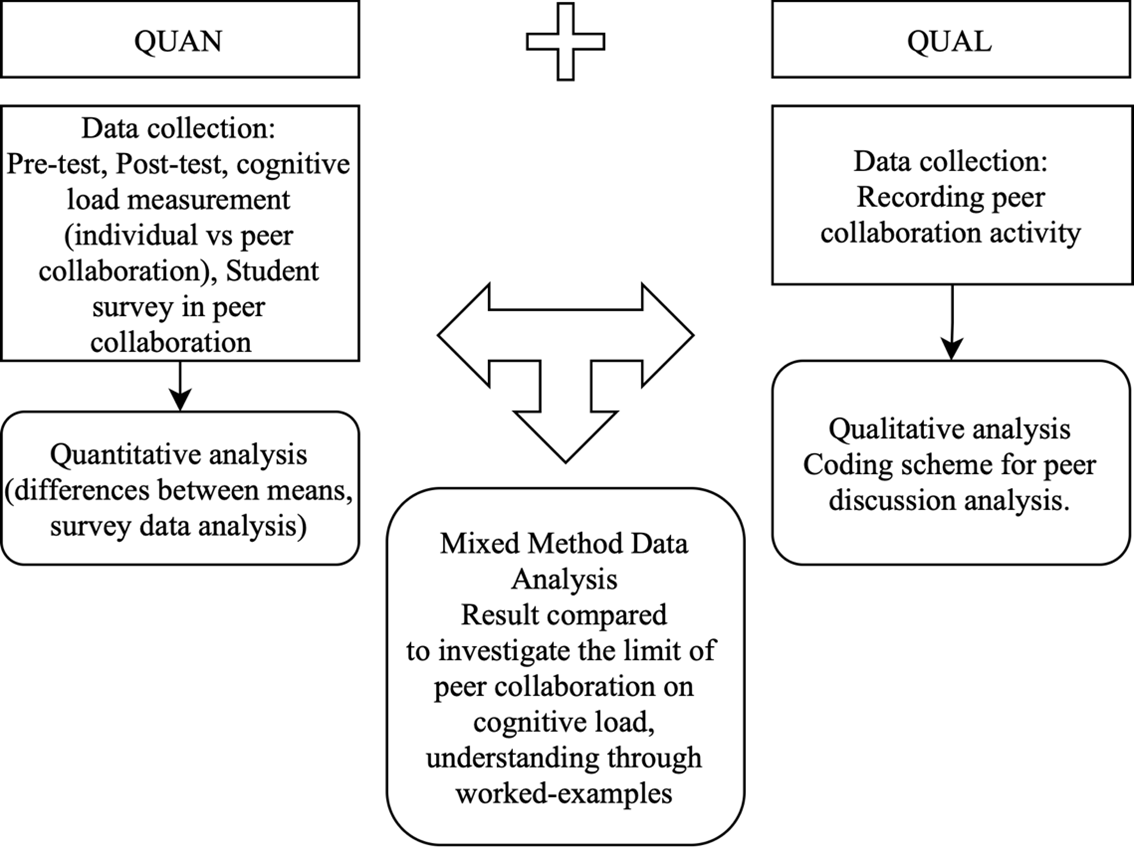
This study validates the superiority of individual learning over peer collaborative learning when studying worked examples in a multivariable calculus course. It examines cognitive load dimensions and the quality of students' conceptual understanding to provide empirical recommendations for instructional design in higher education. A mixed-method approach with a concurrent triangulation design combined quantitative and qualitative analyses. The quantitative aspect involved experimental comparisons of cognitive load, comprehension tests, and surveys, while the qualitative analysis focused on interaction patterns through discussion transcripts. Participants included 131 undergraduate students (41 male, 90 female, average age 19.25 years) from a state university in Banten, Indonesia. They were randomly assigned to individual (52 students) and peer collaboration (79 students) groups. The results revealed that students in the individual learning condition achieved significantly better comprehension than those in peer collaboration, though cognitive load showed no difference between the groups. Peer collaboration presented notable challenges in supporting the effectiveness of worked-example learning. In most cases, collaboration was either ineffective or partially effective. However, instances of effortful understanding and clarification-seeking suggest collaboration may be supportive if instructional design encourages deeper engagement and problem-solving. These findings provide insights for optimizing collaborative strategies in worked-example learning.
Keywords
Cognitive load
Individual learning
Instructional design
Peer collaboration
Worked-example
Article Details

This work is licensed under a Creative Commons Attribution-ShareAlike 4.0 International License.
References
- Anitha, D., & Kavitha, D. (2023). Improving problem-solving skills through technology assisted collaborative learning in a first year engineering mathematics course. Interactive Technology and Smart Education, 20(4), 534-553. https://doi.org/10.1108/ITSE-03-2022-0030
- Asmara, A. S., Waluya, S. B., Suyitno, H., Junaedi, I., & Ardiyanti, Y. (2024). Developing patterns of students' mathematical literacy processes: Insights from cognitive load theory and design-based research. Infinity Journal, 13(1), 197-214. https://doi.org/10.22460/infinity.v13i1.p197-214
- Baddeley, A. (2000). The episodic buffer: a new component of working memory? Trends in Cognitive Sciences, 4(11), 417-423. https://doi.org/10.1016/S1364-6613(00)01538-2
- Baddeley, A. (2010). Working memory. Current Biology, 20(4), R136-R140. https://doi.org/10.1016/j.cub.2009.12.014
- Baddeley, A. (2012). Working memory: Theories, models, and controversies. Annual Review of Psychology, 63, 1-29. https://doi.org/10.1146/annurev-psych-120710-100422
- Baddeley, A. (2017). Exploring working memory: Selected works of Alan Baddeley. Routledge. https://doi.org/10.4324/9781315111261
- Baddeley, A. (2019). Working memory and conscious awareness. In A. F. Collins, M. A. Conway, & P. E. Morris (Eds.), Theories of memory (pp. 11-28). Psychology Press. https://doi.org/10.4324/9781315782119-2
- Baddeley, A. D., & Larsen, J. D. (2007). The phonological loop: Some answers and some questions. Quarterly Journal of Experimental Psychology, 60(4), 512-518. https://doi.org/10.1080/17470210601147663
- Bichler, S., Stadler, M., Bühner, M., Greiff, S., & Fischer, F. (2022). Learning to solve ill-defined statistics problems: does self-explanation quality mediate the worked example effect? Instructional Science, 50, 335-359. https://doi.org/10.1007/s11251-022-09579-4
- Booth, J. L., Lange, K. E., Koedinger, K. R., & Newton, K. J. (2013). Using example problems to improve student learning in algebra: Differentiating between correct and incorrect examples. Learning and Instruction, 25, 24-34. https://doi.org/10.1016/j.learninstruc.2012.11.002
- Braun, V., & Clarke, V. (2006). Using thematic analysis in psychology. Qualitative Research in Psychology, 3(2), 77-101. https://doi.org/10.1191/1478088706qp063oa
- Chen, O., Retnowati, E., & Kalyuga, S. (2019). Effects of worked examples on step performance in solving complex problems. Educational Psychology, 39(2), 188-202. https://doi.org/10.1080/01443410.2018.1515891
- Conati, C. (2016). Commentary on: "toward computer-based support of metacognitive skills: A computational framework to coach self explanation". International Journal of Artificial Intelligence in Education, 26, 183-192. https://doi.org/10.1007/s40593-015-0074-8
- Costley, J., & Lange, C. (2017). The mediating effects of germane cognitive load on the relationship between instructional design and students’ future behavioral intention. Electronic Journal of e-Learning, 15(2), 174-187.
- Creswell, J. W., & Clark, V. L. P. (2018). Designing and conducting mixed methods research (3rd ed.). Sage publications.
- Debue, N., & van de Leemput, C. (2014). What does germane load mean? An empirical contribution to the cognitive load theory. Frontiers in psychology, 5, 1-12. https://doi.org/10.3389/fpsyg.2014.01099
- Diao, Y., & Sweller, J. (2007). Redundancy in foreign language reading comprehension instruction: Concurrent written and spoken presentations. Learning and Instruction, 17(1), 78-88. https://doi.org/10.1016/j.learninstruc.2006.11.007
- Fauziah, A., Putri, R. I. I., & Zulkardi, Z. (2022). Collaborative learning through lesson study in PMRI training for primary school pre-service teacher: the simulation of polygon matter. Infinity Journal, 11(1), 1-16. https://doi.org/10.22460/infinity.v11i1.p1-16
- Fayowski, V., & MacMillan, P. D. (2008). An evaluation of the Supplemental Instruction programme in a first year calculus course. International Journal of Mathematical Education in Science and Technology, 39(7), 843-855. https://doi.org/10.1080/00207390802054433
- Hashemi, N., Abu, M. S., Kashefi, H., Mokhtar, M., & Rahimi, K. (2015). Designing learning strategy to improve undergraduate students' problem solving in derivatives and integrals: A conceptual framework. Eurasia Journal of Mathematics, Science and Technology Education, 11(2), 227-238. https://doi.org/10.12973/eurasia.2015.1318a
- Hausmann, R. G. M., & Chi, M. T. H. (2002). Can a computer interface support self-explaining? Cognitive Technology, 7(1), 4-14.
- Hausmann, R. G. M., Nokes, T. J., VanLehn, K., & Gershman, S. (2009). The design of self-explanation prompts: The fit hypothesis. In Proceedings of the 31st Annual Conference of the Cognitive Science Society, (pp. 2626-2631).
- Hodds, M., Alcock, L., & Inglis, M. (2014). Self-explanation training improves proof comprehension. Journal for Research in Mathematics Education, 45(1), 62-101. https://doi.org/10.5951/jresematheduc.45.1.0062
- Hu, F.-T., Ginns, P., & Bobis, J. (2015). Getting the point: Tracing worked examples enhances learning. Learning and Instruction, 35, 85-93. https://doi.org/10.1016/j.learninstruc.2014.10.002
- Jones, S. R., & Dorko, A. (2015). Students' understandings of multivariate integrals and how they may be generalized from single integral conceptions. Journal of Mathematical Behavior, 40, 154-170. https://doi.org/10.1016/j.jmathb.2015.09.001
- Kalyuga, S. (2011). Cognitive load theory: How many types of load does it really need? Educational Psychology Review, 23, 1-19. https://doi.org/10.1007/s10648-010-9150-7
- Kashefi, H., Ismail, Z., & Yusof, Y. M. (2012). Overcoming students obstacles in multivariable calculus through blended learning: A mathematical thinking approach. Procedia - Social and Behavioral Sciences, 56, 579-586. https://doi.org/10.1016/j.sbspro.2012.09.691
- Kester, L., Paas, F., & van Merriënboer, J. J. G. (2010). Instructional control of cognitive load in the design of complex learning environments. In J. L. Plass, R. Moreno, & R. Brünken (Eds.), Cognitive Load Theory (pp. 109-130). Cambridge University Press. https://doi.org/10.1017/CBO9780511844744.008
- Khemane, T., Padayachee, P., & Shaw, C. (2023). Exploring the complexities of swapping the order of integration in double integrals. International Journal of Mathematical Education in Science and Technology, 54(9), 1907-1927. https://doi.org/10.1080/0020739X.2023.2265948
- Kirschner, F., Paas, F., & Kirschner, P. A. (2009). Individual and group-based learning from complex cognitive tasks: Effects on retention and transfer efficiency. Computers in human Behavior, 25(2), 306-314. https://doi.org/10.1016/j.chb.2008.12.008
- Kirschner, F., Paas, F., & Kirschner, P. A. (2011). Superiority of collaborative learning with complex tasks: A research note on an alternative affective explanation. Computers in human Behavior, 27(1), 53-57. https://doi.org/10.1016/j.chb.2010.05.012
- Kirschner, F., Paas, F., Kirschner, P. A., & Janssen, J. (2011). Differential effects of problem-solving demands on individual and collaborative learning outcomes. Learning and Instruction, 21(4), 587-599. https://doi.org/10.1016/j.learninstruc.2011.01.001
- Kirschner, P. A., Sweller, J., & Clark, R. E. (2006). Why minimal guidance during instruction does not work: An analysis of the failure of constructivist, discovery, problem-based, experiential, and inquiry-based teaching. Educational Psychologist, 41(2), 75-86. https://doi.org/10.1207/s15326985ep4102_1
- Lee, H. M., & Ayres, P. (2024). The worked-example effect and a mastery approach goal orientation. Education Sciences, 14(6), 597. https://doi.org/10.3390/educsci14060597
- Lugosi, E., & Uribe, G. (2022). Active learning strategies with positive effects on students’ achievements in undergraduate mathematics education. International Journal of Mathematical Education in Science and Technology, 53(2), 403-424. https://doi.org/10.1080/0020739X.2020.1773555
- Martínez-Planell, R., & Trigueros, M. (2021). Multivariable calculus results in different countries. ZDM - Mathematics Education, 53, 695-707. https://doi.org/10.1007/s11858-021-01233-6
- Merkel, J. C., & Brania, A. (2015). Assessment of peer-led team learning in calculus I: A five-year study. Innovative Higher Education, 40, 415-428. https://doi.org/10.1007/s10755-015-9322-y
- Miller, G. A. (1956). The magical number seven, plus or minus two: some limits on our capacity for processing information. Psychological Review, 63(2), 81-97. https://doi.org/10.1037/h0043158
- Neuman, Y., & Schwarz, B. (2000). Substituting one mystery for another: The role of self-explanations in solving algebra word-problems. Learning and Instruction, 10(3), 203-220. https://doi.org/10.1016/S0959-4752(99)00027-4
- Oksa, A., Kalyuga, S., & Chandler, P. (2010). Expertise reversal effect in using explanatory notes for readers of Shakespearean text. Instructional Science, 38, 217-236. https://doi.org/10.1007/s11251-009-9109-6
- Oktaviyanthi, R., Agus, R. N., Garcia, M. L. B., & Lertdechapat, K. (2024). Cognitive load scale in learning formal definition of limit: A rasch model approach. Infinity Journal, 13(1), 99-118. https://doi.org/10.22460/infinity.v13i1.p99-118
- Owens, P., & Sweller, J. (2008). Cognitive load theory and music instruction. Educational Psychology, 28(1), 29-45. https://doi.org/10.1080/01443410701369146
- Paas, F., & van Gog, T. (2006). Optimising worked example instruction: Different ways to increase germane cognitive load. Learning and Instruction, 16(2), 87-91. https://doi.org/10.1016/j.learninstruc.2006.02.004
- Paas, F. G. W. C. (1992). Training strategies for attaining transfer of problem-solving skill in statistics: A cognitive-load approach. Journal of educational psychology, 84(4), 429-434. https://doi.org/10.1037/0022-0663.84.4.429
- Paas, F. G. W. C., & Van Merrienboer, J. J. G. (1993). The efficiency of instructional conditions: An approach to combine mental effort and performance measures. Human Factors, 35(4), 737-743. https://doi.org/10.1177/001872089303500412
- Peterson, L., & Peterson, M. J. (1959). Short-term retention of individual verbal items. Journal of Experimental Psychology, 58(3), 193-198. https://doi.org/10.1037/h0049234
- Ramadoni, R., & Chien, K. T. (2023). Integrating peer tutoring video with flipped classroom in online statistics course to improve learning outcomes. Infinity Journal, 12(1), 13-26. https://doi.org/10.22460/infinity.v12i1.p13-26
- Renkl, A. (1997). Learning from worked-out examples: A study on individual differences. Cognitive Science, 21(1), 1-29. https://doi.org/10.1016/S0364-0213(99)80017-2
- Renkl, A. (2017). Learning from worked-examples in mathematics: students relate procedures to principles. Zdm, 49(4), 571-584. https://doi.org/10.1007/s11858-017-0859-3
- Renkl, A., & Atkinson, R. K. (2010). Learning from worked-out examples and problem solving. In J. L. Plass, R. Moreno, & R. Brünken (Eds.), Cognitive load theory (pp. 91-108). Cambridge University Press. https://doi.org/10.1017/CBO9780511844744.007
- Retnowati, E., Ayres, P., & Sweller, J. (2010). Worked example effects in individual and group work settings. Educational Psychology, 30(3), 349-367. https://doi.org/10.1080/01443411003659960
- Retnowati, E., Ayres, P., & Sweller, J. (2017). Can collaborative learning improve the effectiveness of worked examples in learning mathematics? Journal of educational psychology, 109(5), 666-679. https://doi.org/10.1037/edu0000167
- Rittle-Johnson, B., Loehr, A. M., & Durkin, K. (2017). Promoting self-explanation to improve mathematics learning: A meta-analysis and instructional design principles. Zdm, 49(4), 599-611. https://doi.org/10.1007/s11858-017-0834-z
- Rourke, A., & Sweller, J. (2009). The worked-example effect using ill-defined problems: Learning to recognise designers' styles. Learning and Instruction, 19(2), 185-199. https://doi.org/10.1016/j.learninstruc.2008.03.006
- Santosa, C. A. H. F., Mutaqin, A., Syamsuri, S., & Ruhiat, Y. (2024). Kalkulus Peubah Banyak. Untirta Press.
- Santosa, C. A. H. F., Prabawanto, S., & Marethi, I. (2019). Fostering germane load through self-explanation prompting in calculus instruction. Indonesian Journal on Learning and Advanced Education (IJOLAE), 1(1), 37-47. https://doi.org/10.23917/ijolae.v1i1.7421
- Santosa, C. A. H. F., Suryadi, D., Prabawanto, S., & Syamsuri, S. (2018). The role of worked-example in enhancing students’ self-explanation and cognitive efficiency in calculus instruction. Jurnal Riset Pendidikan Matematika, 5(2), 168-180. https://doi.org/10.21831/jrpm.v0i0.19602
- Sweller, J. (2011). Cognitive load theory. In J. P. Mestre & B. H. Ross (Eds.), Psychology of Learning and Motivation (Vol. 55, pp. 37-76). Academic Press. https://doi.org/10.1016/B978-0-12-387691-1.00002-8
- Sweller, J. (2022). The role of evolutionary psychology in our understanding of human cognition: Consequences for cognitive load theory and instructional procedures. Educational Psychology Review, 34(4), 2229-2241. https://doi.org/10.1007/s10648-021-09647-0
- Sweller, J. (2024). Cognitive load theory and individual differences. Learning and Individual Differences, 110, 102423. https://doi.org/10.1016/j.lindif.2024.102423
- Sweller, J., van Merriënboer, J. J. G., & Paas, F. (2019). Cognitive architecture and instructional design: 20 years later. Educational Psychology Review, 31(2), 261-292. https://doi.org/10.1007/s10648-019-09465-5
- Sweller, J., van Merrienboer, J. J. G., & Paas, F. G. W. C. (1998). Cognitive architecture and instructional design. Educational Psychology Review, 10(3), 251-296. https://doi.org/10.1023/A:1022193728205
- Tuovinen, J. E., & Paas, F. (2004). Exploring multidimensional approaches to the efficiency of instructional conditions. Instructional Science, 32(1), 133-152. https://doi.org/10.1023/B:TRUC.0000021813.24669.62
- van Merriënboer, J. J. G., & Kirschner, P. A. (2017). Ten steps to complex learning: A systematic approach to four-component instructional design (3rd ed.). Routledge. https://doi.org/10.4324/9781315113210
- Wagner, J. F. (2018). Students’ obstacles to using Riemann sum interpretations of the definite integral. International Journal of Research in Undergraduate Mathematics Education, 4(3), 327-356. https://doi.org/10.1007/s40753-017-0060-7
- Widodo, S. A., Turmudi, T., Dahlan, J. A., Watcharapunyawong, S., Robiasih, H., & Mustadin, M. (2023). The sociograph: Friendship-based group learning in the mathematics class. Infinity Journal, 12(1), 27-40. https://doi.org/10.22460/infinity.v12i1.p27-40
- Yaman, B. B. (2019). A multiple case study: What happens in peer tutoring of calculus studies? International Journal of Education in Mathematics, Science and Technology, 7(1), 53-72.