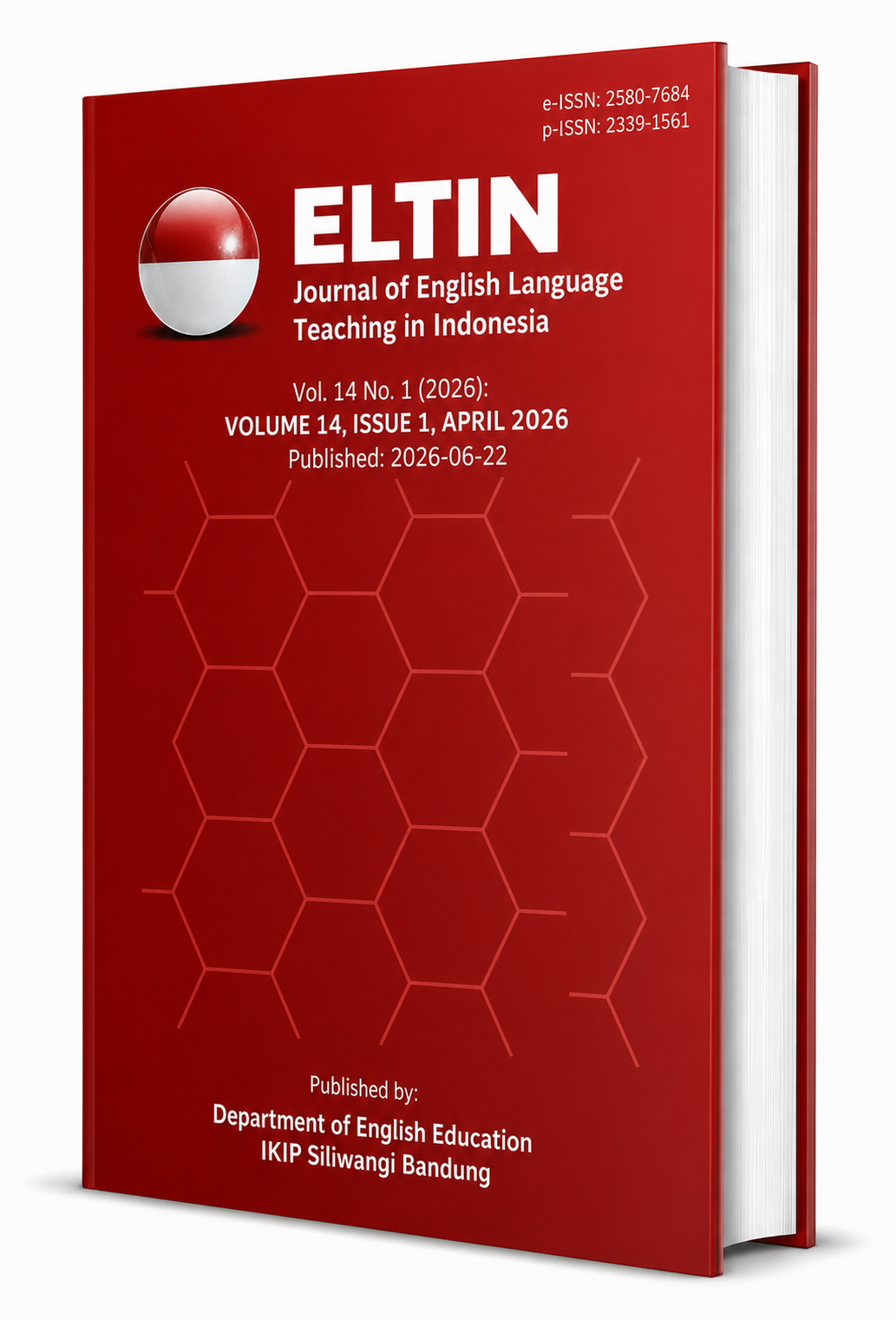
TEACHER AGENCY AND PEDAGOGICAL ADAPTATION IN ONLINE TEYL: A STUDY OF NON-FORMAL ENGLISH EDUCATION CONTEXTS
DOI:
https://doi.org/10.22460/eltin.v14i1.p105-118Abstract
This study investigates how teachers exercise agency and enact pedagogical adaptation in online Teaching English to Young Learners (TEYL) within non-formal English education contexts. Employing a qualitative phenomenological approach, the data were collected through semi-structured interview to five EFL tutors navigating online class. The findings reveal that structural digital challenges, such as connectivity instability, hardware limitations, and platform constraints, function as catalytic conditions that activate teacher agency. In response, tutors invest in technological resources, provide connectivity backups, and implement real-time adaptive solutions to sustain instructional continuity. Furthermore, the study highlights a shift toward human-centered digital pedagogy through intensified individual interaction and parental collaboration. The results suggest that the non-formal English education sector provides a flexible space for pedagogical innovation, transforming digital platforms from emergency tools into permanent infrastructures for inclusivity and digital literacy. This study implies that the future of online TEYL depends on balancing digital efficiency with the fundamental developmental needs of young learners.
References
Anwar, C., Hartono, & Yavuz, F. (2025). Integrating Technology into English Language
Teaching at Indonesian High Schools: Teachers’ Reflections. Studies in English Language and Education, 12(2), 809–826. https://doi.org/10.24815/siele.v12i2.41868
Al-Khresheh, M. H., Alshammari, S. R., & Almayez, M. (2025). Digital integration in the
Saudi ELT context: a supervisory lens on teachers’ technological efficacy. Cogent
Social Sciences, 11(1), 2526011.. https://doi.org/10.1080/23311886.2025.2526011
Asprilia, M., Qodariah, L., & Purba, F. (2020). First Grader’s Attention Span During In-
Class Activity. GUIDENA: Jurnal Ilmu Pendidikan, Psikologi, Bimbingan dan
Konseling, 10(2), 144-150. https://doi:10.24127/gdn.v10i2.3151
Braun, V., & Clarke, V. (2006). Using thematic analysis in psychology. Qualitative Research
in Psychology, 3(2), 77–101.
Cahyono, B. Y., Fauziah, H., Santoso, D. R., & Wulandari, I. (2024). Revisiting
technological tools used in EFL speaking classes during the COVID-19 pandemic: What are the implications for the post-pandemic? The JALT CALL Journal, 20(2). https://doi.org/10.29140/jaltcall.v20n2.1054
Choi, L., & Chung, S. (2021). Navigating online language teaching in uncertain times:
Challenges and strategies of EFL educators in creating a sustainable technology-
mediated language learning environment. Sustainability (Switzerland), 13(14),
7664. https://doi.org/10.3390/su13147664
Creswell, J. W. (2019). Qualitative inquiry and research design: Choosing among five
approaches (3rd ed.). SAGE Publications.
Creswell, J. W., & Creswell, J. D. (2017). Research design: Qualitative, quantitative, and
mixed methods approaches. Sage publications.
Deiniatur, E., & Cahyono, B. Y. (2024). Digital literacy and teaching challenges in the EFL
classroom: The case of novice teachers. Indonesian Journal of English Language
Teaching, 18(3), 74–88. https://doi.org/10.11591/edulearn.v18i1.20899
Fan, J., and Tian, M. (2026). Online Learning Environment Predicting CFL Learning
Achievement Among International Students in China: Mediating Effect of Student
Engagement. Sustainability, 18(4), 1905. https://doi.org/10.3390/su18041905
Farahdina, N., Petrus, I., & Silvhiany, S. (2023). Parents’ investment in English for young
learners: The case of elementary school students attending non-formal English
education. Indonesian Research Journal in Education (IRJE), 7(1), 158–170.
https://doi.org/10.22437/irje.v7i1.25149
Gao, Y., & Cui, Y. (2024). English as a Foreign Language Teachers’ Pedagogical Beliefs
About Teacher Roles and Their Agentic Actions Amid and After COVID-19: A Case
Study. RELC Journal, 55(1), 111–127. https://doi.org/10.1177/00336882221074110
Garrison, D. R., Anderson, T., & Archer, W. (2000). Critical Inquiry in a Text-Based
Environment: Computer Conferencing in Higher Education. The Internet and Higher
Education, 2, 87-105. http://dx.doi.org/10.1016/S1096-7516(00)00016-6
Ghanizadeh, A., Razavi, A., & Jahedizadeh, S. (2015). Technology-Enhanced Language
Learning (TELL): A Review of Resourses and Upshots. International Letters of
Chemistry, Physics and Astronomy, 54, 73–87. https://doi.org/10.56431/p-z6sj8g
Hajar, A., & Karakus, M. (2024). Coming out of the shadows: investing in English private
tutoring at a transition point in Kazakhstan’s education system during the global
pandemic. Language Learning Journal, 52(5), 571–584. https://doi.org/10.1080/09571736.2023.2213244
Harsch, C., Mueller-Karabil, A., & Buchminskaia, E. (2021). Addressing the challenges of
interaction in online language courses. System, 103, 102673.
https://doi.org/10.1016/j.system.2021.102673
Heilporn, G., Lakhal, S., & Bélisle, M. (2021). An examination of teachers’ strategies to
foster student engagement in blended learning in higher education. International
journal of educational technology in higher education, 18(1), 25.
https://doi.org/10.1186/s41239-021-00260-3
Jeon, J., Lee, S., & Choe, H. (2022). Teacher agency in perceiving affordances and
constraints of videoconferencing technology: Teaching primary school students
online. System, 108, 102829. https://doi.org/10.1016/j.system.2022.102829
Karmina, S., Dyson, B., & Setyowati, L. (2024). Teachers’ perspectives on implementing
cooperative learning to promote social and emotional learning. Cakrawala
Pendidikan, 43(2), 470–479. https://doi.org/10.21831/cp.v43i2.68447
Linse, Caroline T. & Nunan, D. (2005). Practical English Language Teaching: Young
Learners. McGraw-Hill Companies, Inc.
Lopez-Caudana, E., Ponce, P., Mazon, N., & Ramirez-Montoya, M. S. (2022). Improving
the attention span of elementary school children for physical education through an NAO robotics platform in developed countries. International Journal on Interactive Design and Manufacturing (IJIDeM), 16(2), 657–675. https://doi.org/10.1007/s12008-022-00851-y
Mafulah, S., Basthomi, Y., Cahyono, B. Y., & Suryati, N. (2023). Exploring Indonesian EFL
Teacher-Student Interactions in Online Learning. Studies in English Language and
Education, 10(2), 686–703. https://doi.org/10.24815/siele.v10i2.23804
Marisa, R., Rachmajanti, S., & Anugerahwati, M. (2024). Investigating the digital
proficiency of English as a foreign language (EFL) educators in association with their
professional identity. JALT CALL Journal, 20(2), 1–31.
https://doi.org/10.29140/jaltcall.1315
Medgyes, P., Benkő, É. T., & Árva, V. (2025). Primary Language Teacher Development in
the Aftermath of Emergency Remote Teaching. Journal of Language Teaching and
Research, 16(4), 1057–1066. https://doi.org/10.17507/jltr.1604.01
Mishra, P., & Koehler, M. J. (2006). Technological pedagogical content knowledge: A
framework for teacher knowledge. Teachers College Record, 108(6), 1017–1054.
https://doi.org/10.1111/j.1467-9620.2006.00684.x
Noprival, N. (2024). Learning English and other foreign languages beyond school walls:
Insight from Indonesian polyglots. Studies in the Education of Adults, 1–13.
https://doi.org/10.1080/02660830.2024.2386141
Phuong, T. T. H. (2025). Integration of ICT into EFL classrooms: Have Vietnamese primary
schools progressed post-Covid-19? Issues in Educational Research, 35(2), 759-778. http://www.iier.org.au/iier35/phuong.pdf
Prihatin, Y., Ekawati, Y. N., & Sakinatulhaq, A. (2021). Challenges in teaching English to
young learners in Southern Thailand (A case study of Indonesian pre-service
teachers’ perspectives). Psychology and Education, 58(2), 10476–10484.
https://www.psychologyandeducation.net
Puentedura, R. R. (2010). SAMR and TPCK: Intro to Advanced Practice. Hippasus.
http://hippasus.com/rrpweblog/.
Putri, W. (2021). E-learning pedagogical challenges of EFL teachers during Covid-19
pandemic. EDUTECH: Jurnal Teknologi Pendidikan, 20(1), 87–97. https://doi.org/10.17509/e.v20i1.30993
Rustan, N. A., Cahyono, B. Y., & Junaid, R. (2023). Teachers' perspectives on technology-
based learning for the kindergarten students. Journal of Education and Learning
(EduLearn), 17(3), 374–381. https://doi.org/10.11591/edulearn.v17i3.20618
Sabila, D., Setyawan, A., & Hidayati, S. (2024). The impact of asynchronous video feedback
on students' speaking skills in online EFL classes. Asian EFL Journal, 32(1), 210–
225. https://doi.org/10.1234/aej.2024.32
Sholihah, Z., Purwati, O., & Tjahjono, T. (2023). Investigating teaching strategy in English
online learning for elementary students. Jurnal Pendidikan Glasser, 7(2), 268–278.
https://doi.org/10.32529/glasser.v7i2.2648
Sujiatmoko, A. H. (2021). Students’ Elements of Motivation in Joining the EFL Virtual
Classroom Using the Zoom Application During the Covid 19 Pandemic. Lensa: Kajian Kebahasaan, Kesusastraan, Dan Budaya, 11(2), 194. https://doi.org/10.26714/lensa.11.2.2021.194-205
Sujiatmoko, A. H. (2022). EFL learners’ cultural perspectives towards online learning
through flipped classrooms in Indonesia for facing 4.0 industry era. Journal of Social
Science, 3(5), 918–928.
https://doi.org/10.46799/jss.v3i5.396
Suwanto, S., & Rahman, F. (2022). The Implementation of TEYL in Indonesia Revisited: A
Study at Primary Schools in Bandung. International Journal of Education, Language, and Religion, 4(1), 19. https://doi.org/10.35308/ijelr.v4i1.5462
Tarigan, F. N., & Lasnumanda, E. S. (2020). Online english shadow education: EFL
learners’ perspective. Lexeme: Journal of Linguistics and Applied Linguistics, 2(2),
70-78. https://doi.org/10.32493/ljlal.v2i2.8104
Tran, L. T. T., Cao, T. T., & Vo, V. L. H. (2023). Pedagogical Challenges in Online
Teaching: A Qualitative Study on Vietnamese University Teachers of Social Sciences. Vietnam Journal of Education, 227–239. https://doi.org/10.52296/vje.2023.300
Wargadinata, W., Maimunah, I., Dewi, E., & Rofiq, Z. (2020). Student’s Responses on
Learning in the Early COVID-19 Pandemic. Tadris: Jurnal Keguruan Dan Ilmu Tarbiyah, 5(1), 141–153. https://doi.org/10.24042/tadris.v5i1.6153
Wu, Z., & Huang, R. (2025). The impact of digital transformation on the quality of college
English teaching: the mediating role of teachers’ support. Asia Pacific Journal of
Education, 1-17. https://doi.org/10.1080/02188791.2025.2467941
Zeng, C., & Yung, K. W. H. (2025). Private Tutoring as a Relief or Burden? Changes in
Parental Beliefs About Young Children’s English Learning in China. TESOL
Quarterly, 59(2), 785–817. https://doi.org/10.1002/tesq.3345
Zhang, J., & Lu, J. (2025). Innovation of English language teaching mode in basic education
under the integration of information technology. Edelweiss Applied Science and Technology, 9(5), 1971–1982. https://doi.org/10.55214/25768484.v9i5.7354
Downloads
Published
Issue
Section
License

This work is licensed under a Creative Commons Attribution-ShareAlike 4.0 International License.
The author is responsible for acquiring the permission(s) to reproduce any copyrighted figures, tables, data, or text that are being used in the submitted paper. Authors should note that text quotations of more than 250 words from a published or copyrighted work will require grant of permission from the original publisher to reprint. The written permission letter(s) must be submitted together with the manuscript.