Implementation of the think talk write model in children's literature learning and students' critical thinking skills
DOI:
https://doi.org/10.22460/semantik.v15i2.p363-374Keywords:
Think Talk Write, children's literature, critical thinking skillsAbstract
This research attempts to characterize the implementation of the TTW (Think Talk Write) approach in children's literary education and students' critical thinking abilities in the Indonesian Language Education Study Program. This study is important because critical thinking is one of the competencies that needs to be developed in children's literature learning. The study used a descriptive strategy in conjunction with a quantitative approach. Twenty-one students that were chosen utilizing a complete sampling technique made up the participants. Information was gathered using questionnaires measuring the application of critical thinking techniques and the Think Talk Write paradigm. The outcomes demonstrated that applying the Think Talk Write paradigm achieved a percentage of 71.67%, which was categorized as high, while students' critical thinking skills reached 72.85%, also categorized as high. The write indicator in the Think Talk Write model obtained the highest percentage of 72.40%, whereas the problem-solving indicator in critical thinking skills achieved the highest percentage of 75.60%. The findings indicate that the effective implementation of the Think Talk High levels of students' critical thinking abilities are linked to the write model in children's literature learning. As a result, the Think Talk Write approach may be a useful teaching strategy for developing students' critical thinking abilities.
References
Aisyah, M. M., & Mustofa, A. (2023). Children literature as a medium to foster critical thinking: A systematic review on benefit. Vivid: Journal of Language and Literature, 12(2), 191–196. https://doi.org/10.25077/vj.12.2.191-196.2023
Akoglu, H. (2018). User’s guide to correlation coefficients. Turkish Journal of Emergency Medicine, 18(3), 91–93. https://doi.org/10.1016/j.tjem.2018.08.001
Al-Mahrooqi, R., Denman, C., & Al-Maamari, F. (2022). Critical thinking in sustainable higher education. Thinking Skills and Creativity, 46, 101182. https://doi.org/10.1016/j.tsc.2022.101182
Arianti, N., Samsudin, A., & Hutajulu, M. (2025). Effectiveness of Think Talk Write assisted Canva application. Tekno-Pedagogi, 16(1). https://doi.org/10.22437/teknopedagogi.v16i1.53486
Awan, M. R., Kadirun, K., Haeniah, N., & Arliwan, D. (2026). Kemampuan Berpikir Kritis Mahasiswa Pendidikan Bahasa Indonesia dalam Menilai Teks Editorial. JURNALISTRENDI: JURNAL LINGUISTIK, SASTRA, DAN PENDIDIKAN, 11(2), 456–467.
Badridduja, F., Elvida, S., & Latipah, E. (2022). Analisis kemampuan bernalar dan berpikir kritis. Jurnal Indonesia Sosial Sains, 3(4), 625–638. https://doi.org/10.59141/jiss.v3i04.577
Daini Putri, V., Botifar, M., & Yunita Putri, R. (2025). Pengaruh Model Pembelajaran Cooperatif Learning Tipe Think Talk Write (Ttw) Pada Anak Lamban Belajar Terhadap Kemampuan Memirsa Mata Pelajaran Bahasa Indonesia Kelas V Sdn 32 Rejang Lebong.
Ennis, R. H. (2015). Critical Thinking: A Streamlined Conception. In M. Davies & R. Barnett (Eds.), The Palgrave Handbook of Critical Thinking in Higher Education (pp. 31–47). Palgrave Macmillan US. https://doi.org/10.1057/9781137378057_2
Ernalida, S. P., Novritika, M. P., & Khalidatun Nuzula, M. P. (2025). Terampil Berbicara Kritis di Berbagai Forum Ilmiah. Bening Media Publishing.
Facione, P. (1990). Critical thinking: A statement of expert consensus for purposes of educational assessment and instruction (The Delphi Report).
Hanifah, H., Sumarno, S., & Rizka, M. (2025). Efektivitas model pembelajaran cooperative tipe Think Talk Write terhadap kemampuan berpikir kritis siswa. Pendas, 11(1). https://doi.org/10.23969/jp.v11i1.43599
Hastutik, W. (2022). Penerapan model pembelajaran TTW (Think-Talk-Write) untuk meningkatkan kompetensi siswa menulis teks deskriptif. Jurnal Pengabdian Pendidikan Masyarakat (JPPM), 3(1), 62–68.
Junining, E., Caterine, W., & Isnaini, M. H. (2022). Critical thinking levels of EFL undergraduate students of Universitas Brawijaya. Jurnal Pendidikan Progresif, 12(3), 1269–1281. https://doi.org/10.23960/jpp.v12.i3.202221
Kurniaman, O., Yuliani, T., & Mansur, M. (2018). Investigating Think Talk Write (TTW) learning model to enhance primary students’ writing skill. Journal of Teaching and Learning in Elementary Education, 1(1), 52–59.
Liu, D., & Zhang, H. (2022). Improving students’ higher order thinking skills and achievement using WeChat based flipped classroom in higher education. Education and Information Technologies, 27, 7281–7302. https://doi.org/10.1007/s10639-022-10922-y
Maisarah, A., Zulaiqah, N. A., Fitri, A., Hakiki, N., Mulyani, S., & Ritonga, S. (2025). Pengaruh Metode Diskusi Kelompok dan Debat Terhadap Kemampuan Berfikir Kritis Mahasiswa. Edu Society: Jurnal Pendidikan, Ilmu Sosial Dan Pengabdian Kepada Masyarakat, 5(2), 334–346.
Mishra, P., Pandey, C., Singh, U., Gupta, A., Sahu, C., & Keshri, A. (2019). Descriptive statistics and normality tests for statistical data. Annals of Cardiac Anaesthesia, 22(1), 67. https://doi.org/10.4103/aca.ACA_157_18
Moh, F., & Riyadi, A. A. (2025). Implementasi Strategi Pembelajaran Aktif Berbasis Diskusi dan Sharing di Kelas. JOIES (Journal of Islamic Education Studies), 10(2), 213–228.
Nurhayati, S., & Erviana, Y. (2024). Tingkat Kemampuan Berpikir Kritis Mahasiswa Dalam Presentasi Akademik: Evaluasi Dari Berbagai Aspek Kualitas Penyampaian Dan Interaksi. Consilium: Education and Counseling Journal, 4(2), 185–200.
Pang, Y. (2022). The role of web-based flipped learning in EFL learners’ critical thinking and learner engagement. Frontiers in Psychology, 13, 1008257. https://doi.org/10.3389/fpsyg.2022.1008257
Putra, M. I. A., & Setiyawati, E. (2022). Analysis of students’ critical thinking ability through problem-based learning model. Academia Open, 7. https://doi.org/10.21070/acopen.7.2022.4170
Putri, N. S., Juandi, D., & Jupri, A. (2022). Pengaruh model pembelajaran kooperatif tipe Think-Talk-Write terhadap kemampuan komunikasi matematis siswa. Jurnal Cendekia, 6(1), 771–785. https://doi.org/10.31004/cendekia.v6i1.1264
Sullivan, G. M., & Artino, A. R. (2013). Analyzing and Interpreting Data From Likert-Type Scales. Journal of Graduate Medical Education, 5(4), 541–542. https://doi.org/10.4300/JGME-5-4-18
Suningsih, A., Budayasa, I. K., & Ismail. (2023). Think Talk Write: Efforts to improve students’ critical thinking in a rural school environment. BIO Web of Conferences, 79, 05007. https://doi.org/10.1051/bioconf/20237905007
Susanti, S., Pomalato, S. W. D., Resmawan, R., & Hulukati, E. (2023). Kemampuan berpikir kritis siswa dalam menggunakan multimedia interaktif. Differential: Journal on Mathematics Education, 1(1), 37–46.
Taherdoost, H. (2022). What are Different Research Approaches? Comprehensive Review of Qualitative, Quantitative, and Mixed Method Research, Their Applications, Types, and Limitations. Journal of Management Science & Engineering Research, 5(1), 53–63. https://doi.org/10.30564/jmser.v5i1.4538
Wibowo, A. (2024). Kemampuan berpikir kritis. Penerbit Yayasan Prima Agus Teknik, 1–473.
Yuan, H., Williams, B. A., & Fan, L. (2022). Effects of problem-based learning instructional intervention on critical thinking in higher education: A meta-analysis. Thinking Skills and Creativity, 45, 101069. https://doi.org/10.1016/j.tsc.2022.101069
Zembylas, M. (2022). Revisiting the notion of critical thinking in higher education: Theorizing the thinking-feeling entanglement using affect theory. Teaching in Higher Education, 29(2), 1606–1620. https://doi.org/10.1080/13562517.2022.2078961
Zhao, X., & Liu, X. (2022). How do Chinese undergraduates understand critical thinking? A phenomenographic approach. Frontiers in Education, 7. https://doi.org/10.3389/feduc.2022.956428
Zou, D., Xie, H., & Wang, F. L. (2023). Effects of technology-enhanced peer, teacher and self-feedback on students’ collaborative writing, critical thinking tendency and engagement in learning. Journal of Computing in Higher Education, 35, 166–185. https://doi.org/10.1007/s12528-022-09337-y
Zulfikar, Z., Azis, Z., & Nasution, M. D. (2022). Perbandingan model pembelajaran creative problem solving dan kooperatif tipe Think Talk Write. Jurnal Pendidikan Matematika Raflesia, 7(3), 35–49. https://doi.org/10.33369/jpmr.v7i3.23467
Downloads
Published
Issue
Section
License

This work is licensed under a Creative Commons Attribution-ShareAlike 4.0 International License.
The author is responsible for acquiring the permission(s) to reproduce any copyrighted figures, tables, data, or text that are being used in the submitted paper. Authors should note that text quotations of more than 250 words from a published or copyrighted work will require a grant of permission from the original publisher to reprint. The written permission letter(s) must be submitted together with the manuscript.
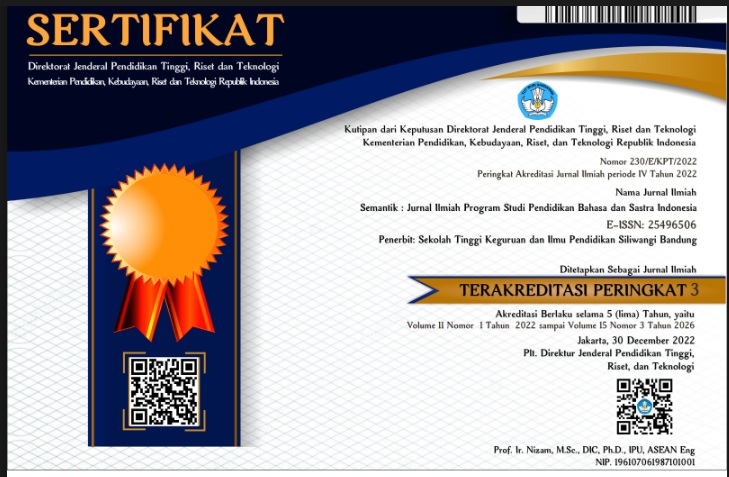 Accreditation Decree