Post-Publication Discussion
A. Policy Statement
Semantik: Jurnal Ilmiah Program Studi Pendidikan Bahasa dan Sastra Indonesia recognizes that scholarly communication does not end with the publication of an article. Post-publication discussion is an important part of the academic process, enabling researchers, authors, readers, and other members of the scholarly community to exchange ideas, provide constructive feedback, clarify research findings, and contribute to the development of knowledge.
Semantik encourages responsible academic discussion and welcomes scholarly comments, questions, critical responses, and alternative interpretations concerning articles published in the journal.
The journal is committed to facilitating post-publication discussion in a manner that is constructive, evidence-based, respectful, transparent, and consistent with publication ethics. Such discussions may address research methodology, theoretical perspectives, data interpretation, academic arguments, findings, and the implications of published studies, particularly in the fields of Indonesian language education, linguistics, literature, and language studies.
B. Scope of Post-Publication Discussion
Post-publication discussion may include, but is not limited to, the following forms:
-
Scholarly Comments: Constructive observations, questions, or suggestions regarding the content, arguments, or findings of a published article.
-
Critical Responses: Academic responses that identify methodological limitations, theoretical disagreements, alternative interpretations, or areas requiring further clarification.
-
Methodological Discussion: Discussions concerning research design, data collection procedures, analytical techniques, research instruments, and the interpretation of research results.
-
Theoretical and Conceptual Discussion: Contributions that offer alternative theoretical perspectives, conceptual explanations, or further academic insights related to the published work.
-
Corrections and Clarifications: Requests to clarify factual information, methodological descriptions, interpretations, or other aspects of a published article.
-
Research Implications: Discussions concerning the relevance, applicability, limitations, and potential development of research findings for language education, linguistic studies, and literary research.
-
Responses from Authors: Formal responses from the original authors addressing questions, criticisms, or scholarly comments raised by readers and other researchers.
C. Submission of Post-Publication Comments
Authors, researchers, lecturers, students, and other interested readers may submit scholarly comments or responses concerning articles published in Semantik.
Submissions should be sent to the Editorial Office through the official communication channels provided on the journal website.
A post-publication comment should:
-
Clearly identify the published article being discussed, including its title, author(s), volume, issue, and DOI or article URL, where available.
-
Present a clear academic argument or specific observation related to the published work.
-
Provide relevant evidence, references, data, or scholarly reasoning to support the discussion.
-
Maintain an objective, respectful, and professional academic tone.
-
Avoid personal attacks, defamatory statements, discriminatory language, or unsupported accusations.
-
Disclose any relevant conflicts of interest.
-
Comply with applicable research ethics and publication standards.
Submissions must be original scholarly contributions and must not infringe copyright or the rights of other individuals.
D. Editorial Assessment and Review
All post-publication comments and responses submitted to Semantik will undergo an initial editorial assessment before being considered for publication.
The Editor-in-Chief or a designated editor will evaluate whether the submission:
-
Is relevant to an article previously published in Semantik.
-
Provides a meaningful academic contribution to the discussion.
-
Is supported by appropriate evidence and scholarly references.
-
Meets the journal's ethical and academic standards.
-
Uses appropriate academic language and a respectful tone.
-
Does not contain defamatory, discriminatory, or otherwise inappropriate content.
When necessary, the journal may request revisions, additional clarification, or supporting evidence from the submitting party.
The editor may also consult independent subject experts when the discussion involves complex methodological, theoretical, or ethical issues.
Acceptance of a post-publication comment does not automatically imply agreement with its arguments by the journal or the original article's authors.
E. Right of Response for Original Authors
Semantik respects the right of authors to respond to scholarly comments, criticisms, or questions concerning their published work.
When a post-publication comment is accepted for publication, the Editorial Office may invite the original author(s) to submit a formal response.
An author's response should:
-
Address the main points raised in the comment.
-
Provide relevant explanations, evidence, or additional references.
-
Maintain a professional and constructive academic tone.
-
Acknowledge valid criticisms or limitations where appropriate.
-
Clarify any potential misunderstanding concerning the research, methodology, findings, or conclusions.
The journal may publish the original comment and the author's response together or in separate publication periods, depending on editorial considerations and publication arrangements.
If the original author(s) choose not to respond or cannot be reached, the journal may still consider publishing the comment if it meets the journal's editorial and ethical requirements.
F. Publication of Comments and Responses
Accepted post-publication discussions may be published as a scholarly comment, academic response, correspondence, or another appropriate editorial format determined by the journal.
Published discussions should include sufficient information to identify the original article and establish the relationship between the discussion and the published research.
Where appropriate, the journal may provide links between the original article, the post-publication comment, and the author's response to facilitate access and scholarly reference.
All published comments and responses will be subject to the journal's editorial standards, publication ethics requirements, and applicable licensing and copyright policies.
G. Ethical Standards for Post-Publication Discussion
All participants in post-publication discussion are expected to uphold academic integrity, intellectual honesty, and professional respect.
The following practices are not permitted:
-
Personal attacks, harassment, intimidation, or discriminatory statements.
-
Unsupported allegations of research misconduct or unethical behavior.
-
Deliberate misrepresentation of an author's arguments, findings, or research procedures.
-
Fabrication or falsification of evidence presented in a scholarly discussion.
-
Plagiarism or unauthorized use of another person's work.
-
Manipulation of citations or references for inappropriate academic or personal advantage.
-
Disclosure of confidential information obtained through unauthorized access.
Concerns involving potential research misconduct will be handled separately in accordance with the Semantik Allegations of Research Misconduct Policy.
H. Corrections, Expressions of Concern, and Retractions
Post-publication discussion may identify errors, inaccuracies, ethical concerns, or other issues that affect the reliability of a published article.
When such concerns arise, Semantik will assess the available evidence and determine the appropriate editorial action.
Depending on the nature and seriousness of the issue, the journal may:
-
Publish a correction to address minor errors or inaccuracies.
-
Publish a clarification or editorial notice when additional explanation is required.
-
Issue an expression of concern when significant questions remain unresolved.
-
Retract an article when the evidence demonstrates that retraction is necessary to protect the integrity of the scholarly record.
All such actions will be conducted in accordance with the journal's Correction and Retraction Policy and applicable publication ethics guidelines.
Post-publication criticism alone does not constitute sufficient grounds for correction or retraction. Editorial decisions must be based on an objective assessment of the available evidence.
I. Confidentiality and Editorial Independence
The journal will handle submitted comments, responses, and related communications responsibly and confidentially during the editorial assessment process.
Editorial decisions concerning post-publication discussion will be made independently and will not be influenced by personal relationships, institutional interests, commercial considerations, or external pressure.
Semantik reserves the right to decline submissions that do not meet its academic, ethical, or editorial requirements.
J. Record Keeping and Transparency
The Editorial Office will maintain appropriate records of submitted comments, editorial assessments, author responses, publication decisions, and related communications.
Published post-publication discussions will be made accessible through the journal website to support transparency, accountability, and the continued exchange of scholarly knowledge.
Where appropriate, the journal will maintain clear links between the original article and related post-publication contributions.
K. Relationship with Other Editorial Policies
This policy should be read in conjunction with the Semantik Publication Ethics Policy, Peer-Review Process Policy, Allegations of Research Misconduct Policy, Conflict of Interest Policy, Copyright and Licensing Policy, and Correction and Retraction Policy.
These policies will be applied together whenever a post-publication discussion raises concerns involving research integrity, authorship, copyright, or the reliability of published findings.
L. Commitment to Continuous Scholarly Dialogue
Semantik considers post-publication discussion an essential component of responsible academic publishing and the continuous development of scholarly knowledge.
By providing opportunities for constructive criticism, academic clarification, and author responses, the journal seeks to strengthen the quality of published research, encourage intellectual openness, promote critical academic engagement, and maintain the credibility and integrity of the scholarly record.
The journal welcomes responsible contributions from the academic community and remains committed to facilitating an inclusive, transparent, and respectful environment for scholarly dialogue.

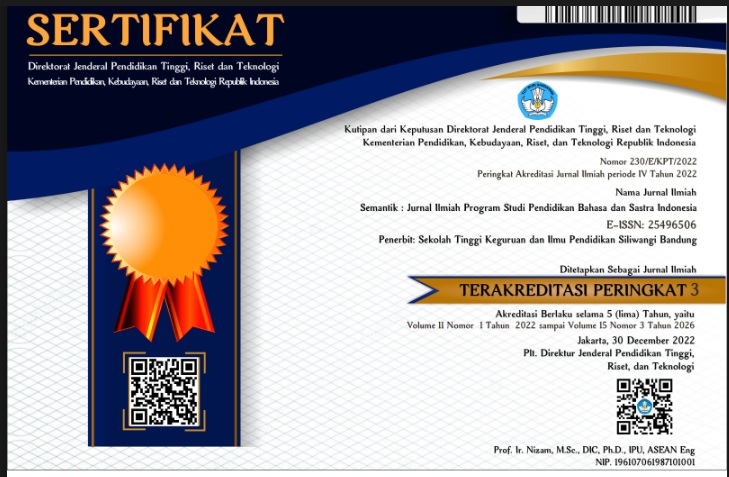 Accreditation Decree