Correction and Retraction
A. Policy Statement
Semantik: Jurnal Ilmiah Program Studi Pendidikan Bahasa dan Sastra Indonesia is committed to maintaining the accuracy, reliability, transparency, and integrity of the scholarly record. The journal recognizes that errors, inaccuracies, ethical concerns, or serious research-related issues may occasionally be identified after an article has been published.
To preserve the credibility of its publications, Semantik provides procedures for correcting, clarifying, expressing concern about, or retracting published articles when necessary. All post-publication actions will be conducted fairly, objectively, transparently, and in accordance with established publication ethics standards.
This policy applies to all articles published in Semantik, including research articles, literature reviews, conceptual papers, and other scholarly contributions.
B. General Principles
Semantik applies the following principles when considering corrections and retractions:
-
Accuracy: The journal seeks to ensure that published information accurately represents the research, its methods, findings, and conclusions.
-
Transparency: Any correction, expression of concern, or retraction will be clearly communicated to readers.
-
Accountability: Authors, editors, reviewers, and other relevant parties are expected to take responsibility for maintaining research and publication integrity.
-
Fairness: Decisions will be based on available evidence and will consider the explanations and responses of the parties concerned.
-
Timeliness: The journal will handle post-publication concerns as promptly as reasonably possible.
-
Preservation of the Scholarly Record: Published articles and their associated editorial notices will remain appropriately accessible to maintain the transparency and traceability of the academic record.
C. Corrections
A correction may be issued when an error or inaccuracy is identified in a published article but does not invalidate the overall reliability of the research or its principal conclusions.
Corrections may involve, but are not limited to:
-
Errors in the spelling of authors' names, affiliations, or institutional information.
-
Incorrect or incomplete information in the title, abstract, keywords, or article metadata.
-
Typographical, grammatical, or formatting errors that affect the clarity of the published article.
-
Errors in tables, figures, references, or supplementary materials.
-
Minor errors in data presentation or descriptions that do not substantially affect the research findings or conclusions.
-
Other inaccuracies that require clarification to maintain the accuracy of the scholarly record.
Correction Procedures
-
Authors, readers, editors, or other concerned parties may report an error to the Editorial Office through the official journal communication channels.
-
The Editor-in-Chief or a designated editor will assess the reported issue and determine whether a correction is necessary.
-
The journal may request clarification or supporting documentation from the author(s).
-
When necessary, the journal may consult independent experts to evaluate the significance of the error.
-
If a correction is approved, the journal will publish a formal correction notice linked to the original article.
-
The correction notice will clearly identify the error and provide the corrected information.
-
The original article will be updated where technically and editorially appropriate, with a clear reference to the published correction notice.
Corrections will be issued as separate, identifiable notices to ensure transparency and proper citation.
D. Retraction
Retraction is a formal editorial action taken when a published article is found to contain serious problems that undermine the reliability, integrity, or ethical legitimacy of the research or its publication.
A retraction may be considered in cases involving, but not limited to:
-
Fabrication or Falsification: Evidence that research data, results, or findings have been invented, manipulated, or misrepresented.
-
Plagiarism: Substantial use of another person's work, ideas, data, or text without appropriate acknowledgment.
-
Duplicate or Redundant Publication: Substantial overlap with previously published work without proper disclosure or justification.
-
Unethical Research Practices: Serious violations of applicable research ethics requirements, including misrepresentation of ethical approval or informed consent.
-
Unreliable Findings: Significant errors in research design, methodology, data analysis, or interpretation that invalidate the principal findings or conclusions.
-
Authorship Misconduct: Serious authorship irregularities, including fraudulent authorship or the unauthorized inclusion or exclusion of contributors, when these compromise the integrity of the publication.
-
Manipulation of the Publication Process: Evidence of peer-review manipulation, fraudulent reviewer identities, or other serious interference with editorial procedures.
-
Copyright or Legal Violations: Serious copyright infringement or other legal issues that make continued publication inappropriate.
-
Other Serious Ethical Violations: Any other circumstances in which retraction is necessary to protect the integrity of the scholarly record.
Retraction is not intended as a punishment for authors but as a mechanism to correct the scholarly record and protect readers from relying on seriously unreliable or ethically compromised research.
E. Retraction Procedures
When a potential reason for retraction is identified, Semantik will undertake an appropriate assessment and investigation.
The procedure may include:
-
Identification of Concerns: Concerns may be raised by authors, readers, reviewers, editors, institutions, or other relevant parties.
-
Initial Assessment: The Editor-in-Chief or a designated editor will evaluate the nature and seriousness of the reported issue.
-
Evidence Examination: The journal may examine the published article, original research data, supporting documents, similarity reports, ethical approval records, and editorial correspondence.
-
Author Notification: The corresponding author and, where appropriate, all co-authors will be informed of the concerns and given a reasonable opportunity to respond.
-
Expert Consultation: Independent experts or relevant institutions may be consulted when necessary.
-
Editorial Decision: The Editor-in-Chief will determine the appropriate editorial action based on the available evidence and applicable publication ethics standards.
-
Retraction Notice: If retraction is justified, the journal will publish a formal retraction notice explaining the reason for the decision.
-
Article Identification: The retracted article will remain identifiable in the journal's archive, with a clear and prominent retraction notice linked to the original publication.
The journal may proceed with an editorial decision when sufficient evidence is available, even if the authors do not respond to requests for clarification.
F. Expression of Concern
An expression of concern may be issued when serious questions arise about the reliability, integrity, or ethical compliance of a published article, but the available evidence is insufficient to make an immediate decision about correction or retraction.
An expression of concern may be considered when:
-
An investigation into suspected research misconduct is ongoing.
-
Relevant research data or documentation cannot yet be verified.
-
An institutional investigation has been delayed or has not reached a conclusion.
-
Significant concerns have been raised that require further examination.
-
The journal is unable to establish the reliability of an article within a reasonable period.
The expression of concern will explain the nature of the unresolved issue as clearly as possible without making unsupported conclusions.
Once additional evidence becomes available, the journal may decide to maintain the expression of concern, issue a correction, or retract the article, as appropriate.
G. Retraction Notice and Article Availability
When an article is retracted, Semantik will publish a formal retraction notice that includes:
-
The title of the retracted article.
-
The name(s) of the author(s).
-
The original publication details, including volume, issue, year, and DOI or article URL, where available.
-
The date of the retraction.
-
A clear explanation of the reason for retraction.
-
Identification of whether the retraction was initiated by the authors, the journal, or another relevant party, where appropriate.
The original article will generally remain accessible in the journal archive to preserve the scholarly record. However, it will be clearly marked as "RETRACTED" on the article page and within the PDF, where technically feasible.
The retraction notice will be published separately and linked to the original article to ensure that readers are aware of its status.
H. Retraction Initiated by Authors
Authors who identify significant errors, ethical concerns, or other serious problems in their published work are encouraged to notify the Semantik Editorial Office promptly.
Authors may request a correction or retraction by providing:
-
A written explanation of the identified problem.
-
Relevant supporting evidence or documentation.
-
An explanation of how the issue affects the reliability or integrity of the article.
-
Confirmation of the position of all co-authors, where reasonably possible.
The journal will independently assess the request and determine the appropriate editorial action.
An author-initiated request does not automatically result in retraction. The final decision remains the responsibility of the journal's editorial leadership.
I. Retraction Initiated by the Journal or Third Parties
Semantik may initiate a correction, expression of concern, or retraction based on credible information received from readers, reviewers, editors, research institutions, publishers, or other relevant parties.
The journal will assess the evidence objectively and provide the affected authors with an appropriate opportunity to respond, where circumstances permit.
A third-party allegation alone will not automatically result in retraction. Editorial action must be supported by sufficient evidence and a proportionate assessment of the potential impact on the scholarly record.
J. Appeals and Reconsideration
Authors or other directly affected parties may request reconsideration of a correction or retraction decision by submitting a written appeal supported by relevant new evidence or identifying a material procedural error.
Where practicable, the appeal will be reviewed by an editor or independent editorial representative who was not directly involved in the original decision.
The journal will consider appeals fairly and objectively. However, an appeal does not prevent the journal from taking necessary measures to protect readers and the integrity of the scholarly record.
K. Responsibilities of Authors and Editors
Authors
Authors are responsible for ensuring the accuracy and integrity of their submitted and published work. They are expected to:
-
Promptly notify the journal of significant errors identified after publication.
-
Cooperate with editorial inquiries and investigations.
-
Provide original data and supporting documentation when reasonably requested.
-
Respond honestly and transparently to concerns about their publications.
-
Participate in correction or retraction procedures when appropriate.
Editors
The Editor-in-Chief and editorial team are responsible for:
-
Assessing reported post-publication concerns objectively.
-
Ensuring that correction and retraction decisions are evidence-based.
-
Providing authors with a fair opportunity to respond.
-
Consulting independent experts or institutions when necessary.
-
Publishing appropriate notices in a timely and transparent manner.
-
Maintaining accurate records of editorial decisions and actions.
L. Record Keeping and Indexing
The Editorial Office will maintain appropriate records of reported concerns, supporting evidence, correspondence, investigation procedures, decisions, and editorial actions.
Correction notices, expressions of concern, and retraction notices will be clearly linked to the relevant articles on the journal website.
Where applicable, the journal will update article metadata and notify relevant indexing and abstracting services to ensure that the publication status is accurately reflected across scholarly databases.
M. Relationship with Other Editorial Policies
This policy should be read in conjunction with the Semantik Publication Ethics Policy, Allegations of Research Misconduct Policy, Plagiarism Policy, Authorship and Contributorship Policy, Conflict of Interest Policy, and Post-Publication Discussion Policy.
These policies will be applied together whenever post-publication concerns involve research integrity, publication ethics, authorship, peer review, or the reliability of published findings.
N. Commitment to the Integrity of the Scholarly Record
Semantik is committed to maintaining a trustworthy and transparent scholarly publishing environment. Through clear correction, expression of concern, and retraction procedures, the journal seeks to ensure that published research remains accurate, credible, and ethically responsible.
The journal recognizes that protecting the scholarly record is a shared responsibility among authors, editors, reviewers, institutions, and readers. All post-publication actions will therefore be guided by fairness, accountability, transparency, and respect for the principles of responsible academic publishing.
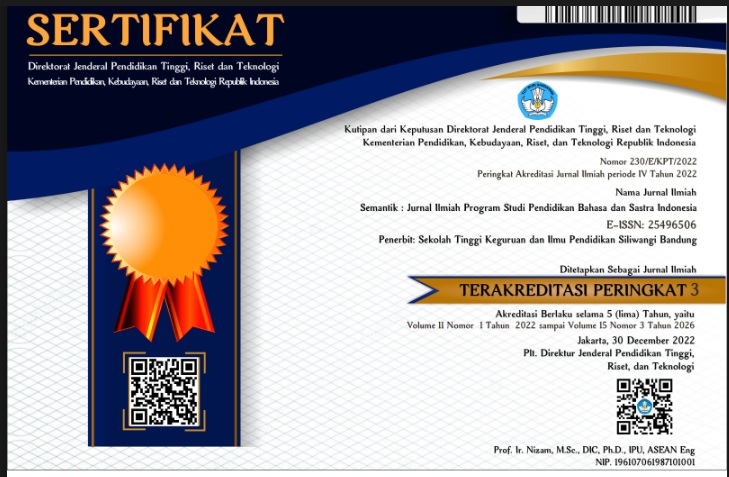 Accreditation Decree