Pengaruh pemanfaatan kahoot dalam model flipped classroom terhadap keterampilan menulis teks eksposisi siswa kelas X
DOI:
https://doi.org/10.22460/semantik.v15i2.p317-328Keywords:
Exposition Text, Flipped Classroom, Kahoot, Writing SkillsAbstract
Limited active practice time and the dominance of one-way conventional teaching methods often trigger low scientific drafting proficiency among vocational students. To overcome these conceptual and structural barriers, a blend of inverted classroom strategies and digital gamification was implemented to optimize time management and enhance student engagement. This quantitative study utilized a quasi-experimental approach with a Nonequivalent Control Group Design to examine the efficacy of this combined methodology. Through purposive sampling, 57 students were divided into an experimental group (27 students) and a control group (30 students). Writing performance data, collected via tests and observations, were evaluated using the non-parametric Mann-Whitney U test. The results indicated that the experimental group achieved a post-test mean score of 85.56 with a medium N-Gain index of 0.68, significantly outperforming the control class which scored a mean of 69.72 with a low N-Gain of 0.16. A significance value of 0.000 and a large effect size of 0.59 empirically confirmed the intervention's success. This study concludes that game-based instructional inversion serves as a strategic solution to substantially improve students' writing literacy in the digital era.
References
Al Fatih, M. A., Lubis, M. R., Nisah, S., Zulpan, & Arianto, N. (2026). Analisis uji normalitas dan homogenitas sebagai prasyarat analisis statistik dalam penelitian pendidikan. Educational Journal of Social Research, 5(2), 805–815.
Anggraeni, D., & Khaerunnisa, E. (2021). Penerapan model flipped classroom berbantuan Kahoot dalam meningkatkan keterampilan menulis teks eksposisi siswa. Metafora: Jurnal Pembelajaran Bahasa dan Sastra, 8(2), 142–151. https://jurnalnasional.ump.ac.id/index.php/METAFORA/article/view/11636
Hasanudin, C., Rosyida, F., Fitrianingsih, A., & Amin, K. (2020). Kolaborasi flipped classroom dengan media Plotagon dalam pembelajaran menulis teks persuasi. Jurnal Pendidikan Edutama, 7(1), 63–72.
Indayani, L., Arifani, Y., & Ma’rifah, U. (2022). The effectiveness of flipped classroom toward students’ writing achievement in EFL classroom. JETLAL (Journal of English Teaching, Linguistics, and Literature), 5(1), 52–61. https://journal.umg.ac.id/index.php/jetlal/article/view/3827
Licorish, S. A., Owen, H. E., Daniel, B., & George, J. L. (2018). Students’ perception of Kahoot!’s influence on teaching and learning. Research and Practice in Technology Enhanced Learning, 13(9), 1–23. https://doi.org/10.1186/s41039-018-0078-8
Mohammad, M., & Khan, A. (2023). Educational research procedures and instrument validation in classroom-based studies. International Journal of Educational Research Review, 8(2), 101–112.
Nguyen, K. A., Kim, Y., Rodriguez de Gil, P., Kellermann, A., & Chen, Y. (2016). Comparing groups using independent samples t-test in educational research. Journal of Modern Applied Statistical Methods, 15(2), 1–12. https://jmasm.com/index.php/jmasm/article/view/794
Pujayanti, S. A. N., Artawan, G., & Yasa, I. N. (2023). Penerapan model flipped classroom berbantuan blog untuk meningkatkan kemampuan menulis teks resensi siswa kelas XI. Jurnal Pendidikan Bahasa dan Sastra Indonesia Undiksha, 13(1), 45–58. https://ejournal.undiksha.ac.id/index.php/JJPBS/article/view/64874
Sari, N., Hasanah, R., & Nursalman, M. (2024). Analisis statistik deskriptif dalam penelitian pendidikan: Konsep dan implementasinya. Jurnal Pendidikan Tambusai, 8(2), 51328–51336. https://jptam.org/index.php/jptam/article/view/24059
Sonjaya, A., Aliyya, N., Naufal, M., & Nursalman, M. (2024). Penggunaan analisis statistik inferensial dalam penelitian eksperimen pendidikan. Jurnal Pendidikan Tambusai, 8(1), 154–162. https://jptam.org/index.php/jptam/article/view/24426
Turan, Z., & Akdag-Cimen, B. (2020). Flipped learning in higher education: A review of the evidence and application. Smart Learning Environments, 7(1), 1–16. https://doi.org/10.1186/s40561-020-00121-y
Yunita, R., & Santoso, M. E. (2022). Student perspective on the use of Kahoot! as a digital self-assessment tool in writing class. Journal of English Education and Teaching, 6(1), 93–107.
Downloads
Published
Issue
Section
License

This work is licensed under a Creative Commons Attribution-ShareAlike 4.0 International License.
The author is responsible for acquiring the permission(s) to reproduce any copyrighted figures, tables, data, or text that are being used in the submitted paper. Authors should note that text quotations of more than 250 words from a published or copyrighted work will require a grant of permission from the original publisher to reprint. The written permission letter(s) must be submitted together with the manuscript.
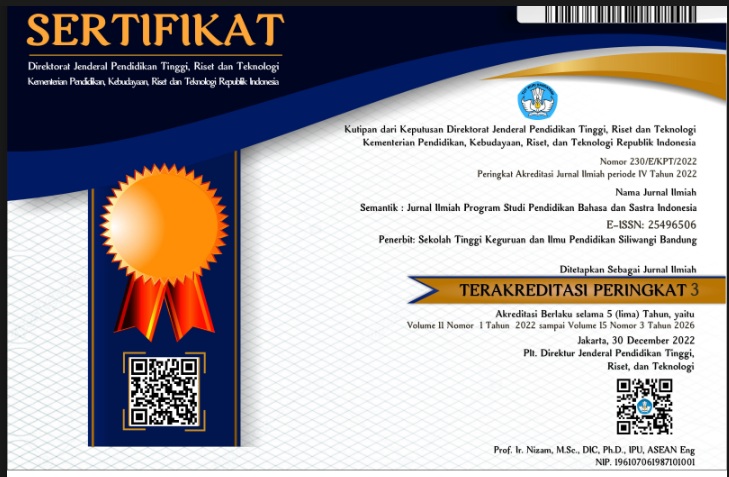 Accreditation Decree