Tindak tutur ilokusi dosen: Perbandingan konteks pengajaran sebudaya dan lintas budaya dalam perkuliahan
DOI:
https://doi.org/10.22460/semantik.v15i2.p245-256Keywords:
classroom discourse, illocutionary act, lecturer speech, sociopragmatics, speech actAbstract
This study examines how the congruence between a lecturer’s cultural background and the cultural context in which they teach shapes their use of illocutionary speech acts in university classrooms. Using a qualitative sociopragmatic approach combined with the ethnography of communication, data were drawn from naturalistic classroom recordings of five lecturers, categorized into two conditions: teaching within their own cultural background (intracultural) and teaching across a different cultural background (intercultural). Utterances were transcribed, coded using Searle’s five illocutionary categories, and analyzed through the padan method. Findings reveal a consistent contrast: lecturers teaching intraculturally produced markedly fewer directive acts (16.6–17.2%) and were dominated by assertive acts (73.0–76.8%), whereas lecturers teaching interculturally produced substantially higher proportions of directives (34.1–45.2%). These patterns are consistent with the social distance parameter in politeness theory, suggesting that cultural distance between lecturer and classroom context shapes communicative strategy. This study contributes an empirically grounded comparative account of how sociocultural congruence shapes lecturers’ pedagogical speech, offering a novel angle beyond conventional taxonomic studies of classroom illocution.
References
Austin, J. L. (1962). How to Do Things with Words. Oxford University Press.
Searle, J. R. (1969). Speech Acts: An Essay in the Philosophy of Language. Cambridge University Press.
Searle, J. R. (1979). Expression and Meaning: Studies in the Theory of Speech Acts. Cambridge University Press.
Leech, G. (1983). Principles of Pragmatics. Longman.
Thomas, J. (1983). Cross-cultural pragmatic failure. Applied Linguistics, 4(2), 91–112. https://doi.org/10.1093/applin/4.2.91
Iroth, S., Ali, M. I., & Tatipang, D. P. (2026). Language, culture, and power: An anthropolinguistic analysis of lecturer–student interaction in multicultural classrooms. Suranaree Journal of Social Science, 20(1). https://doi.org/10.55766/sjss283456
Brown, P., & Levinson, S. C. (1987). Politeness: Some Universals in Language Usage. Cambridge University Press.
Hymes, D. (1974). Foundations in Sociolinguistics: An Ethnographic Approach. University of Pennsylvania Press.
Sudaryanto. (2015). Metode dan Aneka Teknik Analisis Bahasa. Sanata Dharma University Press.
Lincoln, Y. S., & Guba, E. G. (1985). Naturalistic Inquiry. Sage Publications.
Abdullah, A., Noni, N., Basri, M., & Djirong, A. (2023). An auto ethnographic study on communicative approach in teaching English syntax in a university context. International Journal of Language Education, 7(1), 46–57. https://doi.org/10.26858/ijole.v1i1.36457
Al Smadi, O. A., Rashid, R. A., Yassin, B., & Saad, H. (2022). A linguistic ethnography of discursive identities of an English for Medical Purposes (EMP) teacher. International Journal of Instruction, 15(1), 73–88. https://doi.org/10.29333/iji.2022.1515a
Darong, H. C. (2024). Illocutionary acts in EFL teaching: Balancing authority and engagement. RUDN Journal of Language Studies, Semiotics and Semantics, 15(3), 684–700. https://doi.org/10.22363/2313-2299-2024-15-3-684-700
Tao, L., Ren, Y., & Chen, N. (2025). Teacher discourse from the perspective of rapport-management theory: A case study of an authoritative teacher in a Chinese EFL classroom. Language and Semiotic Studies, 11(1), 125–160. https://doi.org/10.1515/lass-2024-0064
Chen, Y., & Weiyun He, A. (2001). Dui bu dui as a pragmatic marker: Evidence from Chinese classroom discourse. Journal of Pragmatics, 33(9), 1441–1465. https://doi.org/10.1016/S0378-2166(00)00084-9
Vicher, A., & Sankoff, D. (1989). The emergent syntax of pre-sentential turn openings. Journal of Pragmatics, 13(1), 81–97. https://doi.org/10.1016/0378-2166(89)90110-0
Duff, P. A. (1995). An ethnography of communication in immersion classrooms in Hungary. TESOL Quarterly, 29(3), 505–537. https://doi.org/10.2307/3588073
Rampton, B., Roberts, C., Leung, C., & Harris, R. (2002). Methodology in the analysis of classroom discourse. Applied Linguistics, 23(3), 373–392.
Tsui, A. B. M. (2013). Ethnography and classroom discourse. In The Routledge Handbook of Discourse Analysis (pp. 383–395). Routledge.
Baran, M. (2020). Questions of identity in sociopragmatics. Lublin Studies in Modern Languages and Literature, 44(3), 5–17. https://doi.org/10.17951/lsmll.2020.44.3.5-17
Kayi-Aydar, H. (2018). Positioning theory in applied linguistics: Research design and applications. Springer.
Duff, P. A. (2002). The discursive co-construction of knowledge, identity, and difference: An ethnography of communication in the high school mainstream. Applied Linguistics, 23(3), 289–322.
Artamonova, O. (2018). Teacher’s ethnic teasing: Playing with ambiguity and exploiting in-group communication. Discourse & Society, 29(1), 3–22. https://doi.org/10.1177/0957926517726113
Comber, B., & Hayes, D. (2023). Classroom participation: Teachers’ work as listeners. Journal of Curriculum Studies, 55(1), 37–48. https://doi.org/10.1080/00220272.2022.2134738
Eren, A., & Çavuşoğlu, Ç. (2023). Stigmatisation and othering: The case of Syrian students in Turkish schools. International Journal of Inclusive Education, 27(13), 1434–1453. https://doi.org/10.1080/13603116.2021.1900422
Poveda, D. (2005). Metalinguistic activity, humor and social competence in classroom discourse. Pragmatics, 15(1), 89–107. https://doi.org/10.1075/prag.15.1.04pov
Downloads
Published
Issue
Section
License

This work is licensed under a Creative Commons Attribution-ShareAlike 4.0 International License.
The author is responsible for acquiring the permission(s) to reproduce any copyrighted figures, tables, data, or text that are being used in the submitted paper. Authors should note that text quotations of more than 250 words from a published or copyrighted work will require a grant of permission from the original publisher to reprint. The written permission letter(s) must be submitted together with the manuscript.
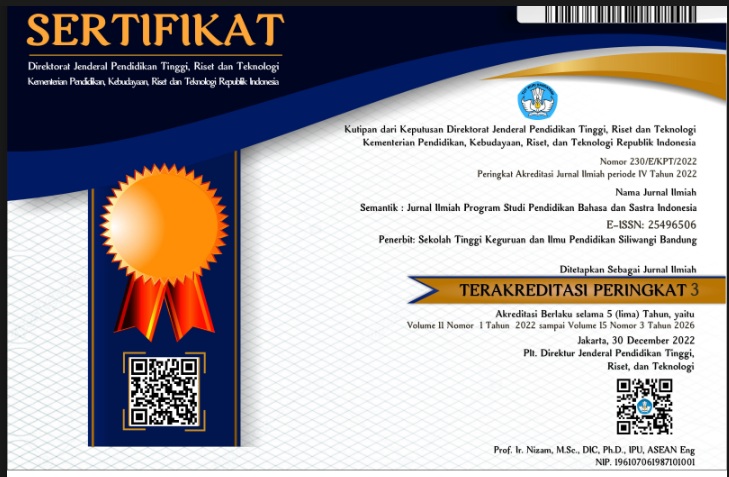 Accreditation Decree