Rekonseptualisasi sastra siber dalam pendidikan Indonesia: Ekologi literasi, produksi makna, dan transformasi apresiasi
DOI:
https://doi.org/10.22460/semantik.v15i2.p329-346Keywords:
Cyber Literature, Digital Literary Education, Literacy Ecology, Literary Appreciation, Meaning ProductionAbstract
This study reconceptualizes cyber literature within Indonesian literary education through three interrelated axes: literacy ecology, meaning production, and the transformation of literary appreciation practice. Research on Indonesian cyber literature, expanding rapidly through platforms such as Wattpad and Webtoon, has largely treated platform description, curriculum policy, and reader engagement as separate concerns, rarely situating them within broader literacy and reception theory. Using a qualitative descriptive-analytical literature review, this study synthesizes international theoretical work on literary ecology, multiliteracies, and digital reading with empirical studies on Indonesian cyber literature and literary education policy, analyzed through reduction, display, and conclusion-drawing supported by source triangulation. The synthesis shows that literacy ecology in Indonesian cyber literature operates through three interlocking layers, namely medium, actors, and platform mechanism; meaning production is generated collaboratively among readers, writers, and algorithmic systems; and the transformation of appreciation practice requires a three-stage pedagogical model spanning multimodal reading, participatory analysis, and algorithmic reflection. These three axes constitute a single recursive process rather than isolated phenomena, offering educators, curriculum developers, and literary researchers a conceptual map for the changing landscape of Indonesian cyber literature
References
Andriana, W. D., Suyatno, & Indrawati, D. (2025). Praktik menulis fanfiction sebagai sarana literasi digital untuk pengembangan keterampilan menulis kreatif mahasiswa Pendidikan Bahasa dan Sastra Indonesia. Kajian Linguistik Dan Sastra, 10(2), 142–160. https://doi.org/10.23917/kls.v10i2.8753
Anita, F., Roza, D., & Suriadiman, N. (2024). Pengaruh literasi digital terhadap kemampuan minat baca mahasiswa Program Studi Ilmu Komunikasi. Journal on Teacher Education, 5(4), 78–87.
Beecroft, A. (2015). An ecology of world literature: From antiquity to the present day. Verso.
Bell, A., & Ensslin, A. (2024). Reading digital fiction: Narrative, cognition, mediality. Routledge. https://doi.org/10.4324/9781003110194
Bowen, G. A. (2009). Document Analysis as a Qualitative Research Method. Qualitative Research Journal, 9(2), 27–40. https://doi.org/10.3316/QRJ0902027
Budiarto, A., Chairunissa, R., & Fitriani, A. (2021). The motivation behind writing fanfictions for digital authors on Wattpad and Twitter. Alphabet, 4(1), 48–53. https://doi.org/10.21776/ub.alphabet.2021.04.01.06
Creswell, J. W., & Poth, C. N. (2023). Qualitative Inquiry and Research Design: Choosing Among Five Approaches (Fifth Edit). SAGE Publications Inc. https://uk.sagepub.com/en-gb/asi/qualitative-inquiry-and-research-design/book266033#reviews
Dewi, D. T., Lasut, K. B., Manungkalit, S. T., & Khatulistiwa, M. B. (2022). Participatory fandom Harries Indonesia pada penulisan fanfiction di Wattpad. Jurnal Komunikasi Global, 11(1), 21–42. https://doi.org/10.24815/jkg.v11i1.24038
Fazilah, N., Azhari, T., & Pratiwi, R. A. (2024). Dampak penggunaan Wattpad terhadap kemampuan literasi membaca siswa SMA Negeri 1 Dewantara. Kande: Jurnal Ilmiah Pendidikan Bahasa Dan Sastra Indonesia, 4(2), 255–262.
Glaser, B. G., & Strauss, A. L. (1967). The discovery of grounded theory: Strategies for qualitative research. Aldine Publishing.
Jenkins, H., Ito, M., & boyd, d. (2015). Participatory culture in a networked era: A conversation on youth, learning, commerce, and politics. Polity Press.
Jin, D. Y. (2022). Understanding Korean webtoon culture: Transmedia storytelling, digital platforms, and genres. Harvard University Asia Center.
Kemendikbudristek. (2024). Kemendikbudristek dorong pemanfaatan bacaan sastra dalam Kurikulum Merdeka. In Kementerian Pendidikan, Kebudayaan, Riset, dan Teknologi. https://www.kemdikbud.go.id/main/blog/2024/05/kemendikbudristek-dorong-pemanfaatan-bacaan-sastra-dalam-kurikulum-merdeka
Miles, M. B., Huberman, A. M., & Saldaña, J. (2014). Qualitative Data Analysis: A Methods Sourcebook (Edition 3). SAGE Publications. https://www.metodos.work/wp-content/uploads/2024/01/Qualitative-Data-Analysis.pdf
Mills, K. A., Unsworth, L., & Scholes, L. (2023). Literacy for digital futures: Mind, body, text. Routledge.
Moleong, L. J. (2021). Metodologi penelitian kualitatif (Rev. ed.). PT Remaja Rosdakarya.
New London Group. (1996). A pedagogy of multiliteracies: Designing social futures. Harvard Educational Review, 66(1), 60–92.
Noviarini, N. P., Prabawati, P. L. S., & Suryanata, I. P. A. (2024). Media pembelajaran digital dalam pembelajaran sastra. Jurnal Edukasi Dan Pembelajaran, 8(2), 327–331. https://doi.org/10.23887/jear.v8i2.77878
Parnell, C. (2023). Reading through Wattpad’s classification and discoverability algorithms. In Post45. https://post45.org/2023/12/reading-through-wattpads-classification-and-discoverability-algorithms/
Poell, T., Nieborg, D. B., & Duffy, B. E. (2022). Platforms and cultural production. Polity Press.
Prasetyo, C. W., & Wati, R. (2022). Cyber sastra: Polemik dan resistensi kapitalisme pada sastra. Pena Literasi: Jurnal Pendidikan Bahasa Dan Sastra Indonesia, 5(1), 18–25. https://doi.org/10.24853/pl.5.1.18-25
Pratiwi, S., & Dewi, T. U. (2023). Pemanfaatan Wattpad sebagai media literasi digital. Khazanah Pendidikan, 17(2), 229–236. https://doi.org/10.30595/jkp.v17i2.18625
Putrayasa, I. M., Suwindia, I. G., & Winangun, I. M. A. (2024). Transformasi literasi di era digital: Tantangan dan peluang untuk generasi muda. Education and Social Sciences Review, 5(2), 156–165.
Rizal, M. A. S., Kholik, K., Faizi, A., Kholiq, A., & Azizan, Y. R. (2024). Masa depan sastra di era digital: Kajian sastra sibernetik. Innovative: Journal of Social Science Research, 4(5), 7574–7590.
Rokib, M. (2024). Sejarah sastra Indonesia: Pengantar ringkas dari Balai Pustaka hingga sastra internet. Minhaj Pustaka.
Sugiyono. (2019). Metode penelitian kuantitatif, kualitatif, dan R&D. Alfabeta.
UNESCO. (2023). Global media and information literacy assessment framework: Country readiness and competencies. UNESCO Publishing.
Wilkins, K., Driscoll, B., & Fletcher, L. (2022). Genre worlds: Popular fiction and twenty-first-century book culture. University of Massachusetts Press.
Wong, G. K. W., Reichert, F., & Law, N. (2023). Reorienting the assessment of digital literacy in the twenty-first century: A product-lifecycle and experience dependence perspective. Educational Technology Research and Development, 71(6), 2389–2412.
Xu, H., Gonzalez Patiño, J., & Linaza, J. L. (2023). Reader influence on the creation of transmedia science fiction: A participatory culture perspective. Humanities and Social Sciences Communications, 10, 279. https://doi.org/10.1057/s41599-023-01772-1
Yusanta, F. B., & Wati, R. (2020). Eksistensi sastra cyber: Webtoon dan Wattpad menjadi sastra populer dan lahan publikasi bagi pengarang. Literasi: Jurnal Bahasa Dan Sastra Indonesia Serta Pembelajarannya, 4(1), 8–14.
Downloads
Published
Issue
Section
License

This work is licensed under a Creative Commons Attribution-ShareAlike 4.0 International License.
The author is responsible for acquiring the permission(s) to reproduce any copyrighted figures, tables, data, or text that are being used in the submitted paper. Authors should note that text quotations of more than 250 words from a published or copyrighted work will require a grant of permission from the original publisher to reprint. The written permission letter(s) must be submitted together with the manuscript.
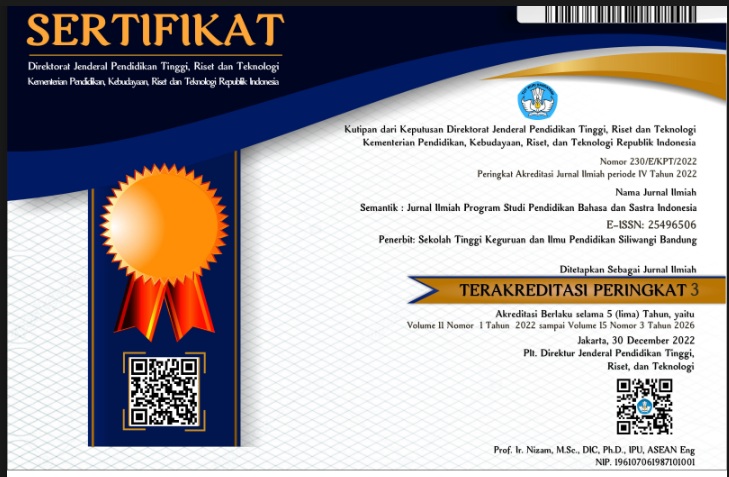 Accreditation Decree