Traumaku warisan keluargaku: Kajian trauma kolektif dalam novel Namaku Alam karya Leila S. Chudori
DOI:
https://doi.org/10.22460/semantik.v15i2.p149-164Keywords:
collective trauma, Cathy Caruth, Namaku Alam, second generation, 1965 political violenceAbstract
This study examines the representation of collective trauma in Leila S. Chudori’s novel Namaku Alam. The topic is significant because the trauma of the 1965 political violence in Indonesia did not only affect direct victims but was also transmitted to the second generation through family memory, social stigma, the body, and identity crisis. This research employs a descriptive qualitative method by using library research, note-taking, and highlighting techniques to identify narrative units, dialogues, and events that represent traumatic experiences in the novel. The data are analyzed through Cathy Caruth’s trauma theory, particularly the concepts of unclaimed experience, belatedness, voice of the other, and narrative as a form of recovery. The findings show that trauma in Namaku Alam is represented through children’s inability to fully understand violence, the delayed return of trauma in recurring dreams, bodily responses, reactive emotions, and identity crisis, as well as the emergence of other voices that transform personal wounds into collective testimony. Alam’s act of writing also demonstrates that narrative functions as a medium for recognizing, organizing, and articulating trauma. Thus, Namaku Alam represents the trauma of 1965 as a collective wound that continues to shape the lives of the second generation.
References
Abubakar, S. (2017). Art as Narrative: Recounting Trauma through Literature. IRA-International Journal of Management & Social Sciences (ISSN 2455-2267), 8(1), 118. https://doi.org/10.21013/jmss.v8.n1.p13
Ahmad, T. (2018). PRODUKSI DAN REPRODUKSI MEMORI: PENGALAMAN KELUARGA EKS TAHANAN POLITIK PKI DI SULAWESI SELATAN. Walasuji : Jurnal Sejarah Dan Budaya, 9(2), 289–302. https://doi.org/10.36869/wjsb.v9i2.48
Avcı, M. (2025). The repetition principle of traumatic dreams. Scientific Reports, 15(1), 19945. https://doi.org/10.1038/s41598-025-05246-z
Brewin, C. R., Atwoli, L., Bisson, J. I., Galea, S., Koenen, K., & Lewis‐Fernández, R. (2025). Post‐traumatic stress disorder: evolving conceptualization and evidence, and future research directions. World Psychiatry, 24(1), 52–80. https://doi.org/10.1002/wps.21269
Caruth, Cathy. (1996). Unclaimed experience : trauma, narrative, and history. Johns Hopkins University Press.
Chudori, L. S. (2023). Namaku Alam. Kepustakaan Populer Gramedia.
Creswell, J. W. . (2013). Educational Research : Planning, Conducting, and Evaluating Quantitative and Qualitative Research. PHI Learning Private Limited.
Eickhoff, M., van Klinken, G., & Robinson, G. (2017). 1965 Today: Living with the Indonesian Massacres. Journal of Genocide Research, 19(4), 449–464. https://doi.org/10.1080/14623528.2017.1393931
Elissa, M. (2006). Trauma and Literary Studies: Some “Enabling Questions.” Reading On: A Journal of Theory and Criticism, 1, 1–6.
Fajar, Y. (2024). Memori Kultural dalam Puisi-Puisi Taufiq Ismail: Keluarga, Kampung Halaman, dan Kampus. HUMANIKA, 31(1), 16–31. https://doi.org/10.14710/humanika.v31i1.62764
Invitto, S., & Moselli, P. (2024). Exploring Embodied and Bioenergetic Approaches in Trauma Therapy: Observing Somatic Experience and Olfactory Memory. Brain Sciences, 14(4), 385. https://doi.org/10.3390/brainsci14040385
Killikelly, C., Smith, K. V, Zhou, N., Prigerson, H. G., O’Connor, M.-F., Kokou-Kpolou, C. K., Boelen, P. A., & Maercker, A. (2025). Prolonged grief disorder. The Lancet, 405(10489), 1621–1632. https://doi.org/10.1016/S0140-6736(25)00354-X
Leys, Ruth. (2010). Trauma : a Genealogy. The University of Chicago Press.
Marzuki, S., & Ali, M. (2023). The settlement of past human rights violations in Indonesia. Cogent Social Sciences, 9(1). https://doi.org/10.1080/23311886.2023.2240643
Maulana, A., & Faruk, F. (2022). Haunted Memory, Trauma, and Recovery in Louise Erdrich’s The Stone. Poetika, 10(2), 123. https://doi.org/10.22146/poetika.v10i2.75899
Mayasari-Hoffert, S. (2025). “I made no sound at all”: Exploring Indonesia’s collective trauma in Saman and Enrico’s Love Story by Ayu Utami. Journal of Postcolonial Writing, 61(6), 884–899. https://doi.org/10.1080/17449855.2026.2623174
Merriam, S. B. ., & Tisdell, E. J. . (2016). Qualitative research : A Guide to Design and Implementation. John Wiley & Sons.
Parma, C., Doria, F., Zulueta, A., Boscarino, M., Giani, L., Lunetta, C., Parati, E. A., Picozzi, M., & Sattin, D. (2024). Does Body Memory Exist? A Review of Models, Approaches and Recent Findings Useful for Neurorehabilitation. Brain Sciences, 14(6), 542. https://doi.org/10.3390/brainsci14060542
Rojas-Saffie, J. P., Álamos-Vial, N., & Pinzón-Merchán, M. (2025). Is PTSD symptomatology a mechanism of emotional regulation? Insights from an interdisciplinary point of view. Frontiers in Psychology, 15. https://doi.org/10.3389/fpsyg.2024.1454900
Sartika, E. (2020). TRAUMATIC EXPERIENCES IN EKA KURNIAWAN’S NOVEL SEPERTI DENDAM, RINDU HARUS DIBAYAR TUNTAS . Poetika. Jurnal Ilmu Sastra, 8(2), 121–134. https://doi.org/10.22146/poetika.v8i2.55895
Van der Kolk, B. A. . (2015). The body keeps the score : brain, mind, and body in the healing of trauma. Penguin Books.
Wiesepape, C. N., Smith, E. A., Muth, A. J., & Faith, L. A. (2025). Personal Narratives in Trauma-Related Disorders: Contributions from a Metacognitive Approach and Treatment Considerations. Behavioral Sciences, 15(2), 150. https://doi.org/10.3390/bs15020150
Downloads
Published
Issue
Section
License

This work is licensed under a Creative Commons Attribution-ShareAlike 4.0 International License.
The author is responsible for acquiring the permission(s) to reproduce any copyrighted figures, tables, data, or text that are being used in the submitted paper. Authors should note that text quotations of more than 250 words from a published or copyrighted work will require a grant of permission from the original publisher to reprint. The written permission letter(s) must be submitted together with the manuscript.
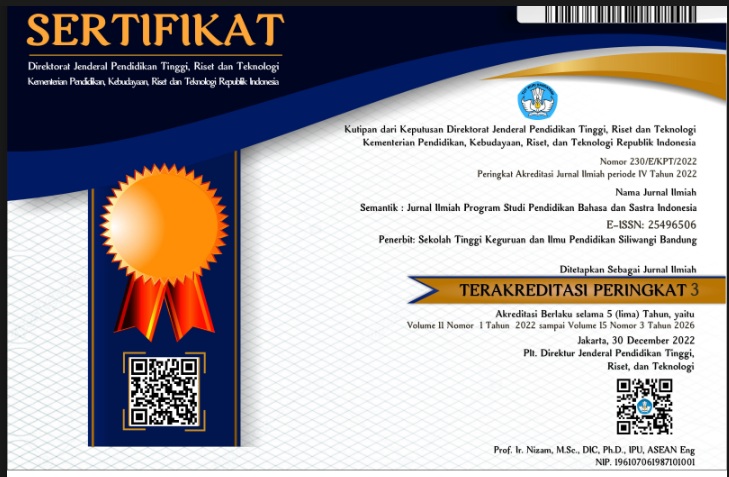 Accreditation Decree