
Aru ethnomathematics: Exploration of mathematical concepts in Daret Damar Jan game and its integration in mathematics learning in elementary school
##plugins.themes.bootstrap3.article.sidebar##
##plugins.themes.bootstrap3.article.main##
Abstract
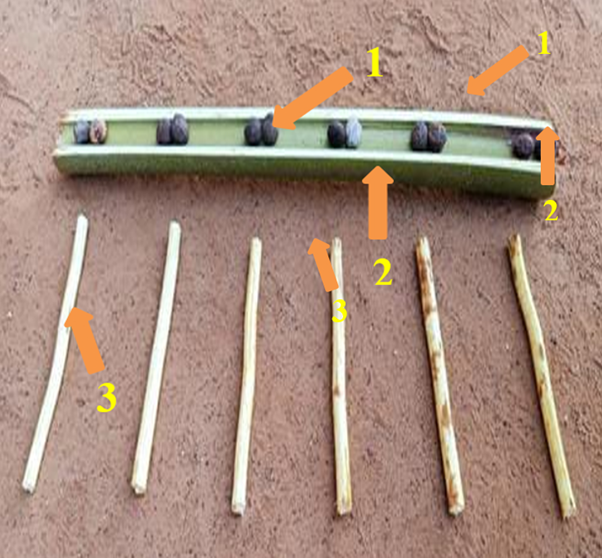
Various research on traditional games has been reviewed in previous studies, including layang-layang, congklak, galah panjang, and guli. However, there has been no research on the Daret Damar Jan game. Previous research has only focused on exploring mathematical concepts in traditional games without integrating these concepts into mathematics learning at school. Therefore, this research aims to explore the mathematical concepts in the traditional game Daret Damar Jan and integrate them into mathematics learning in elementary schools. A descriptive exploratory method was used in this study. The participants in this study were 2 local cultural figures, 6 children of Dokabarat village, 1 teacher, and 22 second-grade students at a public elementary school. Data was collected through participatory observation, in-depth interviews, documentation studies, and concept understanding tests. The data were then analyzed using thematic and descriptive analysis. The results of the research indicate that the concepts of symbols, units, and arithmetic operations of natural numbers were found in the Daret Damar Jan game. The utilization of the Daret Damar Jan game as a learning resource can improve students' concept understanding of natural number counting operations material from 40.91% to 77.27% and is in the high category.
##plugins.themes.bootstrap3.article.details##

This work is licensed under a Creative Commons Attribution-ShareAlike 4.0 International License.
The author is responsible for acquiring the permission(s) to reproduce any copyrighted figures, tables, data, or text that are being used in the submitted paper. Authors should note that text quotations of more than 250 words from a published or copyrighted work will require grant of permission from the original publisher to reprint. The written permission letter(s) must be submitted together with the manuscript.References
Abuhassna, H., Adnan, M. A. B. M., & Awae, F. (2024). Exploring the synergy between instructional design models and learning theories: A systematic literature review. Contemporary Educational Technology, 16(2), ep499. https://doi.org/10.30935/cedtech/14289
Alharbi, M. O. (2022). Teachers and children’s play: Exploring practices through an analysis of Vygotsky and Piaget theories. The Educational Review, USA, 6(11), 668–674.
Almo, A., Rocha, M., Brennan, A., & Dondio, P. (2022). Seven spells and peer tutoring: A collaborative mathematics game experience. European Conference on Games Based Learning, 16(1), 38–47. https://doi.org/10.34190/ecgbl.16.1.533
Anwar, L., Sa'dijah, C., Fauzan, A., Johar, R., Sugiman, S., & Cahyani, S. D. (2024). Exploring ethnomathematics in the traditional house of suku Tengger: bridging structures and classrooms. Journal of Ecohumanism, 3(6), 1872–1882. https://doi.org/10.62754/joe.v3i6.4143
Anwar, L., Sa'dijah, C., Murtafiah, W., & Huljannah, M. (2024). Adversity quotient of Indonesian prospective mathematics teachers in solving geometry higher-order thinking skills problems. Journal on Mathematics Education, 15(1), 79–98. https://doi.org/10.22342/jme.v15i1.pp79-98
Awaji, B. M., Abdel-Hamid, R. H., Khalil, I. A., & Prahmana, R. C. I. (2025). Mathematics teachers’ practices in light of the effective teaching practices. Infinity Journal, 14(1), 1–20. https://doi.org/10.22460/infinity.v14i1.p1-20
Bistari, B., Hamdani, H., Rustam, R., Dashela, T., Mumtazah, N. W., & Veven, V. (2024). How do elementary school teachers shape their students' self-regulated and creativity in learning mathematics? International Journal of Evaluation and Research in Education (IJERE), 13(5), 3360–3368. https://doi.org/10.11591/ijere.v13i5.29296
Bortot, M., Regolin, L., & Vallortigara, G. (2021). A sense of number in invertebrates. Biochemical and Biophysical Research Communications, 564, 37–42. https://doi.org/10.1016/j.bbrc.2020.11.039
Brezovszky, B., McMullen, J., Veermans, K., Hannula-Sormunen, M. M., Rodríguez-Aflecht, G., Pongsakdi, N., Laakkonen, E., & Lehtinen, E. (2019). Effects of a mathematics game-based learning environment on primary school students' adaptive number knowledge. Computers & Education, 128, 63–74. https://doi.org/10.1016/j.compedu.2018.09.011
Cervantes-Barraza, J. A., & Araujo, A. A. (2023). Design of interactive mathematical tasks that make up the reasoning and the ethnomathematics program. Journal on Mathematics Education, 14(3), 469–482. https://doi.org/10.22342/jme.v14i3.pp469-482
Deda, Y. N., Disnawati, H., Tamur, M., & Rosa, M. (2024). Global trend of ethnomathematics studies of the last decade: A bibliometric analysis. Infinity Journal, 13(1), 233–250. https://doi.org/10.22460/infinity.v13i1.p233-250
Fiantika, F. R., Sa’dijah, C., Qohar, A., & Darsono, D. (2020). Link between modern building and Kediri’s tradition: An idea to develop teaching-learning equipment. Journal of Physics: Conference Series, 1470(1), 012001. https://doi.org/10.1088/1742-6596/1470/1/012001
Hendriyanto, A., Priatna, N., Juandi, D., Dahlan, J. A., Hidayat, R., Sahara, S., & Muhaimin, L. H. (2023). Learning mathematics using an ethnomathematics approach: A systematic literature review. Journal of Higher Education Theory and Practice, 23(7), 59–74. https://doi.org/10.33423/jhetp.v23i7.6012
Kaliky, S. H., & Labuem, S. (2025). Metode Jarimatika sebagai alternatif berhitung cepat pada operasi penjumlahan dan pengurangan untuk siswa sekolah dasar negeri 7 Dobo [The Jarimatika method as an alternative for quick calculations in addition and subtraction operations for students of state elementary school 7 Dobo.]. ABDI UNISAP: Jurnal Pengabdian Kepada Masyarakat, 3(1), 123–127. https://doi.org/10.59632/abdiunisap.v3i1.413
Kurniawan, H., Purwoko, R. Y., & Setiana, D. S. (2024). Integrating cultural artifacts and tradition from remote regions in developing mathematics lesson plans to enhance mathematical literacy. Journal of Pedagogical Research, 8(1), 61–74. https://doi.org/10.33902/jpr.202423016
Kusuma, A. B., Hanum, F., Abadi, A. M., & Ahmad, A. (2024). Exploration of ethnomathematics research in Indonesia 2010-2023. Infinity Journal, 13(2), 393–412. https://doi.org/10.22460/infinity.v13i2.p393-412
Kyeremeh, P., Kwadwo Awuah, F., & Dorwu, E. (2023). Integration of ethnomathematics in teaching geometry: A systematic review and bibliometric report. Journal of Urban Mathematics Education, 16(2), 68–89. https://doi.org/10.21423/jume-v16i2a519
Labuem, S., Sa'dijah, C., Parta, I. N., & Sulandra, I. M. (2025). Mathematics in the Tordauk jerpara tel tradition: Contribution of local wisdom to mathematics education innovation in elementary schools. Journal on Mathematics Education, 16(3), 955–980. https://doi.org/10.22342/jme.v16i3.pp955-980
Leton, S. I., Lakapu, M., Dosinaeng, W. B. N., & Fitriani, N. (2025). Integrating local wisdoms for improving students’ mathematical literacy: The promising context in learning whole numbers. Infinity Journal, 14(2), 369–392. https://doi.org/10.22460/infinity.v14i2.p369-392
Mairing, J. P., & Nini, N. (2023). Ethnomathematics learning model based on motifs of" Dayak Ngaju" Central Kalimantan. Mathematics Teaching Research Journal, 15(5), 30–48.
Matiti, J. (2024). Students transitioning from primary to secondary mathematics learning: a study combining critical pedagogy, living theory and participatory action research. Educational Action Research, 32(1), 144–160. https://doi.org/10.1080/09650792.2022.2035787
Mosimege, M., & Egara, F. O. (2023). Students’ perceptions of mathematics teachers’ usage of ethnomathematics materials in the teaching and learning of mathematics. International Journal of Multicultural Education, 25(2), 443–459.
Nurcahyo, A., Ishartono, N., Pratiwi, A. Y. C., & Waluyo, M. (2024). Exploration of mathematical concepts in Batik Truntum Surakarta. Infinity Journal, 13(2), 457–476. https://doi.org/10.22460/infinity.v13i2.p457-476
Nursyahidah, F., Wardono, W., Mariani, S., & Wijayanti, K. (2025). Integrating technology, ethnomathematics, and realistic mathematics education in learning statistics: A learning trajectory. Infinity Journal, 14(3), 633–654. https://doi.org/10.22460/infinity.v14i3.p633-654
O’Hara, G., Kennedy, H., Naoufal, M., & Montreuil, T. (2022). The role of the classroom learning environment in students’ mathematics anxiety: A scoping review. British Journal of Educational Psychology, 92(4), 1458–1486. https://doi.org/10.1111/bjep.12510
Pellas, N., & Mystakidis, S. (2020). A systematic review of research about game-based learning in virtual worlds. JUCS - Journal of Universal Computer Science, 26(8), 1017–1042. https://doi.org/10.3897/jucs.2020.054
Purnomo, H., Sa'dijah, C., Hidayanto, E., Adinda, A., & Abdullah, A. H. (2023). Characteristics of differentiated mathematical creative models in problem-solving activities: Case of middle school students. Mathematics Teaching Research Journal, 15(5), 157–176.
Ramos, L., Simões, V., & Franco, S. (2024). “Active Mathematics”—A classroom-based physical active learning intervention in an elementary school: An experimental pilot study. Education Sciences, 14(6), 637. https://doi.org/10.3390/educsci14060637
Sa’diyah, M., Sa’dijah, C., & Susiswo, S. (2024). Students' ability to formulate situation mathematically from context-based mathematics problems. TEM Journal, 13(2), 1443–1451. https://doi.org/10.18421/tem132-58
Sa'dijah, C., Kholid, M. N., Hidayanto, E., & Permadi, H. (2020). Reflective thinking characteristics: A study in the proficient mathematics prospective teachers. Infinity Journal, 9(2), 159–172. https://doi.org/10.22460/infinity.v9i2.p159-172
Sa'dijah, C., Murtafiah, W., Anwar, L., Nurhakiki, R., & Cahyowati, E. T. D. (2021). Teaching higher order thinking skills in mathematics classrooms: Gender differences. Journal on Mathematics Education, 12(1), 159–180. https://doi.org/10.22342/jme.12.1.13087.159-180
Suherman, S., & Vidákovich, T. (2022). Tapis patterns in the context of ethnomathematics to assess students’ creative thinking in mathematics: A rasch measurement. Mathematics Teaching-Research Journal, 14(4), 56–79.
Sunzuma, G., & Umbara, U. (2025). Ethnomathematics-based technology in Indonesia: A systematic review. Asian Journal for Mathematics Education, 4(1), 129–153. https://doi.org/10.1177/27527263241305812
Supahmi, N. P., Hariastuti, R. M., & Nurmahmudy, W. (2022). Mathematics in seltok: A Banyuwangi traditional game. Journal of Science and Education (JSE), 2(2), 53–64. https://doi.org/10.56003/jse.v2i2.68
Suryaningrum, S. (2023). Penguatan kapasitas guru pada implementasi kurikulum merdeka daerah 3T (tertinggal, terdepan, dan terluar) [Strengthening teacher capacity in the implementation of the independent curriculum in 3T (disadvantaged, frontier, and outermost) regions.]. Wahana Dedikasi: Jurnal PkM, 6(1), 165–172.
Syawahid, M., Purwanto, P., Sukoriyanto, S., & Sulandra, I. M. (2020). Elementary students’ functional thinking: From recursive to correspondence. Journal for the Education of Gifted Young Scientists, 8(3), 1031–1043. https://doi.org/10.17478/jegys.765395
Titikusumawati, E., Sa’dijah, C., As’ari, A. R., & Susanto, H. (2020). The effectiveness of the integration of open-ended and collaborative (OE-C) learning strategies in reducing gaps of elementary school students’ creative thinking skills. Ilkogretim Online, 198–207. https://doi.org/10.17051/ilkonline.2020.653653
Turmudi, T., Susanti, E., Rosikhoh, D., & Marhayati, M. (2021). Ethnomathematics: Mathematical concept in the local game of tong tong galitong ji for high school. Participatory Educational Research, 8(1), 219–231. https://doi.org/10.17275/per.21.12.8.1
Turmuzi, M., Suharta, I. G. P., Astawa, I. W. P., & Suparta, I. N. (2024). Meta-analysis of the effectiveness of ethnomathematics-based learning on student mathematical communication in Indonesia. International Journal of Evaluation and Research in Education (IJERE), 13(2), 903–913. https://doi.org/10.11591/ijere.v13i2.25475
Umbara, U., Prabawanto, S., & Jatisunda, M. G. (2023). Combination of mathematical literacy with ethnomathematics: How to perspective sundanese culture. Infinity Journal, 12(2), 393–414. https://doi.org/10.22460/infinity.v12i2.p393-414
Untu, Z., Purwanto, P., Parta, I. N., Sisworo, S., & Rofiki, I. (2020). Teacher’s mistakes related to declarative knowledge in mathematical learning. Journal of Critical Reviews, 7(7), 229–233.
Utami, N. W., Sayuti, S. A., & Jailani, J. (2019). Math and mate in Javanese primbon: Ethnomathematics study. Journal on Mathematics Education, 10(3), 341–356. https://doi.org/10.22342/jme.10.3.7611.341-356
Vogel, S. E., & De Smedt, B. (2021). Developmental brain dynamics of numerical and arithmetic abilities. npj Science of Learning, 6(1), 22. https://doi.org/10.1038/s41539-021-00099-3
Wiryanto, W., Primaniarta, M. G., & de Mattos, R. L. (2022). Javanese ethnomathematics: Exploration of the Tedhak Siten tradition for class learning practices. Journal on Mathematics Education, 13(4), 661–680. https://doi.org/10.22342/jme.v13i4.pp661-680
Zana, F. M., Sa'dijah, C., & Susiswo, S. (2024). The cognitive alignment of mathematics teachers’ assessments and its curriculum. International Journal of Evaluation and Research in Education (IJERE), 13(3), 1561–1575. https://doi.org/10.11591/ijere.v13i3.26814
Zayyadi, M., Nusantara, T., Hidayanto, E., Sulandra, I. M., & Sa'dijah, C. (2020). Content and pedagogical knowledge of prospective teachers in mathematics learning: Commognitive framework. Journal for the Education of Gifted Young Scientists, 8(1), 515–532. https://doi.org/10.17478/jegys.642131