
Exploring the role of cognitive style and APOS-based scaffolding in developing students’ advanced mathematical thinking on function limits
##plugins.themes.bootstrap3.article.sidebar##
##plugins.themes.bootstrap3.article.main##
Abstract
This qualitative case study explored how field dependence-independence shaped students’ access to Action-Process-Object-Schema (APOS)-based scaffolding and how stage-specific support contributed to the qualitative development of advanced mathematical thinking (AMT) on function limits. In this study, developing denotes the observable emergence or reorganization of mathematical constructions during scaffolded activity, not a statistically measured learning gain. The bounded classroom case involved 24 mathematics education students at an Islamic university in Sumatra, Indonesia. The Group Embedded Figures Test classified 6 students as field-independent (FI) and 18 as field-dependent (FD); four information-rich cases, comprising 2 FI and 2 FD students, were selected for cross-case analysis. APOS-based scaffolding was implemented in four 135-minute Calculus I sessions and examined further through stimulated-recall interviews. Initial written solutions provided the primary evidence, post-prompt explanations and revisions documented students’ responses to Action-, Process-, Object-, and Schema-oriented support, and classroom observation records verified the enactment and gradual fading of the planned scaffolds. FI-1 constructed a complete Schema and required only fading prompts. FI-2 moved from correct but disconnected Objects toward an integrated Schema after a Schema-oriented prompt. FD-1 corrected an invalid limit value after Process-oriented prompts stabilized the transformation sequence. FD-2 moved from direct substitution and 0/0 toward guided algebraic Actions and an emerging Process after explicit Action-oriented cues. The findings indicate that cognitive style influenced task entry and the amount of external structure used, whereas APOS identified the construction that support needed to target. The observed shifts support a diagnostic account of AMT development while avoiding causal or long-term claims.
INTRODUCTION
Function limits constitute a conceptual gateway to continuity, differentiation, integration, and mathematical analysis. However, students often approach limit tasks as routines for substitution and algebraic manipulation rather than as problems that require reasoning about covariation, approximation, and values that are approached but not necessarily attained. Research involving university students and prospective mathematics teachers continues to identify fragmented concept images, confusion between a function value and a limiting value, weak coordination across representations, and difficulty interpreting the indeterminate form 0/0 as a signal for further analysis rather than as a numerical result(Bansilal & Mkhwanazi, 2022; Borg & Fahlgren, 2026; Mirin, 2024; Tall & Vinner, 1981; Thompson & Harel, 2021). These difficulties have particular importance in mathematics teacher education. Prospective teachers must not only obtain a correct answer, but also identify the structure of an expression, justify each transformation, connect intermediate results, and communicate a mathematically defensible conclusion.
The central difficulty in learning limits is therefore not reducible to procedural accuracy. Understanding a limit requires students to coordinate processes, reorganize familiar algebraic relations, and treat the resulting limit as an object that can be examined and used in a broader argument(Cottrill et al., 1996). Advanced mathematical thinking (AMT) provides an appropriate framework for examining this transition from isolated operations to connected mathematical reasoning.Tall (1991)characterizes AMT through abstraction, conceptual reorganization, and formal reasoning. In the present study, abstraction refers to recognizing and reusing an underlying relation, such as a difference of squares or a conjugate structure. Conceptual reorganization refers to coordinating separate transformations and intermediate values into a coherent solution structure. Formal reasoning refers to constructing a logically connected justification for the transformations, limit evaluations, and final identity. These dimensions are treated as qualitative indicators of mathematical activity, not as independent psychometric scores.
Students may display these forms of reasoning through different patterns of information processing. The field dependence-independence framework concerns the extent to which learners can disembed relevant information from a surrounding context and reorganize it through an internally generated reference structure(Witkin et al., 1977). Field-independent (FI) students tend to identify and restructure relevant information more autonomously, whereas field-dependent (FD) students may rely more strongly on explicit organization, instructional cues, or interpersonal guidance. This distinction does not represent a hierarchy of mathematical ability and should not be interpreted as a basis for assigning a fixed teaching method to a cognitive-style category. Recent criticism of mechanical instructional matching further supports the use of cognitive style as an analytical lens for examining task entry and access to support, rather than as a deterministic learner label(Hattie & O’Leary, 2025).
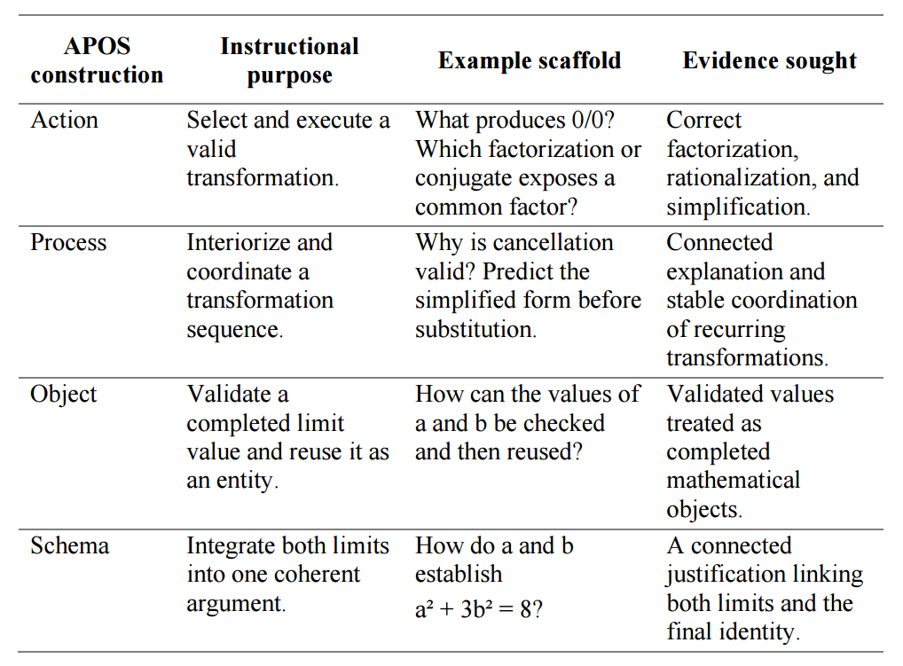
APOS theory provides a complementary explanation of the mathematical constructions that students form while working with limits. In APOS theory, an Action is an externally prompted transformation; a Process emerges when the learner can mentally coordinate and reverse related actions; an Object is formed when a process can be examined, validated, and reused; and a Schema integrates relevant Actions, Processes, Objects, and their relations into a coherent conceptual structure(Arnon et al., 2014; Dubinsky, 2014). For function limits, these constructions may include direct substitution, factorization, conjugate rationalization, cancellation, evaluation of the resulting expression, and integration of separate limit values into a final proof. APOS-based scaffolding can support these constructions through targeted cues, comparison questions, sequencing prompts, requests for explanation, and questions that require students to validate and reuse completed results. Research indicates that APOS-informed activities can strengthen conceptual understanding in university mathematics, while the effectiveness of scaffolding depends on the learner’s available resources and on the specific mechanism targeted by the support(Borji et al., 2022; Chien et al., 2026; DiNapoli & Miller, 2022; Hofer & Reinhold, 2025; Martínez-Planell et al., 2024).
Despite these contributions, the relevant literature remains theoretically and empirically fragmented. Studies of function limits primarily document conceptual and representational difficulties. APOS studies identify the mental constructions required for advanced mathematical concepts. Scaffolding studies explain how contingent support can sustain strategy selection and reasoning. Cognitive-style research describes differences in how learners organize information and use external structure. Limited evidence connects these perspectives within the same instructional episode. In particular, little is known about whether FI and FD students differ mainly in selecting an initial Action, coordinating a Process, validating an Object, or integrating a Schema; how stage-specific APOS prompts change their subsequent reasoning; and how such prompt-response changes appear in abstraction, conceptual reorganization, and formal justification. Analyses based only on final correctness cannot reveal these mechanisms.
This study addresses that gap through an integrated diagnostic model. Cognitive style is used to examine how students initially identify, organize, and act on information in the same function-limit task. APOS theory is used to locate the construction that is already available, remains unstable, or emerges after support. AMT is used to describe the quality of the resulting mathematical reasoning. Within this model, APOS-based scaffolding does not replace students’ reasoning or prescribe identical support for all members of a cognitive-style group. Instead, it targets the next mathematical construction indicated by the student’s written work and interview response. The term developing in the title therefore refers to observable, short-term qualitative change in a student’s mathematical construction during scaffolded activity, such as recognizing a previously unnoticed relation, coordinating a valid sequence of transformations, validating a limit value, or integrating separate results into a coherent argument. It does not claim a statistically measured gain, a causal treatment effect,
##plugins.themes.bootstrap3.article.details##

This work is licensed under a Creative Commons Attribution-ShareAlike 4.0 International License.
The author is responsible for acquiring the permission(s) to reproduce any copyrighted figures, tables, data, or text that are being used in the submitted paper. Authors should note that text quotations of more than 250 words from a published or copyrighted work will require grant of permission from the original publisher to reprint. The written permission letter(s) must be submitted together with the manuscript.References
Arnon, I., Cottrill, J., Dubinsky, E., Oktaç, A., Roa Fuentes, S., Trigueros, M., & Weller, K. (2014). APOS theory: A framework for research and curriculum development in mathematics education. Springer. https://doi.org/10.1007/978-1-4614-7966-6
Bansilal, S., & Mkhwanazi, T. W. (2022). Pre-service student teachers’ conceptions of the notion of limit. International Journal of Mathematical Education in Science and Technology, 53(8), 2083–2101. https://doi.org/10.1080/0020739x.2020.1864488
Baxter, P., & Jack, S. (2008). Qualitative case study methodology: Study design and implementation for novice researchers. The Qualitative Report, 13(4), 544–559. https://doi.org/10.46743/2160-3715/2008.1573
Borg, A., & Fahlgren, M. (2026). Students’ development of instrumented action schemes for numerically determining limits using programming. Digital Experiences in Mathematics Education, 12(1), 95–127. https://doi.org/10.1007/s40751-025-00177-w
Borji, V., Martínez-Planell, R., & Trigueros, M. (2022). Student understanding of functions of two variables: A reproducibility study. The Journal of Mathematical Behavior, 66, 100950. https://doi.org/10.1016/j.jmathb.2022.100950
Braun, V., & Clarke, V. (2006). Using thematic analysis in psychology. Qualitative Research in Psychology, 3(2), 77–101. https://doi.org/10.1191/1478088706qp063oa
Chien, T. M., Leong, K. E., & Chua, K. H. (2026). Design-based research on instructional lessons for differential calculus incorporating Desmos. Infinity Journal, 15(2), 345–370. https://doi.org/10.22460/infinity.v15i2.p345-370
Cottrill, J., Dubinsky, E., Nichols, D., Schwingendorf, K., Thomas, K., & Vidakovic, D. (1996). Understanding the limit concept: Beginning with a coordinated process scheme. The Journal of Mathematical Behavior, 15(2), 167–192. https://doi.org/10.1016/s0732-3123(96)90015-2
DiNapoli, J., & Miller, E. K. (2022). Recognizing, supporting, and improving student perseverance in mathematical problem-solving: The role of conceptual thinking scaffolds. The Journal of Mathematical Behavior, 66, 100965. https://doi.org/10.1016/j.jmathb.2022.100965
Dubinsky, E. (2014). Actions, Processes, Objects, Schemas (APOS) in Mathematics Education. In S. Lerman (Ed.), Encyclopedia of mathematics education (pp. 8–11). Springer. https://doi.org/10.1007/978-94-007-4978-8_3
Hattie, J., & O’Leary, T. (2025). Learning styles, preferences, or strategies? An explanation for the resurgence of styles across many meta-analyses. Educational Psychology Review, 37(2), 31. https://doi.org/10.1007/s10648-025-10002-w
Hofer, S. I., & Reinhold, F. (2025). Scaffolding of learning activities: Aptitude-treatment-interaction effects in math? Learning and Instruction, 99, 102177. https://doi.org/10.1016/j.learninstruc.2025.102177
Kusmaryono, I., Ubaidah, N., & Basir, M. A. (2020). The role of scaffolding in the deconstructing of thinking structure: A case study of pseudo-thinking process. Infinity Journal, 9(2), 247–262. https://doi.org/10.22460/infinity.v9i2.p247-262
Listiawati, E., Juniati, D., & Ekawati, R. (2025). Understanding mathematics prospective teachers' comprehension of function derivatives based on APOS theory: Insights from low mathematics anxiety levels. Infinity Journal, 14(2), 483–512. https://doi.org/10.22460/infinity.v14i2.p483-512
Lithner, J. (2008). A research framework for creative and imitative reasoning. Educational Studies in Mathematics, 67(3), 255–276. https://doi.org/10.1007/s10649-007-9104-2
Lithner, J. (2017). Principles for designing mathematical tasks that enhance imitative and creative reasoning. Zdm, 49(6), 937–949. https://doi.org/10.1007/s11858-017-0867-3
Martínez-Planell, R., Trigueros, M., & Borji, V. (2024). The role of topology in the construction of students’ optimization schema for two-variable functions. The Journal of Mathematical Behavior, 73, 101106. https://doi.org/10.1016/j.jmathb.2023.101106
Mirin, A. (2024). Where we see one function, they see two. International Journal of Mathematical Education in Science and Technology, 55(9), 2107–2135. https://doi.org/10.1080/0020739x.2022.2123285
Mirlanda, E. P., & Pujiastuti, H. (2018). Kemampuan penalaran matematis: Analisis berdasarkan gaya kognitif siswa [Mathematical reasoning ability: An analysis based on students' cognitive styles]. Symmetry: Pasundan Journal of Research in Mathematics Learning and Education, 3(2), 56–67. https://doi.org/10.23969/symmetry.v3i2.1252
Nowell, L. S., Norris, J. M., White, D. E., & Moules, N. J. (2017). Thematic analysis: Striving to meet the trustworthiness criteria. International journal of qualitative methods, 16(1), 1–13. https://doi.org/10.1177/1609406917733847
Santosa, C. A. H. F., & Filiz, M. (2025). Investigating the limit of peer collaboration: Insight from worked-example in multivariable calculus. Infinity Journal, 14(2), 461–482. https://doi.org/10.22460/infinity.v14i2.p461-482
Setiyani, S., Gunawan, G., Waluya, S. B., Sukestiyarno, Y. L., Cahyono, A. N., Mutia, M., & Yunianto, W. (2025). The role of scaffolding in shaping reflective mathematical thinking of dependent field students in numeracy problems. Infinity Journal, 14(2), 531–550. https://doi.org/10.22460/infinity.v14i2.p531-550
Tall, D. (1991). Advanced mathematical thinking. Kluwer Academic Publishers.
Tall, D., & Vinner, S. (1981). Concept image and concept definition in mathematics with particular reference to limits and continuity. Educational Studies in Mathematics, 12(2), 151–169. https://doi.org/10.1007/bf00305619
Thompson, P. W., & Harel, G. (2021). Ideas foundational to calculus learning and their links to students’ difficulties. ZDM – Mathematics Education, 53(3), 507–519. https://doi.org/10.1007/s11858-021-01270-1
Witkin, H. A., Moore, C. A., Goodenough, D. R., & Cox, P. W. (1977). Field-dependent and field-independent cognitive styles and their educational implications. Review of Educational Research, 47(1), 1–64. https://doi.org/10.3102/00346543047001001
Witkin, H. A., Oltman, P. K., Raskin, E., & Karp, S. A. (1971). A manual for the embedded figures tests. Consulting Psychologists Press.
Yin, R. K. (2018). Case study research and applications: Design and methods (6th ed.). Sage Publication.