
Semiotics-based augmented reality learning media for visualizing three-dimensional geometry to support mathematical literacy among deaf learners
##plugins.themes.bootstrap3.article.sidebar##
##plugins.themes.bootstrap3.article.main##
Abstract
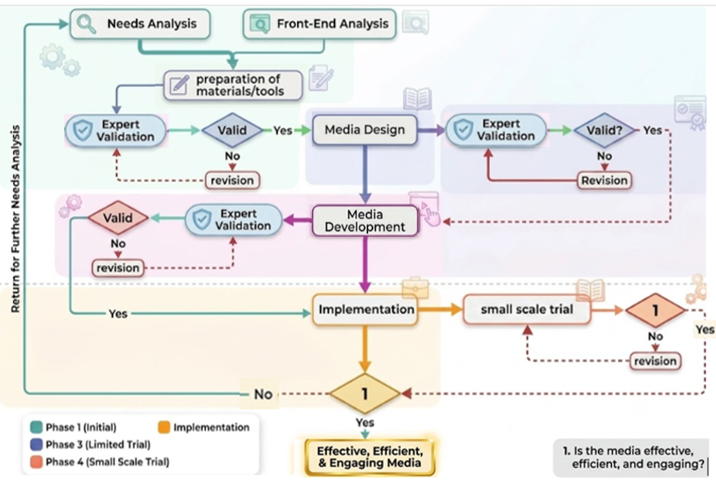
Mathematics learning for deaf learners, particularly in three-dimensional geometry, remains challenging because abstract concepts are commonly presented through two-dimensional instructional materials that do not adequately support visual learning. This study aimed to design, develop, and validate a semiotics-based Augmented Reality (AR) learning medium to support deaf learners' understanding of three-dimensional geometry. The study adopted the Lee and Owens instructional design model, comprising the phases of analysis, design, development, implementation, and evaluation. Front-end analysis involved curriculum review, classroom observations, teacher interviews, and needs analysis with 29 deaf learners to establish the design specifications of the learning media. Data were collected using expert validation questionnaires, classroom observation sheets, teacher and student response questionnaires, and comprehension assessment sheets during a pilot implementation involving seven deaf junior high school students. The developed media achieved an overall expert validity score of 91.2% (Very Valid). Teacher and student responses indicated that the media was practical for classroom use. In contrast, students obtained an average comprehension score of 83.33% on the geometry comprehension assessment, indicating that the developed media effectively supported their understanding of three-dimensional geometry. These findings suggest that integrating semiotic principles with Augmented Reality provides meaningful visual representations that facilitate the learning of abstract geometry concepts for deaf learners. This study contributes to the development of inclusive mathematics learning media and provides a foundation for future large-scale implementation and evaluation.
##plugins.themes.bootstrap3.article.details##

This work is licensed under a Creative Commons Attribution-ShareAlike 4.0 International License.
The author is responsible for acquiring the permission(s) to reproduce any copyrighted figures, tables, data, or text that are being used in the submitted paper. Authors should note that text quotations of more than 250 words from a published or copyrighted work will require grant of permission from the original publisher to reprint. The written permission letter(s) must be submitted together with the manuscript.References
Ahyan, S., Supiyati, S., Fahrurrozi, F., & Hassan, M. N. (2025). An application of many-facet Rasch measurement to validate the numeracy test for elementary students. Infinity Journal, 14(4), 861–876. https://doi.org/10.22460/infinity.v14i4.p861-876
Alawiyah, T. (2024). Development of android-based augmented reality learning media through project based learning on flat side building materials to improve students' mathematical spatial abilities at SMPN 3 Medan. JMEA : Journal of Mathematics Education and Application, 3(3), 85–92. https://doi.org/10.30596/jmea.v3i3.20553
Alhazmi, K. (2024). The effect of multimedia on vocabulary learning and retention. World Journal of English Language, 14(6), 390–399. https://doi.org/10.5430/wjel.v14n6p390
Alomari, M. A., Alqudah, R. A., Al Rub, M. A., Alqsaireen, E. M., & Khasawneh, M. A. S. (2023). The role of media in educational social construction of children with special needs. Information Sciences Letters, 12(7), 2933–2940. https://doi.org/10.18576/isl/120720
Andriyani, A., Buliali, J. L., & Pramudya, Y. (2022). The effectiveness application of learning model with augmented reality on deaf student’s geometry learning outcomes. In The International Conference on Mathematics and Learning Research (ICOMER) 2021, (Vol. 2479, pp. 020003). https://doi.org/10.1063/5.0099940
Asmara, A. S., Yusuf, Y., Prawiyogi, A. G., Zonyfar, C., Alhamssyah, M. A., & Alfarid, M. N. (2026). Profiling numeracy literacy among ninth-grade students: Empirical evidence from junior secondary education. Infinity Journal, 15(1), 291–318. https://doi.org/10.22460/infinity.v15i1.p291-318
Baragash, R. S., Al-Samarraie, H., Alzahrani, A. I., & Alfarraj, O. (2020). Augmented reality in special education: a meta-analysis of single-subject design studies. European Journal of Special Needs Education, 35(3), 382–397. https://doi.org/10.1080/08856257.2019.1703548
Bulut, M., & Borromeo Ferri, R. (2023). A systematic literature review on augmented reality in mathematics education. European Journal of Science and Mathematics Education, 11(3), 556–572. https://doi.org/10.30935/scimath/13124
Fadhila, Y. A., Izzatika, A. F., & Putranto, S. (2024). Hambatan belajar matematika di kelas inklusi: Perspektif siswa tunarungu dan guru [Barriers to learning mathematics in inclusive classrooms: Perspectives of deaf students and teachers]. JPI (Jurnal Pendidikan Inklusi), 7(1), 49–58. https://doi.org/10.26740/inklusi.v7n1.p49-58
Fauzan, A., Harisman, Y., Yerizon, Y., Suherman, S., Tasman, F., Nisa, S., Sumarwati, S., Hafizatunnisa, H., & Syaputra, H. (2024). Realistic mathematics education (RME) to improve literacy and numeracy skills of elementary school students based on teachers’ experience. Infinity Journal, 13(2), 301–316. https://doi.org/10.22460/infinity.v13i2.p301-316
Godino, J. D., Burgos, M., & Gea, M. M. (2022). Analysing theories of meaning in mathematics education from the onto-semiotic approach. International Journal of Mathematical Education in Science and Technology, 53(10), 2609–2636. https://doi.org/10.1080/0020739x.2021.1896042
Healy, L., Ramos, E. B., Fernandes, S. H. A. A., & Peixoto, J. L. B. (2016). Mathematics in the hands of deaf learners and blind learners: Visual–gestural–somatic means of doing and expressing mathematics. In R. Barwell, P. Clarkson, A. Halai, M. Kazima, J. Moschkovich, N. Planas, M. S. Phakeng, P. Valero, & M. Villavicencio Ubillús (Eds.), Mathematics Education and Language Diversity: The 21st ICMI Study (pp. 141–162). Springer International Publishing. https://doi.org/10.1007/978-3-319-14511-2_8
Henner, J., Pagliaro, C., Sullivan, S., & Hoffmeister, R. (2021). Counting differently: Assessing mathematics achievement of signing deaf and hard of hearing children through a unique lens. American Annals of the Deaf, 166(3), 318–341. https://doi.org/10.1353/aad.2021.0023
Hidayah, I. R., Sa'dijah, C., Anwar, L., Yerizon, Y., & Arnawa, I. M. (2025). Empowering students’ numeracy skills: Mathematics teachers’ perceptions regarding the effectiveness and challenges of Indonesian national curriculum and the programs – A mixed method study. Infinity Journal, 14(1), 163–188. https://doi.org/10.22460/infinity.v14i1.p163-188
Hoffmeister, R. J., Karipi, S., & Kourbetis, V. (2022). Bilingual curriculum materials supporting signed language as a first language for deaf students. Momento - Diálogos em Educação, 31(2), 500–527. https://doi.org/10.14295/momento.v31i02.14506
İslim, Ö. F., Namlı, Ş., Sevim, N., Özçakır, B., & Lavicza, Z. (2024). Augmented reality in mathematics education: A systematic review. Participatory Educational Research, 11(4), 115–139. https://doi.org/10.17275/per.24.52.11.4
Krause, C. M. (2023). Facing and challenging language ideologies towards a more inclusive understanding of language in mathematics education research—the case of sign languages. ZDM – Mathematics Education, 55(6), 1173–1185. https://doi.org/10.1007/s11858-023-01526-y
Krause, C. M., & Wille, A. M. (2021). Sign language in light of mathematics education: An exploration within semiotic and embodiment theories of learning mathematics. American Annals of the Deaf, 166(3), 352–377. https://doi.org/10.1353/aad.2021.0025
Kuncoro, K. S., Kusumah, Y. S., Suryadi, D., Juandi, D., & Jupri, A. (2024). Augmented reality for supporting student’s engagement in mathematics education: A systematic literature review. The Eurasia Proceedings of Educational and Social Sciences, 35, 19–29. https://doi.org/10.55549/epess.797
Kusasi, M., Fahmi, F., Sanjaya, R. E., Riduan, M., & Anjani, N. (2021). Feasibility of STEM-based basic chemistry teaching materials to improve students’ science literature in wetland context. Journal of Physics: Conference Series, 2104(1), 012022. https://doi.org/10.1088/1742-6596/2104/1/012022
Langdon, C., Kurz, C., & Coppola, M. (2023). The importance of early number concepts for learning mathematics in deaf and hard of hearing children. Perspectives on Early Childhood Psychology and Education, 5(2), 6. https://doi.org/10.58948/2834-8257.1061
Latif, W. B., Yasin, I. M. Y., Rahaman, M. A., Forid, M. S., Islam, M. N., & Hossain, M. Z. (2024). Impact of augmented reality (AR) and virtual reality (VR) on Interactive learning systems. Pacific Journal of Advanced Engineering Innovations, 1(1), 23–32. https://doi.org/10.70818/pjaei.2024.v01i01.016
Lee, W. W., & Owens, D. L. (2004). Multimedia-based instructional design: computer-based training, web-based training, distance broadcast training, performance-based solutions (2nd ed.). John Wiley & Sons.
Lestari, M., Syamsudin, A., & Ilmiyah, N. F. (2025). Enhancing students’ spatial ability through augmented reality: Development of 3D geometry learning media. Indonesian Journal of Mathematics Education, 8(2), 105–111. https://doi.org/10.31002/ijome.v8i2.2039
Li, J., & Yu, G. (2023). Constructing the festival tourist attraction from the perspective of Peircean semiotics: The case of Guangzhou, China. PLoS One, 18(2), e0282102. https://doi.org/10.1371/journal.pone.0282102
Li, R.-Y., & Sun, J. C.-Y. (2024). Identifying key factors of dynamic ADDIE model for instructional virtual reality design: an exploratory study. Interactive Learning Environments, 32(10), 6984–6996. https://doi.org/10.1080/10494820.2023.2296519
Lim, K. Y. T., & Lim, R. (2020). Semiotics, memory and augmented reality: History education with learner‐generated augmentation. British Journal of Educational Technology, 51(3), 673–691. https://doi.org/10.1111/bjet.12904
Mahayukti, G. A., & Dewi, P. K. (2022). Evaluation of the implementation of the discovery learning model in learning mathematics in deaf special junior high schools. Indonesian Journal of Educational Research and Review, 5(3), 631–642. https://doi.org/10.23887/ijerr.v5i3.58626
Mandala, A. S., Anwar, L., Sa'dijah, C., & Zulnaidi, H. (2025). Development of mobile augmented reality-based geometry learning games to facilitate spatial reasoning. Infinity Journal, 14(2), 323–348. https://doi.org/10.22460/infinity.v14i2.p323-348
Mayer, R. E. (2024). The past, present, and future of the cognitive theory of multimedia learning. Educational Psychology Review, 36(1), 8. https://doi.org/10.1007/s10648-023-09842-1
Mohd Ekhsan, H., Muhamad Khairi, M. D., & Hamid, J. N. (2022). Enhancing sign language learning with augmented reality. Journal of Computing Research and Innovation, 7(1), 139–146. https://doi.org/10.24191/jcrinn.v7i1.277
Nindiasari, H., Pranata, M. F., Sukirwan, S., Sugiman, S., Fathurrohman, M., Ruhimat, A., & Yuhana, Y. (2024). The use of augmented reality to improve students' geometry concept problem-solving skills through the STEAM approach. Infinity Journal, 13(1), 119–138. https://doi.org/10.22460/infinity.v13i1.p119-138
OECD. (2023). PISA 2022 assessment and analytical framework. OECD. https://doi.org/10.1787/dfe0bf9c-en
Pabis, S., & Catalano, J. (2023). Explicit and contextualized math vocabulary instruction with deaf and hard-of-hearing students. The Journal of Deaf Studies and Deaf Education, 28(4), 424–425. https://doi.org/10.1093/deafed/enad012
Pahmi, S., Hendriyanto, A., Sahara, S., Muhaimin, L. H., Kuncoro, K. S., & Usodo, B. (2023). Assessing the influence of augmented reality in mathematics education: A systematic literature review. International Journal of Learning, Teaching and Educational Research, 22(5), 1–25. https://doi.org/10.26803/ijlter.22.5.1
Poythress, V. (2022). A semiotic analysis of multiple systems of logic: using tagmemic theory to assess the usefulness and limitations of formal logics, and to produce a mathematical lattice model including multiple systems of logic. Semiotica, 2022(244), 145–162. https://doi.org/10.1515/sem-2020-0051
Purwasih, R., Turmudi, T., Dahlan, J. A., & Irawan, E. (2023). Semiotic perspective in mathematics problem-solving. Journal of Didactic Studies, 1(1), 36–46.
Purwasih, R., Turmudi, T., Dahlan, J. A., Irawan, E., & Minasyan, S. (2024). A semiotic perspective of mathematical activity: The case of integer. Infinity Journal, 13(1), 271–284. https://doi.org/10.22460/infinity.v13i1.p271-284
Qasserras, L. (2024). The role of visual learning aids across diverse learning styles in high school education. European Journal of Applied Linguistics Studies, 7(2), 68–81. https://doi.org/10.46827/ejals.v7i2.550
Rahmawati, F., & Pamungkas, M. D. (2023). Use of assistive learning technology in learning mathematics for hearing impairment students. Indonesian Journal of Mathematics Education, 6(1), 35–39. https://doi.org/10.31002/ijome.v6i1.556
Samaranayake, S. (2025). A semiotic exploration of human language: Nature, characteristics, and linguistic equality. Journal of Mass Communication Technology, RMUTP, 10(1), 161–178.
Santos, S., & Cordes, S. (2022). Math abilities in deaf and hard of hearing children: The role of language in developing number concepts. Psychological Review, 129(1), 199–211. https://doi.org/10.1037/rev0000303
Schiavetto, S., & Schnaider, K. (2024). Agency and signification in learning with digital technologies. In Proceedings of the Thirteenth International Conference on Networked Learning, (Vol. 13, pp. 1–5). https://doi.org/10.54337/nlc.v13.8527
Schnaider, K. (2023). The influence of technological designs on teachers’ and students’ meaning-making: Semiotic chains configuring teaching and learning activities. Computers and Education Open, 4, 100136. https://doi.org/10.1016/j.caeo.2023.100136
Setiyani, S., Gunawan, G., Waluya, S. B., Sukestiyarno, Y. L., Cahyono, A. N., Mutia, M., & Yunianto, W. (2025). The role of scaffolding in shaping reflective mathematical thinking of dependent field students in numeracy problems. Infinity Journal, 14(2), 531–550. https://doi.org/10.22460/infinity.v14i2.p531-550
Shusterman, A., Peretz-Lange, R., Berkowitz, T., & Carrigan, E. (2022). The development of early numeracy in deaf and hard of hearing children acquiring spoken language. Child development, 93(5), e468–e483. https://doi.org/10.1111/cdev.13793
Sitompul, M. L., Mukhtar, M., & Endriani, D. (2026). Development of augmented reality (AR) based discovery learning media to improve junior high school students' mathematics learning outcomes. FINGER : Jurnal Ilmiah Teknologi Pendidikan, 5(2), 140–153. https://doi.org/10.58723/finger.v5i2.632
Srivastava, A., Vaidya, V., Murthy, S., & Dasgupta, C. (2024). GeoSolvAR: Scaffolding spatial perspective‐taking ability of middle‐school students using AR‐enhanced inquiry learning environment. British Journal of Educational Technology, 55(6), 2617–2638. https://doi.org/10.1111/bjet.13456
Suarsana, I. M., Sudatha, I. G. W., Mahayukti, G. A., Suandana, I. W. E. A., & Suharta, I. G. P. (2021). Implementation of cognitive theory in developing measurement learning multimedia for deaf students. Jurnal Pendidikan dan Pengajaran, 54(3), 425–433. https://doi.org/10.23887/jpp.v54i3.38700
Suryaningrum, C. W., & Lestari, R. P. H. D. (2022). Multiple representations appear when students interpret signs in constructing rectangle concepts. JTAM (Jurnal Teori Dan Aplikasi Matematika), 6(1), 1–9. https://doi.org/10.31764/jtam.v6i1.3965
Suryaningrum, C. W., Misyana, M., & Jatmikowati, T. E. (2021). Playing mathematics in early childhood based on semiotics. Jurnal Obsesi : Jurnal Pendidikan Anak Usia Dini, 6(2), 601–610. https://doi.org/10.31004/obsesi.v6i2.1341
Suryaningrum, C. W., Munandar, K., Ah, N. I., & Khaulida, Y. (2023). The investigation of interpretation shift among elementary students in semiotic reasoning for constructing a concept in math. Kasetsart Journal of Social Sciences, 44(4), 1051–1060. https://doi.org/10.34044/j.kjss.2023.44.4.09
Suryaningrum, C. W., Purwanto, P., Subanji, S., Susanto, H., Ningtyas, Y. D. W. K., & Irfan, M. (2020). Semiotic reasoning emerges in constructing properties of a rectangle: A study of adversity quotient. Journal on Mathematics Education, 11(1), 95–110. https://doi.org/10.22342/jme.11.1.9766.95-110
Wang, J., & Tan, X. (2023). Mutually beneficial transformer for multimodal data fusion. IEEE transactions on circuits and systems for video technology, 33(12), 7466–7479.
Yerizon, Y., Arnellis, A., Suherman, S., Arnawa, I. M., Sa'dijah, C., & Anwar, L. (2025). Developing adaptive digital book (ADB) in enhancing students’ numeracy literacy ability. Infinity Journal, 14(3), 571–586. https://doi.org/10.22460/infinity.v14i3.p571-586