
Integrating the Lesh translation model in e-learning to foster students’ numeracy skills
##plugins.themes.bootstrap3.article.sidebar##
##plugins.themes.bootstrap3.article.main##
Abstract
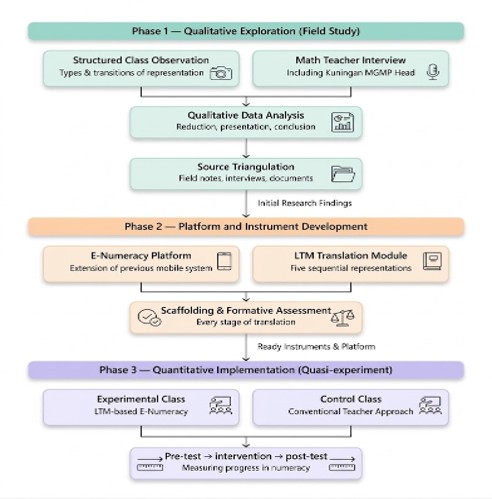
Although the Lesh Translation Model (LTM) has proven effective in addressing students' difficulties in translating mathematical ideas across representations, its application has so far been limited to face-to-face learning and its effectiveness when integrated into structured e-learning environments to improve students' numeracy skills has not been widely studied. This study aims to examine the effectiveness of integrating LTM into an e-learning platform (E-Numerasi) in enhancing students' numeracy skills compared to conventional instruction. This research uses a quasi-experimental pretest-posttest control group design and involves 119 eighth-grade students from two public junior high schools in Kuningan Regency, West Java, who were divided into an experimental group (n = 61) and a control group (n = 58). T-tests confirmed the equivalence of initial numeracy skills between the two groups prior to the intervention (p = 0.832). After the intervention, the experiment group obtained a significantly higher posttest mean score (M = 74.46) than the control group (M = 63.88), t(117) = 4.962; p < 0.001, supported by a moderate Normalized Gain (0.39) and a very large effect size (Cohen's d = 0.91). These results indicate that integrating the Lesh Translation Model into e-learning is significantly more effective in improving students' numeracy skills than conventional instruction.
##plugins.themes.bootstrap3.article.details##

This work is licensed under a Creative Commons Attribution-ShareAlike 4.0 International License.
The author is responsible for acquiring the permission(s) to reproduce any copyrighted figures, tables, data, or text that are being used in the submitted paper. Authors should note that text quotations of more than 250 words from a published or copyrighted work will require grant of permission from the original publisher to reprint. The written permission letter(s) must be submitted together with the manuscript.References
Abdullah, N., Halim, L., & Zakaria, E. (2014). VStops: A thinking strategy and visual representation approach in mathematical word problem solving toward enhancing STEM literacy. Eurasia Journal of Mathematics, Science and Technology Education, 10(3), 165–174. https://doi.org/10.12973/eurasia.2014.1073a
Abraham, M., & Prediger, S. (2025). Scaffolding fifth graders’ learning with a digital multi-representation applet: Design research on focusing multiplicative structures with dynamic dot arrays. Digital Experiences in Mathematics Education, 11(2), 219–246. https://doi.org/10.1007/s40751-024-00156-7
Annajmi, A., Kuswandi, D., Setyosari, P., & Praherdhiono, H. (2026). Integrating multiple representations and local cultural contexts into problem-based learning within a flipped classroom: A new framework for mathematics education. Social Sciences & Humanities Open, 13, 102797. https://doi.org/10.1016/j.ssaho.2026.102797
Asmara, A. S., Yusuf, Y., Prawiyogi, A. G., Zonyfar, C., Alhamssyah, M. A., & Alfarid, M. N. (2026). Profiling numeracy literacy among ninth-grade students: Empirical evidence from junior secondary education. Infinity Journal, 15(1), 291–318. https://doi.org/10.22460/infinity.v15i1.p291-318
Bossé, M. J., Adu-Gyamfi, K., & Chandler, K. (2014). Students’ differentiated translation processes. International Journal for Mathematics Teaching and Learning, 1–28. http://www.cimt.org.uk/journal/bosse5.pdf
Chan, J. Y.-C., & Scalise, N. R. (2022). Numeracy skills mediate the relation between executive function and mathematics achievement in early childhood. Cognitive Development, 62, 101154. https://doi.org/10.1016/j.cogdev.2022.101154
Cirneanu, A.-L., & Moldoveanu, C.-E. (2024). Use of digital technology in integrated mathematics education. Applied System Innovation, 7(4), 66. https://doi.org/10.3390/asi7040066
Cohen, L., Manion, L., & Morrison, K. (2002). Research methods in education (5th ed.). Routledge. https://doi.org/10.4324/9780203224342
Cramer, K. A., Monson, D. S., Wyberg, T., Leavitt, S., & Whitney, S. B. (2009). Models for initial decimal ideas. Teaching Children Mathematics, 16(2), 106–117. https://doi.org/10.5951/tcm.16.2.0106
Creswell, J. W. (2014). Research design: Qualitative, quantitative, and mixed methods approaches (4th ed.). Sage.
Dewantara, A. H., Setiawati, F. A., & Saraswati, S. (2023). Towards numeracy literacy development: A single-case study on the use of the living book homeschooling model. Infinity Journal, 12(2), 225–242. https://doi.org/10.22460/infinity.v12i2.p225-242
Drijvers, P., & Sinclair, N. (2024). The role of digital technologies in mathematics education: purposes and perspectives. ZDM – Mathematics Education, 56(2), 239–248. https://doi.org/10.1007/s11858-023-01535-x
Duval, R. (2006). A cognitive analysis of problems of comprehension in a learning of mathematics. Educational Studies in Mathematics, 61(1-2), 103–131. https://doi.org/10.1007/s10649-006-0400-z
Dyrvold, A., & Bergvall, I. (2024). Digital teaching platforms: The use of dynamic functions to express mathematical content. Scandinavian Journal of Educational Research, 68(5), 861–877. https://doi.org/10.1080/00313831.2023.2196555
Engelbrecht, J., & Borba, M. C. (2024). Recent developments in using digital technology in mathematics education. ZDM – Mathematics Education, 56(2), 281–292. https://doi.org/10.1007/s11858-023-01530-2
Fauzan, A., Harisman, Y., Yerizon, Y., Suherman, S., Tasman, F., Nisa, S., Sumarwati, S., Hafizatunnisa, H., & Syaputra, H. (2024). Realistic mathematics education (RME) to improve literacy and numeracy skills of elementary school students based on teachers’ experience. Infinity Journal, 13(2), 301–316. https://doi.org/10.22460/infinity.v13i2.p301-316
Hake, R. R. (1998). Interactive-engagement versus traditional methods: A six-thousand-student survey of mechanics test data for introductory physics courses. American Journal of Physics, 66(1), 64–74. https://doi.org/10.1119/1.18809
Hidayah, I. R., Sa'dijah, C., Anwar, L., Yerizon, Y., & Arnawa, I. M. (2025). Empowering students’ numeracy skills: Mathematics teachers’ perceptions regarding the effectiveness and challenges of Indonesian national curriculum and the programs – A mixed method study. Infinity Journal, 14(1), 163–188. https://doi.org/10.22460/infinity.v14i1.p163-188
Hidayat, A., & Chao, T. (2025). Unleashing mathematics teachers: Insights from a systematic literature review on digital learning in Indonesia. Cogent Education, 12(1), 2442868. https://doi.org/10.1080/2331186x.2024.2442868
Hidayat, W., Wahyudin, W., & Prabawanto, S. (2018). Improving students’ creative mathematical reasoning ability students through adversity quotient and argument driven inquiry learning. Journal of Physics: Conference Series, 948(1), 012005. https://doi.org/10.1088/1742-6596/948/1/012005
Hoogland, K., de Koning, J., Bakker, A., Pepin, B. E. U., & Gravemeijer, K. (2018). Changing representation in contextual mathematical problems from descriptive to depictive: The effect on students’ performance. Studies in Educational Evaluation, 58, 122–131. https://doi.org/10.1016/j.stueduc.2018.06.004
Jäder, J., & Johansson, H. (2025). Exploring students’ conceptual understanding through mathematical problem solving: students’ use of and shift between different representations of rational numbers. Research in Mathematics Education, 1–18. https://doi.org/10.1080/14794802.2025.2456840
Jonsson, B., Kulaksiz, Y. C., & Lithner, J. (2016). Creative and algorithmic mathematical reasoning: effects of transfer-appropriate processing and effortful struggle. International Journal of Mathematical Education in Science and Technology, 47(8), 1206–1225. https://doi.org/10.1080/0020739X.2016.1192232
Kandemir, M., & Karadeniz, İ. (2021). Pre-service teachers’ cognitive and metacognitive processes in integrated STEM modeling activity. Journal of Education in Science, Environment and Health, 7(2), 104–127. https://doi.org/10.21891/jeseh.832574
Khatin-Zadeh, O., Farsani, D., & Yazdani-Fazlabadi, B. (2022). Transforming dis-embodied mathematical representations into embodied representations, and vice versa: a two-way mechanism for understanding mathematics. Cogent Education, 9(1), 2154041. https://doi.org/10.1080/2331186x.2022.2154041
Kusaeri, K., Lailiyah, S., Arrifadah, Y., & Asmiyah, S. (2022). Enhancing creative reasoning through mathematical task: The quest for an ideal design. International Journal of Evaluation and Research in Education (IJERE), 11(2), 482–490. https://doi.org/10.11591/ijere.v11i2.22125
Lesh, R., & Doerr, H. M. (2003). Beyond constructivism: Models and modeling perspectives on mathematics problem solving, learning, and teaching. Lawrence Erlbaum Associates Publishers.
Lesh, R., Post, T., & Behr, M. (1987). Representations and translations among representations in mathematics learning and problem solving. In C. Janvier (Ed.), Problems of representation in the teaching and learning of mathematics (pp. 33–40). Routledge. https://doi.org/10.4324/9781042000227-5
Lithner, J. (2017). Principles for designing mathematical tasks that enhance imitative and creative reasoning. ZDM – Mathematics Education, 49(6), 937–949. https://doi.org/10.1007/s11858-017-0867-3
Lockwood, E., & Ellis, A. B. (2022). Two students’ mathematical thinking and activity across representational registers in a combinatorial setting. ZDM – Mathematics Education, 54(4), 829–845. https://doi.org/10.1007/s11858-022-01352-8
Mac an Bhaird, C., Nolan, B. C., O’Shea, A., & Pfeiffer, K. (2017). A study of creative reasoning opportunities in assessments in undergraduate calculus courses. Research in Mathematics Education, 19(2), 147–162. https://doi.org/10.1080/14794802.2017.1318084
Mainali, B. (2021). Representation in teaching and learning mathematics. International Journal of Education in Mathematics, Science and Technology, 9(1), 1–21. https://doi.org/10.46328/ijemst.1111
Miles, M. B., Huberman, A. M., & Saldaña, J. (2014). Qualitative data analysis a methods sourcebook (3rd ed.). SAGE.
Nindiasari, H., Hendriana, H., Fathurrohman, M., Kurniawati, N. K., Nirmalasari, D., Rofiroh, R., & Ruhimat, A. (2026). Numeracy website of local wisdom in mathematics learning: Metacognitive approach and mathematical reflective thinking ability. Infinity Journal, 15(2), 595–622. https://doi.org/10.22460/infinity.v15i2.p595-622
OECD. (2019). PISA 2018 assessment and analytical framework. OECD. https://doi.org/10.1787/b25efab8-en
OECD. (2023). PISA 2022 assessment and analytical framework. OECD. https://doi.org/10.1787/dfe0bf9c-en
Rahayu, W. A., & Subekti, P. (2025). Implementation of "E-Lens" inquiry-based learning game to improve literacy and numeracy skills. Jurnal Cakrawala Pendidikan, 44(3), 510–522. https://doi.org/10.21831/cp.v44i3.76930
Rosita, C. D., Setiyani, S., Muhidin, I., & Sagita, L. (2026). Enhancing junior high school students’ numeracy through differentiated contextual worksheets. Infinity Journal, 15(2), 545–570. https://doi.org/10.22460/infinity.v15i2.p545-570
Santosa, C. A. H. F., & Filiz, M. (2025). Investigating the limit of peer collaboration: Insight from worked-example in multivariable calculus. Infinity Journal, 14(2), 461–482. https://doi.org/10.22460/infinity.v14i2.p461-482
Scheid, J., Müller, A., Hettmannsperger, R., & Schnotz, W. (2019). Improving learners’ representational coherence ability with experiment-related representational activity tasks. Physical Review Physics Education Research, 15(1), 010142. https://doi.org/10.1103/PhysRevPhysEducRes.15.010142
Setiyani, S., Gunawan, G., Waluya, S. B., Sukestiyarno, Y. L., Cahyono, A. N., Mutia, M., & Yunianto, W. (2025). The role of scaffolding in shaping reflective mathematical thinking of dependent field students in numeracy problems. Infinity Journal, 14(2), 531–550. https://doi.org/10.22460/infinity.v14i2.p531-550
Steen, L. A. (2001). Mathematics and democracy: The case for quantitative literacy. NCED.
Stohlmann, M., Yang, Y., Huang, X., & Olson, T. (2020). Fourth to sixth grade teachers’ invented real world problems and pictorial representations for fraction division. International Electronic Journal of Mathematics Education, 15(1), em0557. https://doi.org/10.29333/iejme/5939
Vaillant, D., Rodríguez Zidán, E., & Bentancor-Biagas, G. (2021). Plan CEIBAL and the incorporation of digital tools and platforms in the teaching of mathematics according to the teachers’ perceptions. Eurasia Journal of Mathematics, Science and Technology Education, 17(12), em2037. https://doi.org/10.29333/ejmste/11307
Verkerk, J. C., van de Rijt, B., & van Viersen, S. (2026). Development of numerical relational and counting skills as components of early numeracy. Learning and Instruction, 102, 102313. https://doi.org/10.1016/j.learninstruc.2025.102313
Weingarden, M., Karsenty, R., & Koichu, B. (2026). Realistic visual representations as mediators between everyday and mathematical discourses in heterogeneous classrooms. The Journal of Mathematical Behavior, 81, 101300. https://doi.org/10.1016/j.jmathb.2025.101300
Weinhandl, R., Baldinger, S., & Kapplmüller, M. (2026). Educational design characteristics of digital mathematics learning environments from a student perspective. International Journal of Mathematical Education in Science and Technology, 57(10), 2231–2257. https://doi.org/10.1080/0020739x.2025.2562275
Wijaya, T. T., Hidayat, W., Hermita, N., Alim, J. A., & Talib, C. A. (2024). Exploring contributing factors to PISA 2022 mathematics achievement: Insights from Indonesian teachers. Infinity Journal, 13(1), 139–156. https://doi.org/10.22460/infinity.v13i1.p139-156
Yerizon, Y., Arnellis, A., Suherman, S., Arnawa, I. M., Sa'dijah, C., & Anwar, L. (2025). Developing adaptive digital book (ADB) in enhancing students’ numeracy literacy ability. Infinity Journal, 14(3), 571–586. https://doi.org/10.22460/infinity.v14i3.p571-586
Zaenal, R. M., Nasrullah, S. F., & Puadi, E. F. W. (2024). Development of e-learning of mathematics numeracy to improve students' numeracy ability. AKSIOMA: Jurnal Program Studi Pendidikan Matematika, 13(3), 838–850. https://doi.org/10.24127/ajpm.v13i3.8832