
Designing and enacting mathematics lessons: Insights from pre-service teachers’ learning through project-based learning and lesson study
##plugins.themes.bootstrap3.article.sidebar##
##plugins.themes.bootstrap3.article.main##
Abstract
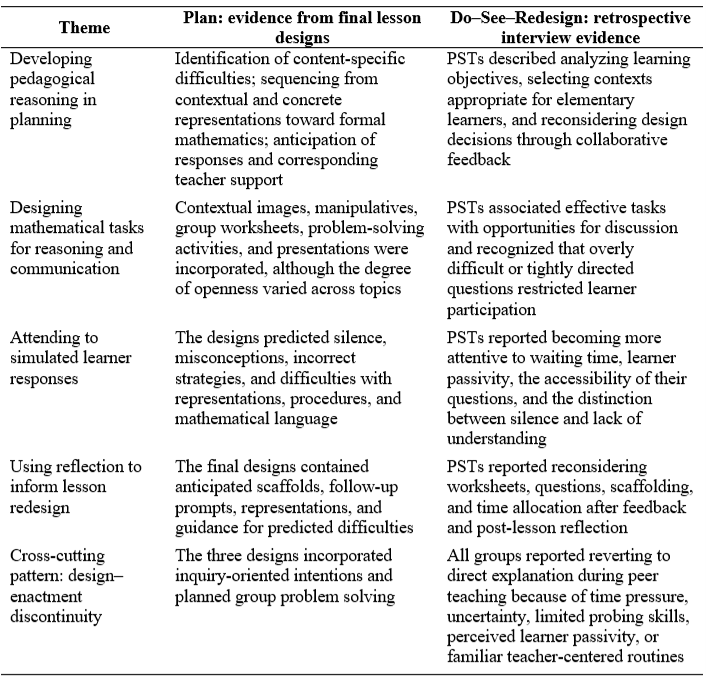
Bridging lesson design and instructional enactment remains a challenge in mathematics teacher education. This qualitative case study explored how Project-Based Learning (PjBL) and lesson study supported pre-service mathematics teachers (PSTs) in addressing this challenge. PjBL provided the macro-pedagogical architecture for a seven-week collaborative project, while LS structured the micro-cycles of Plan, Do, See, and Redesign. Participants were 13 third-year PSTs enrolled in an undergraduate Mathematics Education program and taking an Elementary Mathematics Instruction course at an Indonesian university. Organized into three groups, they selected an elementary mathematics topic, designed a two-meeting lesson sequence, and completed two lesson study cycles through peer teaching. Data consisted of lesson designs and semi-structured group interviews and were analyzed thematically. The findings revealed that participants engaged in pedagogical reasoning, designed tasks intended to promote mathematical reasoning and communication, considered simulated learner responses, and used reflection to redesign their lessons. However, interview data revealed instances of reverting to direct explanation when simulated learners hesitated or required additional time. These findings identify a design–enactment discontinuity in which the capacity to construct student-centered lessons did not automatically translate into responsive enactment. The study suggests that combining sustained project work with iterative professional inquiry can provide a useful structure for lesson design, but PSTs also require repeated and scaffolded opportunities to rehearse responding to learner thinking.
INTRODUCTION
Preparing pre-service teachers (PSTs) to design and deliver effective instruction in elementary classrooms has become a central concern in teacher education. Beyond content knowledge, novice teachers must develop the capacity to plan instruction that promotes conceptual understanding, addresses student misconceptions, and engages diverse learners(Allmendinger et al., 2023). This includes selecting and sequencing meaningful tasks, anticipating learners’ possible responses, and determining appropriate pedagogical support(Sujadi et al., 2025). However, this instructional design competence cannot be developed in isolation from practice. Research has consistently shown that traditional university-based coursework tends to separate theoretical knowledge from the practical demands of real teaching, leaving teacher candidates underprepared for the complexity of the classroom(Christiansen & Erixon, 2024; Hoover & Ball, 2021). A particularly persistent challenge is the design–enactment gap: the presence of student-centered elements in a lesson design does not necessarily ensure that novice teachers can enact those elements responsively in practice.(Farrow et al., 2024; Fitriati & Novita, 2018). In response, there is growing interest in embedding practice-based approaches into teacher education programs, emphasizing teaching as a form of disciplined inquiry and design(Mancenido et al., 2026).
Project-Based Learning (PjBL) has emerged as a promising approach in teacher preparation because it positions pre-service teachers (PSTs) as active designers and decision makers. Through authentic, extended projects, PSTs learn to connect theory with practice, collaborate to solve instructional problems, and create meaningful products such as lesson designs(Farrow et al., 2022; Pratiwi et al., 2025; Qi et al., 2025). In Indonesia, the use of project-oriented learning in higher education has been reinforced through the national Key Performance Indicators for higher education. Under KPI 7, collaborative and participatory learning is recognized through the use of case methods or team-based projects, in which students work collaboratively on authentic problems or complex questions and present a final product for feedback (Directorate General of Higher Education, 2021;Ministry of Education Culture Research and Technology, 2023). Through PjBL, PSTs are encouraged to structure lessons around rich problems, anticipate student strategies, and design learning trajectories that promote inquiry of learning in the 21st century. However, while PjBL strengthens PSTs’ conceptual understanding of instructional models, research indicates that novice teachers often struggle to enact these designs in real classrooms without additional guided practice(Liang et al., 2025; Magaji et al., 2024).
Lesson study offers a complementary structure by situating PSTs’ learning within cycles of collaborative planning, observation, reflection, and revision(Fitriati et al., 2023; Tan et al., 2024). In lesson study, teachers jointly plan a lesson, often called a research lesson, observe its implementation in a real classroom, and engage in structured reflection based on student learning evidence(Lewis, 2016; Lewis & Hurd, 2011; Murata, 2011). The process enables PSTs to focus deeply on teaching and learning, to test and refine ideas, and to grow professionally through collective inquiry(Dudley, 2014; Lewis, 2016). While lesson study has traditionally been used for in-service teacher development, recent studies have highlighted its potential in teacher education, especially for enhancing PSTs’ skills in lesson planning, pedagogical reasoning, and classroom observation(Fitriati et al., 2025; Tan et al., 2024; Wood et al., 2019).
The inclusion of lesson study in initial teacher education aligns with a broader shift toward pedagogies of enactment, which situate professional learning within approximations of teaching practice. AsLewanowski-Breen et al. (2021)argue, such pedagogies provide opportunities that allow PSTs not only to apply knowledge for teaching mathematics but also to develop pedagogical reasoning by connecting instructional purposes, anticipated learner responses, teaching decisions, and reflection on enactment. In mathematics education, pedagogical reasoning is closely related to professional noticing, commonly understood as teachers’ capacity to attend to, interpret, and respond to learners’ mathematical thinking(Bakker et al., 2022). Research indicates that noticing does not develop automatically; PSTs require structured opportunities to anticipate responses, examine evidence from enactment, and reconsider instructional decisions (Ekawati et al., 2023;Yilmaz & Yetkin Ozdemir, 2023). In this study, pedagogical reasoning and professional noticing therefore provide complementary lenses for examining how PSTs justify lesson-design decisions and interpret simulated learner responses during peer teaching.
Recent research indicates that PSTs benefit from opportunities to design contextually meaningful mathematical tasks, anticipate possible responses, and revise instruction through collaborative inquiry (Sujadi et al., 2025;Yilmaz & Yetkin Ozdemir, 2023). Lesson study supports these processes by connecting planning, enactment, reflection, and redesign(Fitriati et al., 2025; Fitriati et al., 2023; García et al., 2024), while PjBL provides sustained engagement with an authentic professional project. The two approaches therefore contribute at different but complementary levels. PjBL provides the macro-pedagogical architecture that organizes the extended lesson-design project, participant collaboration, project milestones, feedback, and final products. Lesson study operates within that architecture as a micro-cycle of professional inquiry through Plan, Do, See, and Redesign. This nested relationship is consistent with recent mathematics education research showing that PjBL and Lesson study can be combined to support teachers’ interpretation and adaptation of instructional resources(Qi et al., 2025). However, evidence of successful lesson design should not be equated with successful enactment, as student-centered features in planned lessons may not transfer directly into instructional practice(Farrow et al., 2024).
Despite growing research on lesson study in teacher education(Baumfield et al., 2022; Larssen et al., 2018; Tan et al., 2024), two issues remain insufficiently examined.
##plugins.themes.bootstrap3.article.details##

This work is licensed under a Creative Commons Attribution-ShareAlike 4.0 International License.
The author is responsible for acquiring the permission(s) to reproduce any copyrighted figures, tables, data, or text that are being used in the submitted paper. Authors should note that text quotations of more than 250 words from a published or copyrighted work will require grant of permission from the original publisher to reprint. The written permission letter(s) must be submitted together with the manuscript.References
Allmendinger, H., Aslaksen, H., & Buchholtz, N. (2023). Strengthening mathematical orientation: How university mathematics courses can gain relevance for pre-service teachers. ZDM – Mathematics Education, 55(4), 851–865. https://doi.org/10.1007/s11858-023-01492-5
Almacioglu, G., & Arslan, F. Y. (2026). The role of lesson study in pre-service teacher education: a systematic review. International Journal for Lesson & Learning Studies, 15(2), 99–123. https://doi.org/10.1108/ijlls-07-2025-0179
Bakker, C., de Glopper, K., & de Vries, S. (2022). Noticing as reasoning in Lesson Study teams in initial teacher education. Teaching and Teacher Education, 113, 103656. https://doi.org/10.1016/j.tate.2022.103656
Baumfield, V., Bethel, A., Boyle, C., Katene, W., Knowler, H., Koutsouris, G., & Norwich, B. (2022). How lesson study is used in initial teacher education: An international review of literature. Teacher Development, 26(3), 356–372. https://doi.org/10.1080/13664530.2022.2063937
Cardoso, L., da Ponte, J. P., & Quaresma, M. (2025). Lesson study in primary initial teacher education: Participants’ perspectives on potential and challenges. Eurasia Journal of Mathematics, Science and Technology Education, 21(5), em2629. https://doi.org/10.29333/ejmste/16306
Christiansen, I. M., & Erixon, E.-L. (2024). Opportunities to learn mathematics pedagogy and learning to teach mathematics in Swedish mathematics teacher education: A survey of student experiences. European Journal of Teacher Education, 47(1), 159–177. https://doi.org/10.1080/02619768.2021.2019216
Clivaz, S., & Ni Shuilleabhain, A. (2019). What knowledge do teachers use in lesson study? A focus on mathematical knowledge for teaching and levels of teacher activity. In R. Huang, A. Takahashi, & J. P. da Ponte (Eds.), Theory and Practice of Lesson Study in Mathematics (pp. 419–440). Springer. https://doi.org/10.1007/978-3-030-04031-4_20
Directorate General of Higher Education. (2021). Buku panduan indikator kinerja utama perguruan tinggi negeri [Guidebook on key performance indicators for state universities] (2nd ed.). Ministry of Education, Culture, Research, and Technology. https://kemdiktisaintek.go.id/api/file/humas-production/2021/07/Buku-Panduan-IKU-2021-28062021-1.pdf
Dudley, P. (2014). Lesson study: Professional learning for our time. Routledge. https://doi.org/10.4324/9780203795538
Ekawati, R., Kohar, A. W., Siswono, T. Y. E., Lukito, A., Yang, K.-L., & Nisa, K. (2023). Mathematics teacher educators’ noticing of pedagogical content knowledge on hierarchical classification of quadrilateral. Infinity Journal, 12(2), 261–274. https://doi.org/10.22460/infinity.v12i2.p261-274
Farrow, J., Kavanagh, S., & Samudra, P. (2022). Exploring relationships between professional development and teachers’ enactments of project-based learning. Education Sciences, 12(4), 282. https://doi.org/10.3390/educsci12040282
Farrow, J., Kavanagh, S. S., Samudra, P., & Pupik Dean, C. (2024). The promise of the project to student-centered learning: Connections between elements, curricular design, and practices of project based learning. Teaching and Teacher Education, 152, 104776. https://doi.org/10.1016/j.tate.2024.104776
Fitriati, F., & Novita, R. (2018). Designing student worksheet for rich mathematical tasks. Journal of Physics: Conference Series, 1088, 012029. https://doi.org/10.1088/1742-6596/1088/1/012029
Fitriati, F., Novita, R., Hidayat, A., & Khairunnisak, C. (2026). Uncovering learning poverty in mathematics classrooms: Linking learning gaps, instructional practices, and teacher professional learning through SUPER-LS program and slow pedagogy. Journal on Mathematics Education, 17(1), 115–134. https://doi.org/10.22342/jme.v17i1.pp115-134
Fitriati, F., Rosli, R., Hidayat, A., & Khairunnisak, C. (2025). Strengthening mathematics teachers’ subject matter knowledge for teaching critical thinking through the SUPER-LS. Jurnal Didaktik Matematika, 12(1), 1–22. https://doi.org/10.24815/jdm.v12i1.43656
Fitriati, F., Rosli, R., & Iksan, Z. H. (2023). Enhancing prospective mathematics teachers' lesson planning skills through lesson study within school university partnership program. Journal on Mathematics Education, 14(1), 69–84. https://doi.org/10.22342/jme.v14i1.pp69-84
García, F. J., Lendínez, E. M., Lerma, A. M., & Abril, A. M. (2024). Mechanisms and evidence of prospective teachers’ learning through enquiry-oriented practices: the case of a lesson study intervention. ZDM – Mathematics Education, 56(6), 1183–1196. https://doi.org/10.1007/s11858-024-01620-9
Hoover, M., & Ball, D. L. (2021). Practice-based research on the teaching of mathematics: progress and imperatives for the future. NOMAD Nordic Studies in Mathematics Education, 26(3-4), 171–190. https://doi.org/10.7146/nomad.v26i3-4.149177
Larssen, D. L. S., Cajkler, W., Mosvold, R., Bjuland, R., Helgevold, N., Fauskanger, J., Wood, P., Baldry, F., Jakobsen, A., Bugge, H. E., Næsheim-Bjørkvik, G., & Norton, J. (2018). A literature review of lesson study in initial teacher education. International Journal for Lesson and Learning Studies, 7(1), 8–22. https://doi.org/10.1108/ijlls-06-2017-0030
Lewanowski-Breen, E., Ni Shuilleabhain, A., & Meehan, M. (2021). Lesson study and the long-term impact on teacher professional community development. International Journal for Lesson & Learning Studies, 10(1), 89–101. https://doi.org/10.1108/ijlls-09-2020-0059
Lewis, C. (2016). How does lesson study improve mathematics instruction? ZDM – Mathematics Education, 48(4), 571–580. https://doi.org/10.1007/s11858-016-0792-x
Lewis, C., & Hurd, J. (2011). Lesson study step by step: How teacher learning communities improve instruction. Heinemann.
Liang, H., Guo, T., & Zhang, C. (2025). Understanding teacher agency of novice teachers in the context of project-based learning (PjBL). Journal of Ecohumanism, 4(2), 1339–1351. https://doi.org/10.62754/joe.v4i2.6503
Magaji, A., Adjani, M., & Coombes, S. (2024). A systematic review of preservice science teachers’ experience of problem-based learning and implementing It in the classroom. Education Sciences, 14(3), 301. https://doi.org/10.3390/educsci14030301
Mancenido, Z., Hill, H. C., Garcia Coppersmith, J., Carter, H., Pollard, C., & Monschauer, C. (2026). Practice-based teacher education pedagogies improve responsiveness: Evidence from a lab experiment. Journal of Research on Educational Effectiveness, 19(1), 201–225. https://doi.org/10.1080/19345747.2025.2456716
Ministry of Education Culture Research and Technology. (2023). Keputusan Menteri Pendidikan, Kebudayaan, Riset, dan Teknologi Republik Indonesia nomor 210/M/2023 tentang indikator kinerja utama perguruan tinggi dan lembaga layanan pendidikan tinggi di Kementerian Pendidikan, Kebudayaan, Riset, dan Teknologi [Decree of the Minister of Education, Culture, Research, and Technology of the Republic of Indonesia Number 210/M/2023 concerning Key Performance Indicators for Higher Education Institutions and Higher Education Service Institutions within the Ministry of Education, Culture, Research, and Technology.]. Ministry of Education, Culture, Research, and Technology.
Murata, A. (2011). Introduction: Conceptual overview of lesson study. In L. Hart, A. Alston, & A. Murata (Eds.), Lesson study research and practice in mathematics education (pp. 1–12). Springer. https://doi.org/10.1007/978-90-481-9941-9_1
Nguyen, D. T., & Tran, D. (2023). High school mathematics teachers' changes in beliefs and knowledge during lesson study. Journal of Mathematics Teacher Education, 26(6), 809–834. https://doi.org/10.1007/s10857-022-09547-2
Pratiwi, R. T., Rismawati, R., Nuryatin, A., Rosaline, C. D., Suryani, Y., & Agustira, D. (2025). Lesson study through the project-based learning model to improve creative thinking ability. QALAMUNA: Jurnal Pendidikan, Sosial, dan Agama, 17(1), 365–380. https://doi.org/10.37680/qalamuna.v17i1.6778
Qi, C., Zuo, S., & Liu, L. (2025). Curricular noticing in Chinese lesson study: teachers’ interactions with textbooks for project-based learning. ZDM – Mathematics Education, 57(5), 1035–1049. https://doi.org/10.1007/s11858-025-01679-y
Schunk, D. H. (2014). Learning theories: An educational perspective (6th ed.). Pearson New International edition.
Shulman, L. (1987). Knowledge and teaching: Foundations of the new reform. Harvard educational review, 57(1), 1–23. https://doi.org/10.17763/haer.57.1.j463w79r56455411
Sujadi, I., Suprihatiningsih, S., Irfan, M., & Pepkolaj, L. (2025). Pre-service mathematics teachers: Designing context-based tasks. Infinity Journal, 14(4), 995–1018. https://doi.org/10.22460/infinity.v14i4.p995-1018
Tan, S., Goei, S. L., & Willemse, T. M. (2024). Global insights on lesson study in initial teacher education: A systematic literature review encompassing English, Japanese, and Chinese language sources. Teaching and Teacher Education, 152, 104791. https://doi.org/10.1016/j.tate.2024.104791
Tsakeni, M., Mosia, M., Egara, F. O., & Nwafor, S. C. (2026). Bridging the gap between intention and enactment: a Bayesian analysis of pre-service teachers’ implementation of inquiry-based practical work in STEM (science-led) classrooms. Frontiers in Education, 10, 1719693. https://doi.org/10.3389/feduc.2025.1719693
Wood, P., Cajkler, W., & Jakobsen, A. (2019). The role of observation in ITE lesson study. In P. Wood, D. L. S. Larssen, N. Helgevold, & W. Cajkler (Eds.), Lesson study in initial teacher education: Principles and practices (pp. 75–88). Emerald Publishing Limited. https://doi.org/10.1108/978-1-78756-797-920191006
Yilmaz, N., & Yetkin Ozdemir, I. E. (2023). Pre-service mathematics teachers’ learning to notice student statistical thinking in the context of lesson study. International Electronic Journal of Mathematics Education, 18(3), em0745. https://doi.org/10.29333/iejme/13398
Yin, R. K. (2003). Case study research: Design and methods. Sage.