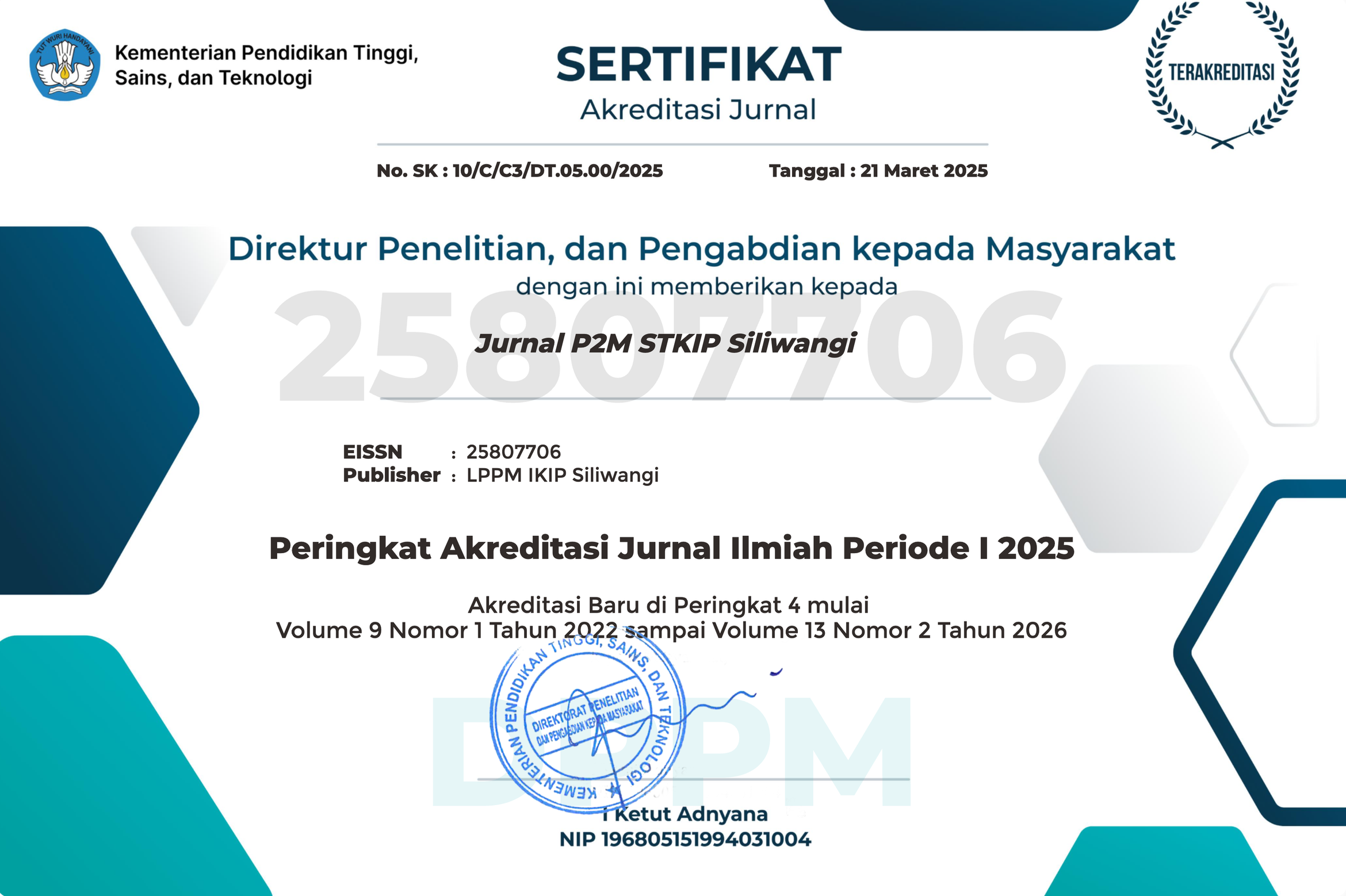
Accreditation Decree
No. 10/C/C3/DT.05.00/2025

Jurnal Ilmiah P2M STKIP Siliwangi (p-ISSN 2355-9004; e-ISSN 2580-7706) is a peer-reviewed, open-access journal published by IKIP Siliwangi, Indonesia. The journal publishes original empirical research articles in education and instructional innovation, focusing on evidence-based practices that improve teaching and learning, educator competencies, and learners’ outcomes and development.
The journal welcomes research conducted in early childhood, primary, secondary, higher, and non-formal education settings. It provides a scholarly forum for researchers, educators, and educational practitioners to disseminate findings that contribute to educational knowledge and the improvement of educational practice.
The journal accepts quantitative, qualitative, and mixed-methods research. Eligible designs include experimental and quasi-experimental research, surveys, case studies, educational ethnography, classroom action research, Didactical Design Research (DDR), Research and Development (R&D), and other empirical research designs relevant to its focus and scope.
Jurnal Ilmiah P2M STKIP Siliwangi is published twice a year, in May and November. Manuscripts are accepted in English or Indonesian, and all articles must include an English abstract.
The journal is accredited SINTA 4 by the Ministry of Education, Culture, Research, and Technology of the Republic of Indonesia, as stated in Accreditation Decree No. 10/C/C3/DT.05.00/2025
Focus and Scope
Jurnal Ilmiah P2M STKIP Siliwangi focuses on the development, implementation, and evaluation of educational practices and instructional innovations supported by empirical evidence. Each article must demonstrate a clear contribution to educational scholarship or the improvement of teaching and learning.
The scope of the journal includes:
Instructional Models, Strategies, and Methods
Development, implementation, and evaluation of instructional approaches that improve learner engagement and learning outcomes.
Learning Media, Instructional Materials, and Educational Technology
Development, validation, use, and evaluation of learning resources, educational games, instructional materials, and digital technologies.
Curriculum, Assessment, and Learning Evaluation
Curriculum implementation, instructional planning, differentiated instruction, assessment instrument development, and evaluation of learning processes and outcomes.
Literacy, Numeracy, and Subject-Specific Teaching and Learning
Literacy and numeracy development and teaching and learning in languages, mathematics, science, social studies, civic education, and other educational subjects.
Educational Psychology and Learner Development
Motivation, learning participation, self-regulation, academic procrastination and stress, and psychological and social factors associated with learning.
Character Education and Culture-Based Learning
Character development, moral and religious values, social skills, and the use of culture and local wisdom as educational resources and learning contexts.
Educator Competencies and Supportive Learning Environments
Pedagogical and professional competencies, continuing professional development, and educational leadership and management directly related to improving teaching and learning.
Non-Formal Education and Community-Based Learning
Learning processes, literacy development, and community capacity building investigated through systematically planned educational research.
Accepted Article Types and Scope Limitations
The journal accepts original empirical research articles only. All manuscripts must present clearly defined research problems and objectives, methodologically sound procedures, findings derived from data analysis, and a discussion demonstrating the contribution of the research.
The journal does not accept community service articles, activity reports, essays or opinion pieces, conceptual articles without empirical research, or literature review articles.
Training, workshops, mentoring, and community empowerment activities may serve as research contexts only when investigated through a clearly defined research design, systematic data collection and analysis, and findings relevant to education.
Research on administration, management, tourism, economics, or sociocultural phenomena must demonstrate a direct and substantive connection to educational processes, teaching and learning, or competency development.
Manuscripts outside the journal’s focus, scope, or accepted article types are declined at the initial screening stage.
Peer Review Process
Initial Screening
Editors examine each submission for alignment with the journal’s focus and scope, compliance with the template and Author Guidelines, methodological adequacy, and relevant research ethics requirements. Textual similarity is checked using Turnitin, with a maximum overall similarity index of 20%, subject to editorial interpretation. Similarity scores are assessed alongside the sources and nature of overlapping text and do not independently establish the presence or absence of plagiarism. Initial screening is normally completed within two weeks.
Double-Blind Peer Review
Manuscripts that pass initial screening are assessed by at least two independent external reviewers with relevant expertise who are not members of the journal’s editorial team. Author and reviewer identities are concealed from each other. Reviewers assess originality, contribution, relevance, methodological rigor, ethical integrity, and clarity of presentation.
Review Period
The first round of external review normally takes approximately four to eight weeks, excluding author revision and production time. This is an estimated timeframe, and authors are informed of substantial delays.
Editorial Decisions
Decisions comprise Accept, Accept with Revisions, Resubmit for Review, and Reject/Decline. Minor revisions are normally verified by the editor. Major or substantial revisions undergo another round of peer review. An invitation to revise does not guarantee acceptance.
Revision
Authors normally submit revised manuscripts within four weeks, accompanied by a point-by-point response to editorial and reviewer comments. Extensions may be requested before the deadline. Authors are contacted before an unresponsive submission is closed; manuscripts submitted after closure may be treated as new submissions.
Final Decision and Independence
The Editor-in-Chief, or an authorised independent editor where a conflict of interest exists, makes the final decision after considering the reviewers’ reports, author responses, and editorial board deliberations. Decisions are independent of publication fees, sponsorship, and institutional relationships. Submissions by editors or editorial board members are handled independently and undergo the same external review requirements.
The complete policy is available on the Peer Review Process page.
Publication Frequency
Jurnal Ilmiah P2M STKIP Siliwangi is published twice a year:
Number 1: May
Number 2: November
Previous issues are available in the journal’s Archives.
Open Access Policy
The journal provides immediate open access to its published articles to support the exchange and dissemination of educational knowledge. Readers can access and download full-text articles without charge and without registration.
Reuse, redistribution, and adaptation are governed by the Creative Commons license displayed on each article. Any applicable author publication charges are separate from reader access and are explained in the journal’s Author Fees policy.
Archiving and Access to Published Content
Published articles and previous issues are accessible through the journal’s online archive. Article landing pages provide access to full-text files and associated publication information.
The journal distinguishes access through its website from long-term digital preservation. Information about preservation services and repository arrangements is published when the journal’s participation and operational status have been verified.
Copyright and License
The copyright holder and applicable Creative Commons license are stated on each published article. Readers must follow the attribution and other reuse conditions specified by that license.
The copyright terms, publication agreement, article metadata, and full-text files must consistently identify the rights granted to the journal and its users. Any changes to licensing policy apply in accordance with the rights and agreements governing the affected articles.
Publication Ethics
Authors, editors, and reviewers are expected to uphold research integrity, confidentiality, fair assessment, and transparency concerning conflicts of interest.
The journal addresses suspected plagiarism, redundant publication, fabrication, falsification, authorship concerns, and other ethical issues through its editorial procedures. Corrections, expressions of concern, or retractions may be issued where warranted.
Further information is available in the journal’s Publication Ethics policy.
Contact and Correspondence
Manuscript correspondence, editorial enquiries, appeals, and complaints should be submitted through the journal’s online system or sent to:
The corresponding author is responsible for sharing editorial communications with all co-authors. Authors should include their manuscript identifier when contacting the editorial office.
Accreditation Decree
No. 10/C/C3/DT.05.00/2025