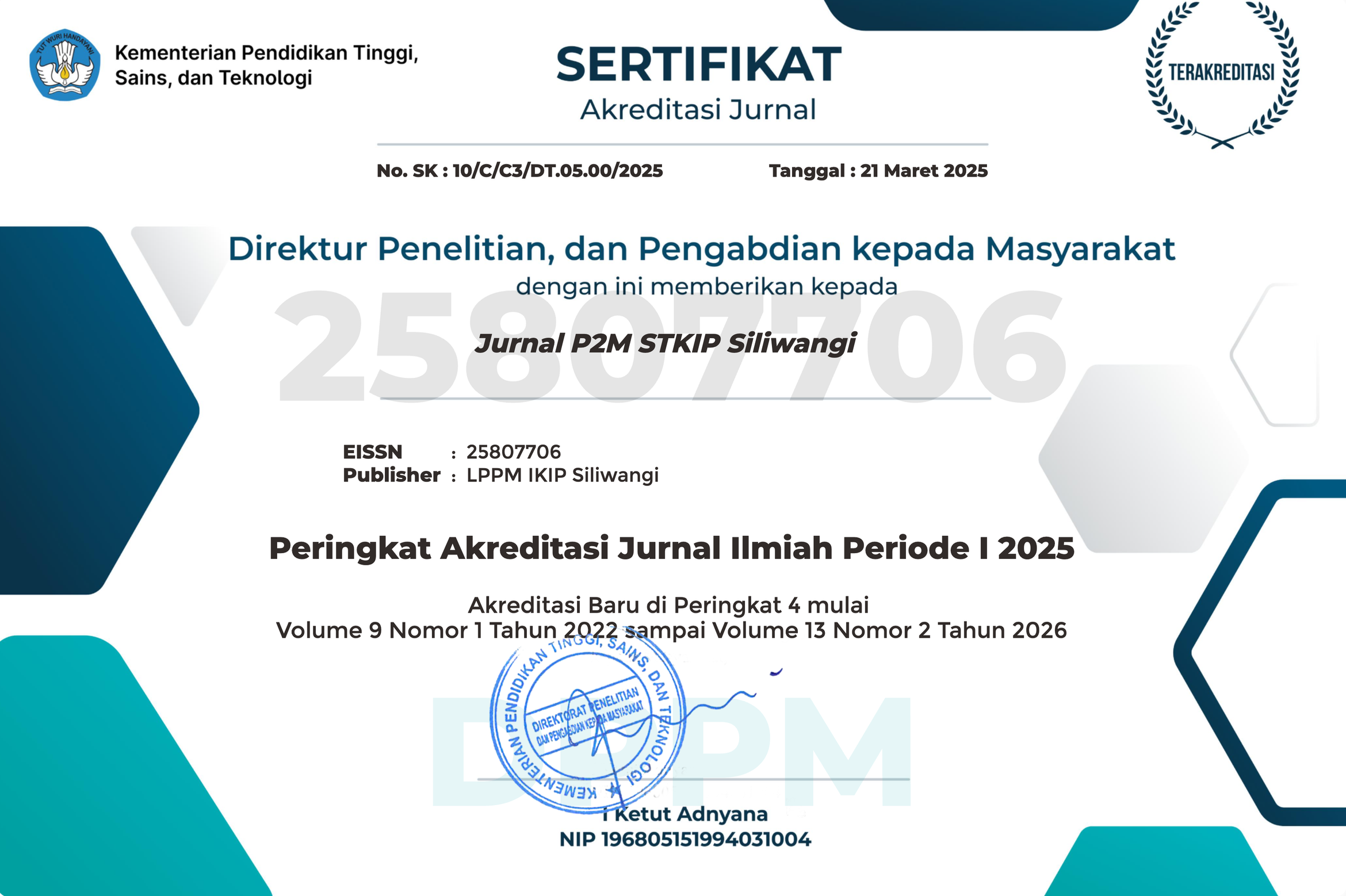
Accreditation Decree
No. 10/C/C3/DT.05.00/2025

PUBLICATION ETHICS AND PUBLICATION MALPRACTICE STATEMENT
1. General Principles
Jurnal Ilmiah P2M STKIP Siliwangi is a peer-reviewed, open-access journal published by IKIP Siliwangi, Indonesia. The journal publishes original empirical research articles in education and instructional innovation across early childhood, primary, secondary, higher, and non-formal education.
This statement defines the ethical responsibilities of authors, editors, reviewers, and the publisher. All parties are expected to uphold research integrity, fair assessment, confidentiality, transparency, and the protection of research participants.
The journal’s ethical framework is informed by the COPE Core Practices and the Principles of Transparency and Best Practice in Scholarly Publishing. Reference to these frameworks does not imply membership, endorsement, or indexing.
2. Duties of Authors
Accurate and Transparent Reporting
Authors must describe their research accurately and present findings objectively. Methods, analysis, limitations, and conclusions must be reported sufficiently for scholarly assessment.
Fabrication, falsification, misleading data presentation, and selective reporting that distorts the findings are unacceptable. Conclusions must be supported by the evidence and must not exceed the capabilities of the research design.
Originality, Plagiarism, and Acknowledgement of Sources
Authors must submit original work and appropriately acknowledge the ideas, words, data, instruments, and materials of others. Plagiarism, unattributed paraphrasing, and presenting another person’s findings as one’s own are prohibited.
References must be accurate, relevant, and genuinely support the statements for which they are cited. Fabricated references and citation manipulation are unacceptable. Permission must be obtained for third-party material where required.
Exclusive Submission and Related Publications
A manuscript must not be under consideration by another journal at the same time or substantially duplicate a previously published article.
Authors must disclose related publications, overlapping datasets, and previous dissemination of the work. Research developed from a thesis, dissertation, preprint, or conference presentation must be identified, with relevant citations or links. The editor assesses its eligibility and original contribution.
Authorship and Contributorship
Authorship requires a substantive contribution to the research, participation in drafting or critically revising the manuscript, approval of the final version, and accountability for the work.
Gift, honorary, purchased, and ghost authorship are prohibited. Contributions that do not qualify for authorship should be acknowledged with permission.
The corresponding author must ensure that all eligible authors are included, all co-authors approve submission and revisions, and editorial communications are shared with them.
Changes to authorship require an explanation, written agreement from all affected authors, and editorial approval. Unresolved authorship disputes may suspend processing and be referred to the relevant institutions.
Research Ethics and Participant Protection
Research must comply with applicable ethical, institutional, and regulatory requirements. Authors must report ethics approval where required. Where approval was not required or an exemption applies, the basis must be explained.
Participation must be voluntary and supported by appropriate informed consent. Research involving children or other vulnerable participants must address parental or guardian permission, age-appropriate assent where required, confidentiality, and protection from harm.
Permission from a school or other organisation does not replace individual consent requirements. Researchers must manage power imbalances arising from teacher–student or supervisory relationships. Refusal to participate must not improperly affect grades, services, or educational opportunities.
Identifiable participant information, photographs, recordings, and student work require appropriate permission for publication.
Data Access, Retention, and Reproducibility
Authors must maintain accurate research records and provide sufficient methodological detail for assessment. Manuscripts should include a data availability statement explaining whether and how supporting data may be accessed.
Editors may request research instruments, anonymised data, analysis records, or other supporting materials. Data sharing must respect consent, confidentiality, intellectual property, and applicable restrictions. Authors must explain justified access limitations.
Research records must be retained in accordance with applicable institutional, funder, and regulatory requirements.
Funding and Competing Interests
Authors must disclose funding sources and financial, professional, institutional, or personal interests that could reasonably influence the research or its interpretation.
The role of funders in study design, data collection, analysis, manuscript preparation, and publication decisions must be stated where applicable. Authors must also declare when no competing interests exist.
Errors and Cooperation
Authors must promptly notify the editorial office when they discover significant errors in submitted or published work. They must cooperate with reasonable editorial enquiries and with justified corrections or other actions.
3. Duties of Editors
Fair Assessment and Editorial Independence
Editors evaluate manuscripts according to their relevance, originality, methodological quality, ethical integrity, and contribution to educational scholarship or practice.
Decisions must not be influenced by discrimination, personal relationships, institutional pressure, publication fees, sponsorship, or commercial interests.
The Editor-in-Chief, or an authorised independent editor where a conflict of interest exists, is responsible for the final publication decision.
Peer Review
All research articles undergo initial editorial screening and double-blind peer review by at least two independent external reviewers with relevant expertise who are not members of the journal’s editorial team.
Editors select suitable reviewers, manage conflicts of interest, assess the substance of reports, and communicate decisions with appropriate reasons. Acceptance is not guaranteed by submission, revision, or payment.
Confidentiality
Editors and editorial staff must protect confidential submissions, reports, and correspondence. Information is shared only with authorised persons involved in editorial assessment or necessary integrity investigations.
Unpublished information must not be used for personal advantage or unrelated research.
Conflicts of Interest
Editors must disclose conflicts and withdraw from handling affected submissions.
Manuscripts authored by editors, editorial board members, or journal personnel are assigned to an independent editor. Author-editors must not select reviewers, access confidential review deliberations, or decide their own manuscripts.
Editorial Records
Reviewer assignments, substantive reports, revised manuscripts, author responses, and editorial decisions are documented in OJS. Relevant communications conducted outside OJS are incorporated into the editorial record.
4. Duties of Reviewers
Expertise and Timeliness
Reviewers must accept assignments only when they have appropriate expertise, sufficient time, and no unresolved conflict of interest. They must promptly inform the editor if they cannot complete an assessment.
Objectivity and Constructive Assessment
Reviews must be evidence-based, constructive, and supported by clear reasons. Reviewers should assess the research question, methods, analysis, interpretation, limitations, references, and ethical reporting.
Personal criticism, discriminatory remarks, and unnecessary requests to cite the reviewer’s or journal’s publications are unacceptable.
Confidentiality and Independence
Manuscripts and review reports are confidential. Reviewers must not share them, involve another person without editorial permission, contact authors directly about the submission, or use unpublished information for personal advantage.
Potential conflicts arising from collaboration, employment, supervision, financial interests, or personal relationships must be disclosed. Reviewers must decline assignments when impartiality cannot be maintained.
Reporting Concerns
Suspected plagiarism, substantial overlap, unreliable findings, or ethical problems must be reported confidentially to the editor. Reviewers provide recommendations; final publication decisions remain with the editor.
5. Duties of the Publisher
IKIP Siliwangi supports ethical editorial management and the independence of the journal’s editorial decisions.
The publisher supports appropriate investigation of integrity concerns, maintenance of publication records, and implementation of justified corrections, expressions of concern, or retractions.
Commercial and institutional interests must not override scholarly assessment or the integrity of the published record.
6. Similarity Screening and Plagiarism
The journal uses Turnitin to support similarity assessment and applies a maximum overall similarity index of 20%, subject to editorial interpretation.
Editors examine the sources, extent, attribution, and nature of overlapping text. A similarity score below 20% does not establish that a manuscript is free from plagiarism. A higher score requires contextual assessment before an editorial decision is made.
Depending on the evidence, the journal may request clarification or revision, decline a submission, or initiate post-publication action.
7. Artificial Intelligence and Automated Tools
AI tools cannot be listed as authors. Authors remain accountable for the accuracy, originality, references, and integrity of all submitted content.
Use of generative AI beyond routine spelling, grammar, and formatting assistance must be disclosed, identifying the tool and purpose. AI used as part of the research methodology must be described sufficiently for assessment.
AI must not be used to fabricate data, participant responses, references, or research procedures.
Editors and reviewers must not upload confidential manuscripts, data, correspondence, or reports to public generative AI services or other tools that cannot ensure confidentiality. Generative AI must not be used to generate peer review assessments or make editorial decisions. Automated integrity alerts require human verification.
8. Handling Allegations of Misconduct
The journal considers specific, evidence-based concerns about submitted or published articles, including concerns raised after publication. An allegation is not treated as established misconduct before the evidence has been assessed.
The handling process normally includes:
Preliminary assessment by an editor without a conflict of interest.
Preservation and examination of relevant records.
An opportunity for authors to provide explanations and supporting evidence.
Independent advice or referral to the relevant institution where necessary.
A documented decision and proportionate editorial action.
Processing or publication may be suspended during assessment. The journal addresses the integrity of submissions and publications; institutions may be asked to investigate matters beyond the journal’s capacity.
9. Corrections, Expressions of Concern, and Retractions
A correction addresses an error where the article’s principal findings remain reliable.
An expression of concern may alert readers to serious unresolved questions while evidence or an investigation remains incomplete.
A retraction may be issued when findings are unreliable or serious publication or ethical problems warrant withdrawal of the article’s standing in the scholarly record.
Notices identify and link to the affected article and explain the reasons for the action. Retracted articles normally remain accessible and are clearly marked. Content removal is reserved for exceptional circumstances involving compelling legal, privacy, or safety considerations.
Author disagreement does not prevent a justified editorial action. Substantive errors in published research are not silently overwritten.
10. Appeals, Complaints, and Post-Publication Discussion
Authors may appeal a decision by identifying a material factual error, conflict of interest, or procedural irregularity and providing supporting evidence. An appeal does not guarantee reconsideration or acceptance.
Complaints concerning an editor are assessed by an independent editor. Complaints involving the Editor-in-Chief are referred to the publisher or another authorised independent person.
Readers may submit evidence-based comments on published work. Relevant concerns are assessed, and authors may be invited to respond. Personal attacks and unsupported accusations are not accepted.
Appeals and complaints receive a reasoned response, subject to appropriate confidentiality.
11. Publication Fees
Any publication charges and waiver arrangements are governed by the journal’s published Author Fees policy.
Payment does not guarantee acceptance, preferential treatment, or exemption from peer review and ethical requirements. Editorial decisions remain independent of financial considerations.
12. Copyright, Licensing, and Intellectual Property
The journal’s configured publication license is the Creative Commons Attribution 4.0 International License (CC BY 4.0).
Under CC BY 4.0, users may share and adapt licensed material, including for commercial purposes, provided they give appropriate credit, link to the license, and indicate any changes. Users must not imply endorsement or impose additional restrictions that prevent uses permitted by the license.
Copyright ownership is determined by the applicable publication agreement and copyright notice. Applying a Creative Commons license does not, by itself, transfer copyright ownership.
Previously published articles remain subject to the licenses validly granted for those articles. The journal does not automatically replace historical article licenses when updating its general policy.
Third-party content is covered by the article’s license only to the extent that the rights holder has authorised its inclusion under that license. Separate credit lines or restrictions must be respected.
13. Contact
Ethical concerns, appeals, complaints, and post-publication comments should be submitted through OJS or emailed to:
Please include the manuscript identifier or article title/DOI, a clear explanation of the concern, and relevant supporting evidence.
Reports are handled with appropriate confidentiality and without retaliation against persons raising concerns in good faith.
Policy Acknowledgement
The structure of this statement was informed by the publication ethics policies of Jurnal Profesi Pendidikan and PrimaryEdu: Journal of Primary Education, with substantive adaptation for Jurnal Ilmiah P2M STKIP Siliwangi.
Further guidance is available through the COPE Core Practices and the Principles of Transparency and Best Practice in Scholarly Publishing.
Accreditation Decree
No. 10/C/C3/DT.05.00/2025