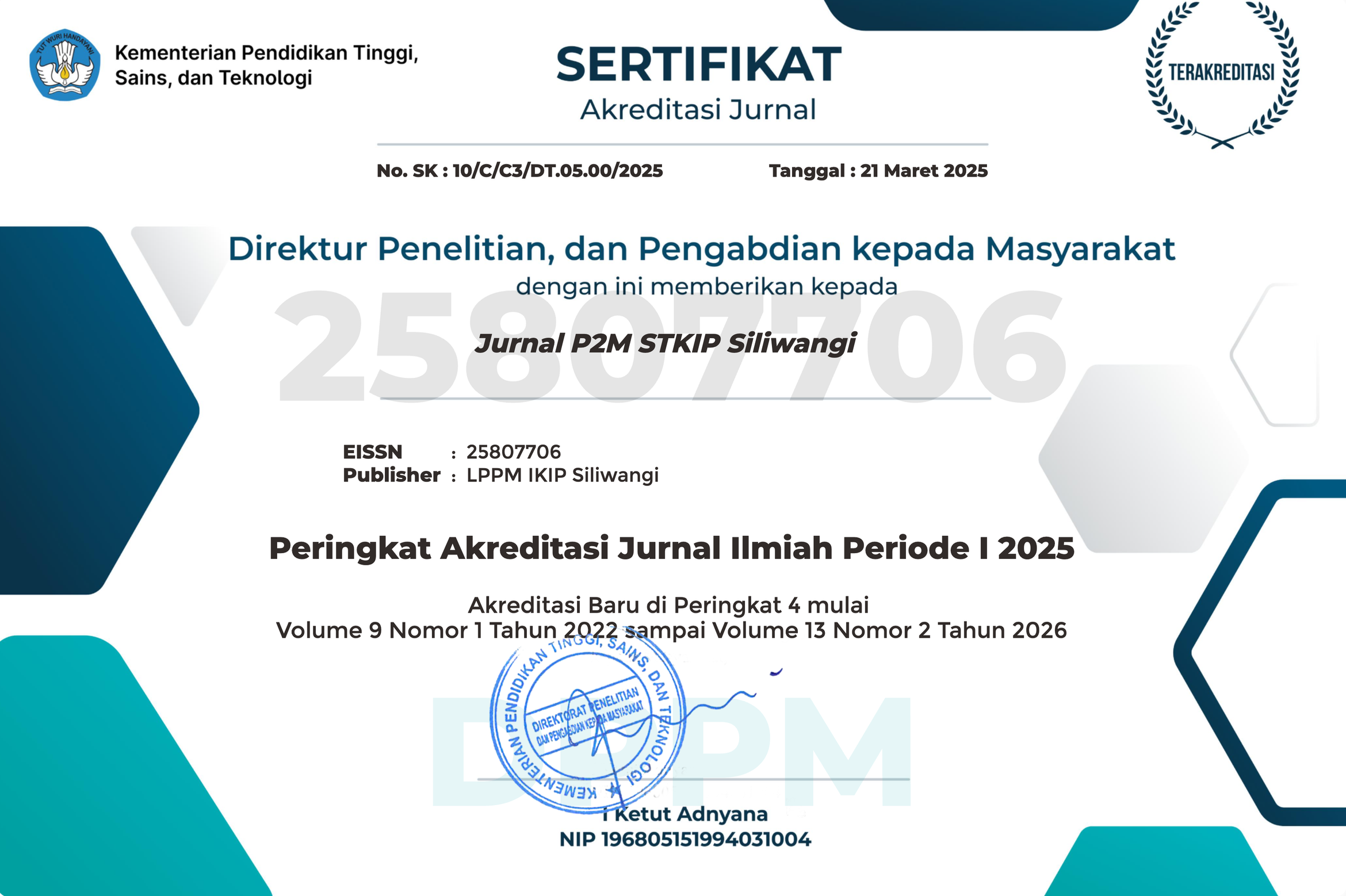
Accreditation Decree
No. 10/C/C3/DT.05.00/2025

Jurnal Ilmiah P2M STKIP Siliwangi requires authors, reviewers, and editors to disclose relationships or interests that could influence, or reasonably be perceived to influence, the preparation, assessment, or publication of a manuscript.
Disclosure supports transparency. The existence of a competing interest does not automatically disqualify a manuscript or establish improper conduct.
Authors must disclose relevant financial and non-financial interests at submission and update their disclosures if circumstances change during the editorial process.
Relevant interests may include employment, consultancies, honoraria, grants, financial holdings, patent interests, personal relationships, academic competition, or institutional relationships that may affect the research or its interpretation.
Funding sources and the funders’ roles in study design, data collection, analysis, manuscript preparation, and the decision to submit must be stated.
Where no relevant competing interests exist, authors should include:
“The authors declare that they have no competing interests relevant to this article.”
Reviewers must inform the editor of any potential competing interest before accepting an assignment. Relevant circumstances include close personal relationships, recent or ongoing collaboration, direct academic competition, or financial interests related to the manuscript.
Reviewers must decline or discontinue an assignment when impartial assessment cannot be maintained. The editor will determine whether reassignment is necessary.
Editors must not handle manuscripts when their relationships or interests could compromise impartiality. Such manuscripts will be assigned to an editor without the relevant conflict.
Manuscripts authored by editors or editorial board members must undergo independent editorial handling and the same external peer-review requirements as other manuscripts. Authors serving in editorial roles must not participate in decisions concerning their own work.
Editorial decisions are based on scholarly merit, methodological soundness, ethical integrity, and relevance to the journal. Publication fees, waivers, sponsorship, and institutional relationships must not determine acceptance.
Concerns about undisclosed competing interests may be reported through:
https://e-journal.stkipsiliwangi.ac.id/index.php/p2m/about/contact
The journal will seek clarification and assess whether the interest affected the review process, interpretation, or reliability of the article. Appropriate action may include independent reassessment, publication of a corrected disclosure, or further action under the journal’s research misconduct and correction policies.
Accreditation Decree
No. 10/C/C3/DT.05.00/2025