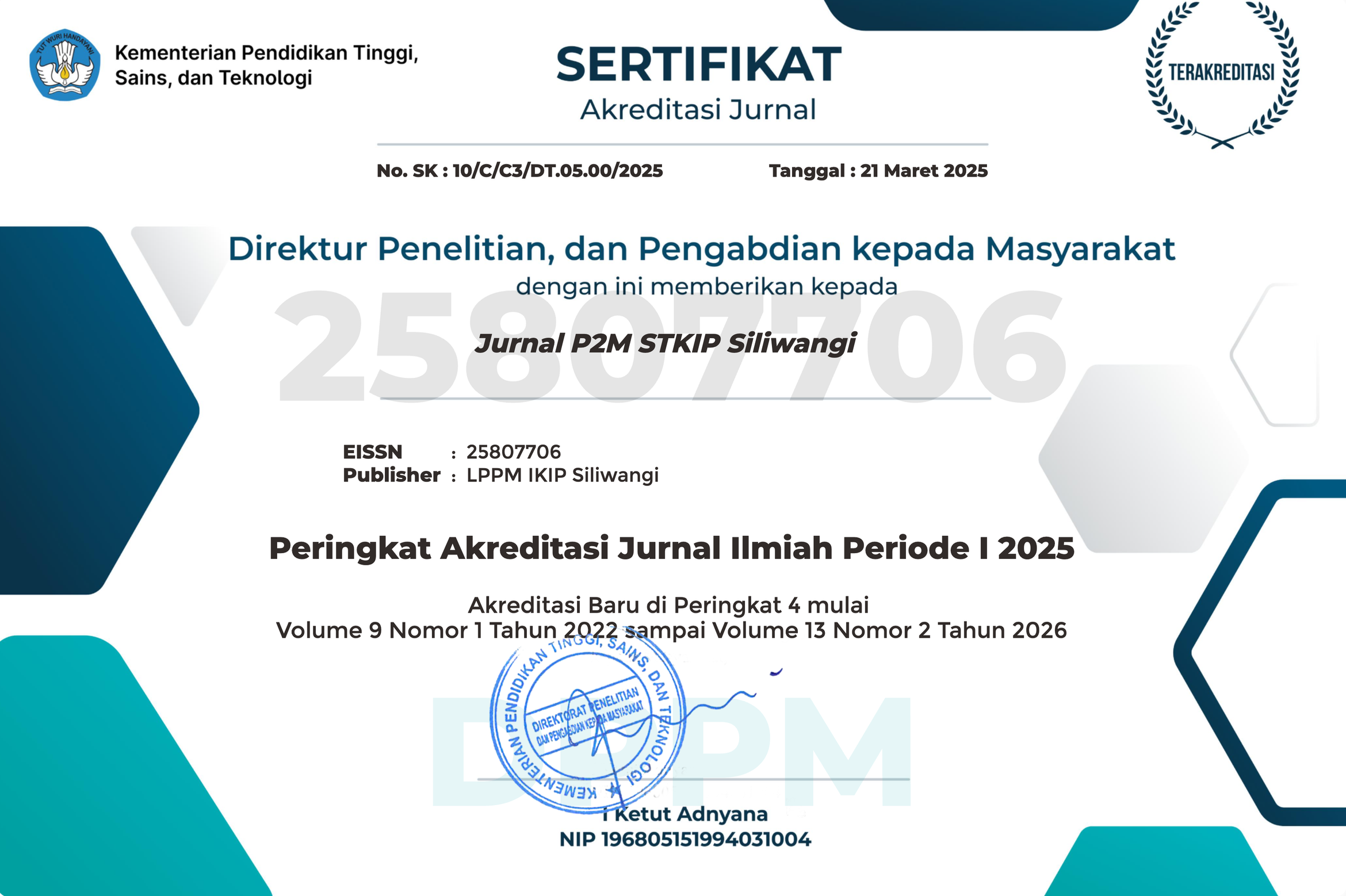
Accreditation Decree
No. 10/C/C3/DT.05.00/2025

Jurnal Ilmiah P2M STKIP Siliwangi supports the responsible and transparent use of generative artificial intelligence (AI) and AI-assisted technologies in educational research and scholarly communication. Such technologies must support human scholarship while preserving research integrity, confidentiality, originality, and accountability.
This policy applies to authors, reviewers, editors, and editorial staff. It covers manuscript preparation, research activities, peer review, editorial assessment, and publication.
Generative AI includes technologies capable of generating or substantially transforming text, images, audio, video, computer code, or other content. Examples include large language models, chatbots, image generators, and AI research agents.
AI tools must not be listed as authors or co-authors. They cannot approve a manuscript, disclose conflicts of interest, or assume responsibility for research integrity.
All listed authors remain responsible for the entire submission, including AI-assisted content. Authors must verify the accuracy, originality, completeness, and appropriateness of that content and approve the final manuscript.
The use of AI does not reduce authors’ responsibilities under the journal’s Publication Ethics, Author Guidelines, or copyright and licensing requirements.
Authors may use generative AI as a supporting tool under meaningful human supervision. Permitted uses include:
Improving language, readability, and translation.
Assisting with the organisation of an author-developed draft.
Supporting programming, debugging, or the preparation of analysis code.
Supporting research procedures when the use is methodologically justified, documented, and validated.
Authors must critically assess and revise AI-assisted outputs. Submitting unverified AI-generated passages, interpretations, or conclusions as the authors’ scholarly contribution is not acceptable.
AI-generated summaries must not replace consultation of the original literature. Authors must read and verify the sources supporting their claims.
Authors must not use AI to:
Fabricate or falsify research data, participant responses, interviews, observations, assessment results, or ethical approval.
Invent references, quotations, bibliographic details, or DOI links.
Manipulate findings or selectively alter evidence to produce a desired conclusion.
Conceal plagiarism, disguise unattributed copying, or evade editorial checks.
Misrepresent synthetic content as authentic empirical evidence.
Produce fictitious authors, affiliations, reviewer identities, or peer review reports.
Disclosure of AI use does not make an otherwise unethical practice acceptable.
Research involving AI-supported teaching, learning materials, assessment, feedback, or educational interventions is eligible when it falls within the journal’s Focus and Scope and presents original empirical research.
When AI forms part of the research method or intervention, the Methods section must describe, as applicable:
The tool, provider, model or version, and period of use.
Its purpose and role in the research.
Relevant prompts, settings, procedures, or workflows necessary to understand and reproduce the study.
How outputs were checked, validated, or evaluated.
The extent of human supervision and any methodological limitations.
Relevant ethical safeguards and participant consent procedures.
AI-generated responses must not be presented as responses obtained from human participants. Where synthetic data or AI outputs are objects of investigation, they must be clearly identified and distinguished from human participant data.
Studies involving children or other vulnerable participants must provide appropriate consent, assent where applicable, and institutional or ethical permissions.
Generative AI must not be used to fabricate or misleadingly alter visual evidence, research results, or documentary records.
AI-generated artwork is not permitted as a decorative substitute for scholarly figures or as a graphical abstract.
An exception applies when AI-generated materials or AI-based image processing are integral to the research design—for example, educational media developed and evaluated in an empirical study. Such use must be explained in the Methods section and identified in the relevant captions or supplementary materials.
Authors must retain original materials and relevant processing records for editorial verification. Conventional charts produced from verified data using statistical or visualisation software are permitted.
Authors must disclose generative AI use beyond routine, non-generative spelling checks, reference management, and basic formatting.
Disclosure is required for generative AI-assisted translation, rewriting, text generation, coding, analysis, and the creation of research materials.
At submission, authors must:
Describe the use in the cover letter or submission comments.
Include a declaration under “Declaration of Generative AI and AI-Assisted Technologies” in the manuscript’s Declarations section, before the References.
Provide additional methodological details in the Methods section when AI was used in conducting the research.
The declaration must identify the tool and model or version where available, its purpose, and the authors’ verification and responsibility.
Suggested declaration:
“During the preparation of this manuscript, the authors used [tool name, provider, and model/version where available] for [specific purpose]. The authors reviewed, verified, and revised the AI-assisted output and accept full responsibility for the accuracy, originality, and integrity of the manuscript.”
When no relevant AI use occurred, authors should state:
“The authors did not use generative AI or AI-assisted technologies in conducting the research or preparing this manuscript.”
Routine tools with generative features are subject to disclosure when those features are used.
Authors must verify every cited source against the original publication or an authoritative bibliographic record.
References must follow APA Style, seventh edition. A DOI must be included whenever one has been assigned to the source, using the format https://doi.org/xxxxx.
Authors must not invent DOI links or rely on AI-generated bibliographies without verification. AI output is not a substitute for supporting scholarly evidence.
Where AI-generated content itself is examined as research material, authors must identify its provenance and document its generation sufficiently for scholarly assessment.
Authors must not upload identifiable participant information, confidential institutional records, unpublished third-party materials, or protected research data to AI services without an appropriate lawful basis, necessary permissions, and adequate confidentiality safeguards.
Particular care is required for student records, children’s data, interview transcripts, photographs, assessment results, and sensitive personal information. Removing names alone may not adequately protect identity.
Authors must check the service’s data retention, access, and training arrangements before use.
AI assistance does not remove obligations to respect copyright, obtain permissions, or attribute third-party materials. Authors must ensure that submitted content can lawfully be published under the journal’s applicable terms, including its default Creative Commons Attribution 4.0 International licence.
Peer review must remain an independent human assessment.
Reviewers must not:
Upload manuscripts, extracts, tables, figures, supplementary files, or confidential correspondence to generative AI services.
Use generative AI to assess the scientific quality of a submission or formulate review recommendations.
Use generative AI to draft, rewrite, translate, or polish confidential review reports.
Reviewers remain personally responsible for their reports and must notify the editor if a confidentiality breach occurs.
Suspected inappropriate AI use by authors must be reported confidentially to the editor, with supporting observations. Reviewers must not upload the manuscript to external AI-detection services.
Editors and editorial staff must protect submission confidentiality and the anonymity of double-blind peer review.
Generative AI must not be used to evaluate scholarly merit, formulate acceptance or rejection recommendations, or make editorial decisions. Confidential manuscripts, reviewer reports, and manuscript-specific correspondence must not be entered into generative AI tools, including for language improvement.
Approved editorial systems may support administrative tasks or similarity screening only under appropriate confidentiality and data protection safeguards. Such tools do not replace editorial judgment.
Final decisions remain the responsibility of the Editor-in-Chief or an authorised independent editor when a conflict of interest exists.
The journal may request clarification, source materials, original data, analysis records, or relevant AI-use documentation when concerns arise.
An AI-detection score alone is insufficient evidence of misconduct. AI-detection results and textual similarity scores measure different matters; the journal’s overall similarity threshold of 20% must not be interpreted as an allowable percentage of AI-generated text.
Authors will be informed of substantive concerns and given a reasonable opportunity to respond. Depending on the evidence and seriousness of the issue, editorial action may include:
Requesting clarification or an amended disclosure.
Requiring revision or additional verification.
Declining the manuscript.
Issuing a correction, expression of concern, or retraction after publication.
Referring substantiated serious concerns to the relevant institution where appropriate.
Actions will follow the journal’s publication ethics procedures, with reference to applicable COPE guidance. Responsible, properly disclosed AI assistance is not, by itself, grounds for rejection.
The journal will review this policy periodically. Material changes and their effective dates will be published on the journal website. New requirements will not automatically be treated as retrospective violations.
Questions, disclosures, and concerns should be submitted through the journal’s online system or sent to [email protected].
Accreditation Decree
No. 10/C/C3/DT.05.00/2025