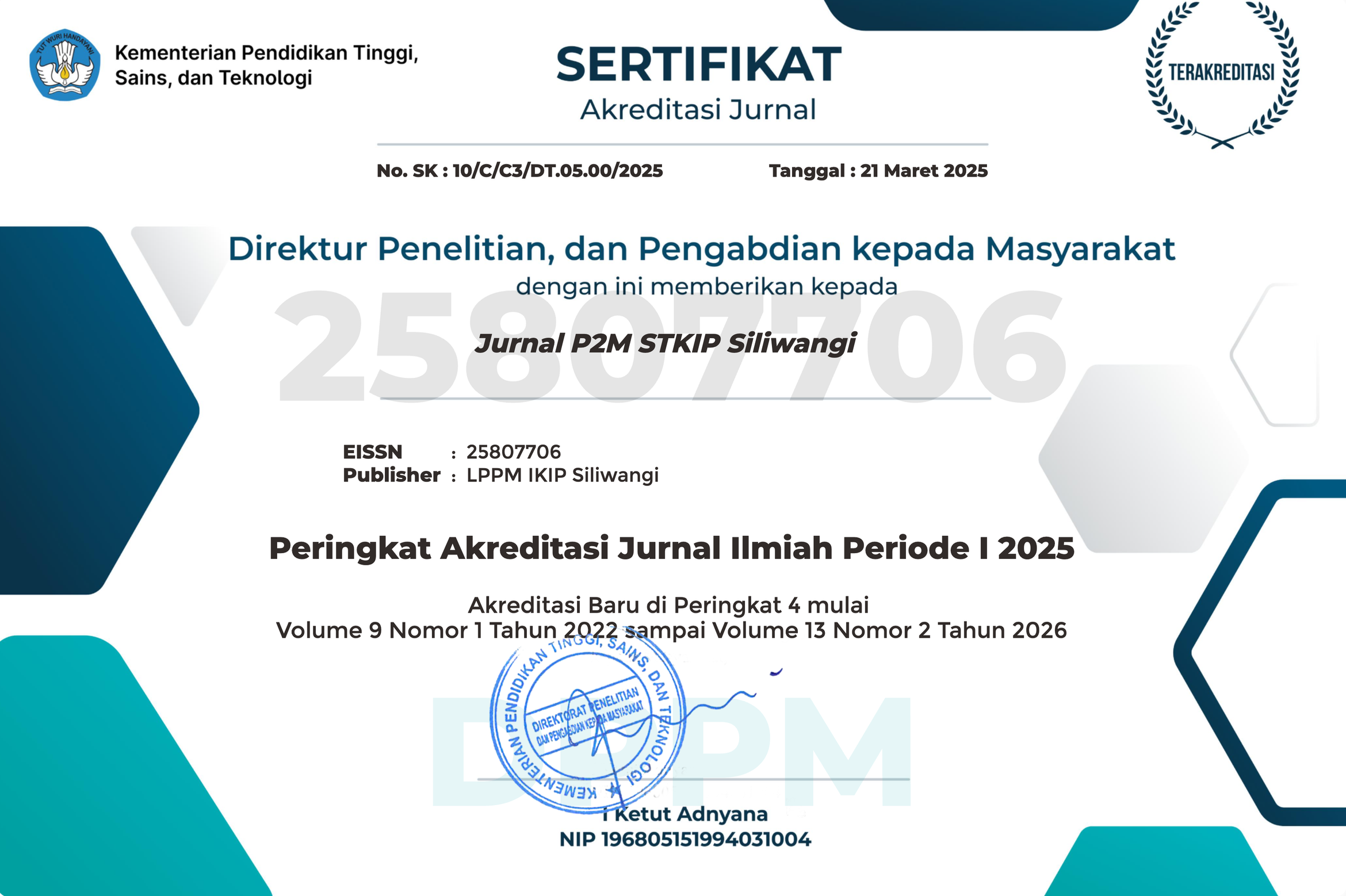
Accreditation Decree
No. 10/C/C3/DT.05.00/2025

Jurnal Ilmiah P2M STKIP Siliwangi publishes original empirical research articles in education and instructional innovation. All research articles undergo initial editorial screening and double-blind peer review before acceptance. Editorial decisions are based on scholarly merit, originality, methodological soundness, ethical integrity, and relevance to the journal’s Focus and Scope. Submission does not guarantee acceptance.
1. Initial Screening
Every submitted manuscript is first evaluated by the editor to determine whether it falls within the Focus and Scope of Jurnal Ilmiah P2M STKIP Siliwangi, follows the journal template and Author Guidelines, and is free from fundamental methodological deficiencies. Editors also check the completeness of authorship information, relevant disclosures, and research ethics statements.
Textual similarity is checked using Turnitin. The journal applies a maximum overall similarity index of 20%, subject to editorial interpretation. Editors examine the sources, extent, and nature of overlapping text, including attribution and possible redundant publication. A similarity score below 20% does not establish that a manuscript is free from plagiarism, and a higher score requires contextual assessment before an editorial decision is made.
Manuscripts that do not meet the journal’s requirements may be declined or returned to the authors for correction. Initial screening is normally completed within two weeks.
2. Double-Blind Peer Review
Manuscripts that pass initial screening are sent to at least two independent external reviewers with relevant subject or methodological expertise. These reviewers are not members of the journal’s editorial team. The identities of authors and reviewers are concealed from each other throughout the review process.
Authors must submit identifying information separately from the anonymised manuscript. Editors check the review files before assigning reviewers.
Reviewers assess originality, contribution to educational knowledge or practice, relevance, methodological rigor, quality of analysis, research ethics, and clarity of presentation. Relevant supplementary materials are included in the assessment.
Reviewers must disclose potential conflicts of interest and decline assignments when impartiality cannot be maintained. Manuscripts and review reports are confidential and must not be shared or used for personal advantage. Confidential materials must not be uploaded to public generative AI services.
The first round of external review normally takes approximately four to eight weeks. This estimate excludes author revision and production time and may vary depending on reviewer availability and manuscript complexity. Authors will be informed of substantial delays.
3. Editorial Decision
Based on the reviewers’ reports, the handling editor proposes a decision for consideration by the editorial board. The Editor-in-Chief, or an authorised independent editor when a conflict of interest exists, makes the final decision and communicates it to the corresponding author.
Reviewers provide recommendations; the final decision remains the responsibility of the editor. When recommendations differ substantially, an additional independent review may be requested.
Decision categories are:
Accept: The manuscript meets the journal’s scholarly and ethical requirements and is accepted without further substantive revision.
Accept with Revisions: The manuscript requires minor revisions that can normally be verified by the editor. Acceptance remains conditional on satisfactory completion of the required changes. Reviewers may be consulted where necessary.
Resubmit for Review: The manuscript requires major or substantial revisions and will undergo another round of peer review. An invitation to revise does not guarantee acceptance.
Reject/Decline: The manuscript does not meet the journal’s requirements and will not be published. A revised version of the rejected manuscript will not normally be reconsidered unless the editor explicitly invites a new submission. Authors may appeal the decision if they identify a material factual error, conflict of interest, or procedural irregularity.
Editorial decisions are independent of author fees, fee waivers, sponsorship, and institutional relationships. Manuscripts authored by editors or editorial board members are handled by an independent editor and undergo the same external review requirements.
4. Revision
Reviewers’ and editors’ comments are sent to the corresponding author. Revised manuscripts must normally be submitted within four weeks, together with a point-by-point response letter explaining how each comment has been addressed. Authors must provide a reasoned explanation for any recommendation not adopted.
Authors may request an extension before the revision deadline. If no revision or extension request is received, the editorial office will contact the corresponding author before closing the submission. A manuscript submitted after the submission has been closed may be treated as a new submission.
Minor revisions are normally checked by the editor. Major revisions are returned to the relevant reviewers, and further review rounds may be required.
Correspondence
All correspondence concerning manuscripts should be conducted through the journal’s online submission system or sent to [email protected].
The editor communicates with the corresponding author, who is responsible for sharing all communications with the co-authors. Authors should include the manuscript identifier in correspondence. Relevant communications conducted outside the online system are retained in the editorial record.
Appeals and complaints may be submitted through the same channels, accompanied by reasons and supporting evidence. Matters involving the handling editor are referred to an editor without a conflict of interest; complaints involving the Editor-in-Chief are referred to the publisher or another authorised independent person.
Accepted manuscripts may require further correspondence during copyediting, language editing, and layout preparation.
After Acceptance
Accepted manuscripts undergo copyediting, language editing where necessary, and layout editing. Manuscripts written in English are proofread by lecturers of the English Education Study Program, IKIP Siliwangi, without an additional language-editing charge. Any applicable article publication fee is governed separately by the journal’s Author Fees policy.
The corresponding author is asked to check and approve the galley proof before publication. Substantive changes to the research findings or conclusions require editorial assessment and may require further review.
Each published article is assigned a DOI registered with Crossref. Submission, acceptance, and publication dates are displayed in the published article. Reviewer assignments, review reports, revisions, author responses, and editorial decisions are documented in OJS.
Ethical concerns identified before or after publication are handled through the journal’s publication ethics procedures. Where warranted, the journal may issue a correction, an expression of concern, or a retraction.
Accreditation Decree
No. 10/C/C3/DT.05.00/2025