
Digital geometry worksheets with an agro-tourism context: A catalyst for rational thinking in generation alpha
##plugins.themes.bootstrap3.article.sidebar##
##plugins.themes.bootstrap3.article.main##
Abstract
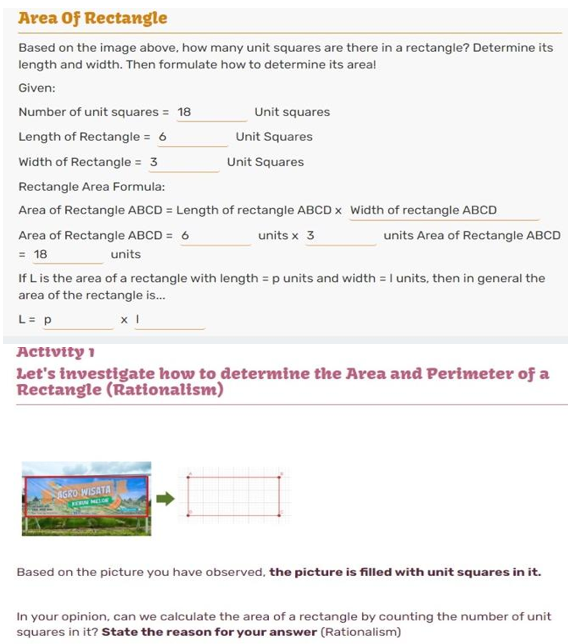
Implementing the Merdeka curriculum and strengthening character are necessary to foster rationalism in the Alpha generation, which is highly dependent on technology. One way is to develop geometry teaching materials based on the local agrotourism context, which has been proven effective in stimulating students' problem-solving skills. This study proposes to develop digital teaching materials on geometry content, grounded in the agritourism context, that are valid, practical, and effective in supporting students' rationalism in the Alpha generation in junior high school. The research method used is a design research type development study, consisting of 3 stages: the preparation phase, the prototyping phase, and the evaluation phase. The research subjects consisted of 80 seventh-grade students from SMPN 13 Palembang, representing Generation Alpha learners who are familiar with digital technology and visual-based learning. The study was conducted over one academic semester and followed the three stages of design research: preparation, prototyping, and evaluation. Data were collected through work-throughs, student interviews, and tests. The results show that digital worksheets are valid, practical, and effective, supporting students' rational thinking skills. The validity aspect was demonstrated through expert evaluations indicating that the digital worksheet met pedagogical and contextual standards, including content accuracy, alignment with learning objectives, clarity of instructions, contextual relevance, and technical presentation, with only minor revisions recommended. The practicality aspect emerged from the one-to-one and small-group trials, where students were able to use the worksheet independently, navigate the task flow clearly, and show positive engagement with the digital activities. Digital worksheets also have the following characteristics: they contain questions that encourage students to provide supporting reasons for their answers, are packaged in digital form, and are easy to use. The digital worksheets developed have been effective in supporting students' rationalism values.
##plugins.themes.bootstrap3.article.details##

This work is licensed under a Creative Commons Attribution-ShareAlike 4.0 International License.
The author is responsible for acquiring the permission(s) to reproduce any copyrighted figures, tables, data, or text that are being used in the submitted paper. Authors should note that text quotations of more than 250 words from a published or copyrighted work will require grant of permission from the original publisher to reprint. The written permission letter(s) must be submitted together with the manuscript.References
Aisyah, N. (2016). Penerapan nilai oleh guru dalam pengajaran matematik di sekolah menengah pertama Palembang [Application of grades by teachers in teaching mathematics in junior high schools in Palembang]. Dissertation. Universiti Pendidikan Sultan Idris.
Aisyah, N., Chotimah, U., & Meryansumayeka, M. (2019). Developing e-learning content based on character values in mathematics teaching and learning. Journal of Physics: Conference Series, 1166, 012016. https://doi.org/10.1088/1742-6596/1166/1/012016
Aisyah, N., Susanti, E., Meryansumayeka, M., Siswono, T. Y. E., & Maat, S. M. (2023). Proving geometry theorems: Student prospective teachers’ perseverance and mathematical reasoning. Infinity Journal, 12(2), 377–392. https://doi.org/10.22460/infinity.v12i2.p377-392
Akker, J. V. d., Bannan, B., Kelly, A. E., Nieveen, N., & Plomp, T. (2013). Educational design research part A: An introduction. SLO.
Alfaro, L., Rivera, C., Luna-Urquizo, J., Castaneda, E., Zuniga-Cueva, J., & Rivera-Chavez, M. (2021). New trends in e-technologies and e-learning. In 2021 IEEE World Conference on Engineering Education (EDUNINE), (pp. 1–6). https://doi.org/10.1109/edunine51952.2021.9429120
Angraini, L. M., Larsari, V. N., Muhammad, I., & Kania, N. (2023). Generalizations and analogical reasoning of junior high school viewed from Bruner's learning theory. Infinity Journal, 12(2), 291–306. https://doi.org/10.22460/infinity.v12i2.p291-306
Azman, O. M. N., Anom, A. R. M., Rosnita, I. I., Abd Aziz, M. F., Saifulrizan, N., & Mohamad, S. S. A. (2021). Predicting preferred learning styles on teaching approaches among Gen Z visual learner. Turkish Journal of Computer and Mathematics Education, 12(9), 2969–2978.
Baginda, M. (2018). Nilai-nilai pendidikan berbasis karakter pada pendidikan dasar dan menengah [Character-based educational values in primary and secondary education]. Jurnal Ilmiah Iqra', 10(2), 1–12. https://doi.org/10.30984/jii.v10i2.593
Bakker, A. (2018). Design research in education: A practical guide for early career researchers. Routledge. https://doi.org/10.4324/9780203701010
Barana, A. (2021). From formulas to functions through geometry: A path to understanding algebraic computations. European Journal of Investigation in Health, Psychology and Education, 11(4), 1485–1502. https://doi.org/10.3390/ejihpe11040106
Beltrán-Pellicer, P., & Godino, J. D. (2020). An onto-semiotic approach to the analysis of the affective domain in mathematics education. Cambridge Journal of Education, 50(1), 1–20. https://doi.org/10.1080/0305764x.2019.1623175
Bishop, A. J. (1991). Mathematical values in the teaching process. In A. J. Bishop, S. Mellin-Olsen, & J. Van Dormolen (Eds.), Mathematical knowledge: Its growth through teaching (pp. 193–214). Springer Netherlands. https://doi.org/10.1007/978-94-017-2195-0_10
Brieger, E., Arghode, V., & McLean, G. (2020). Connecting theory and practice: reviewing six learning theories to inform online instruction. European Journal of Training and Development, 44(4/5), 321–339. https://doi.org/10.1108/ejtd-07-2019-0116
Cesaria, A., & Herman, T. (2019). Learning obstacle in geometry. Journal of Engineering Science and Technology, 14(3), 1271–1280.
Corey, D. L., & Ninomiya, H. (2019). Values of the Japanese mathematics teacher community. In P. Clarkson, W. T. Seah, & J. Pang (Eds.), Values and valuing in mathematics education: Scanning and scoping the territory (pp. 53–67). Springer International Publishing. https://doi.org/10.1007/978-3-030-16892-6_4
Cornelius, M., & Ernest, P. (1991). The Philosophy of Mathematics Education. British Journal of Educational Studies, 39(3), 348. https://doi.org/10.2307/3121156
Darmawijoyo, D., Zulkardi, Z., Putri, R. I. I., Hapizah, H., & Syutaridho, S. (2025). How do students use mathematical reasoning to solve PISA-type mathematics problems based on making kite contexts? Infinity Journal, 14(4), 1065–1080. https://doi.org/10.22460/infinity.v14i4.p1065-1080
Davis, E. K., Carr, M. E., & Ampadu, E. (2019). Valuing in mathematics learning amongst Ghanaian students: What does it look like across grade levels? In P. Clarkson, W. Seah, & J. Pang (Eds.), Values and Valuing in Mathematics Education (pp. 89–102). Springer. https://doi.org/10.1007/978-3-030-16892-6_6
de Guzman, S. V. (2024). Elements and beyond: Content creation for nextgen learners and making Bloom’s taxonomy in action using icons. Journal of Innovative Research, 2(2), 40–52. https://doi.org/10.54536/jir.v2i2.3100
Deepa, V., Sujatha, R., & Mohan, J. (2022). Unsung voices of technology in school education-findings using the constructivist grounded theory approach. Smart learning environments, 9(1), 1–25. https://doi.org/10.1186/s40561-021-00182-7
Duman, B., & Oğuz, T. (2023). The connection of geometry learning domain of primary school mathematics lesson to everyday life in the context of curriculum elements. Education 3-13, 54(1), 107–121. https://doi.org/10.1080/03004279.2023.2288274
Duval, R. (1998). Geometry from a cognitive point of view. In C. Mammana & V. Villani (Eds.), Perspectives on the Teaching of Geometry for the 21st Century (pp. 37–52). Springer.
Fauzan, A., Harisman, Y., Yerizon, Y., Suherman, S., Tasman, F., Nisa, S., Sumarwati, S., Hafizatunnisa, H., & Syaputra, H. (2024). Realistic mathematics education (RME) to improve literacy and numeracy skills of elementary school students based on teachers’ experience. Infinity Journal, 13(2), 301–316. https://doi.org/10.22460/infinity.v13i2.p301-316
Fauziah, H. N., Arisoesilaningsih, E., & Yanuwiadi, B. (2016). Agroedutourism model to improve environmental awareness of students in some elementary school in Malang Raya, East Java. Journal of Indonesian Tourism and Development Studies, 4(1), 25–30. https://doi.org/10.21776/ub.jitode.2016.004.01.05
Fischbein, E. (1993). The theory of figural concepts. Educational Studies in Mathematics, 24(2), 139–162. https://doi.org/10.1007/BF01273689
Fitri, P., Hartono, Y., & Meryansumayeka, M. (2024). Gen Z generation's difficulties in proving trigonometric identities with the help of gpt chat. EDUKASIA: Jurnal Pendidikan dan Pembelajaran, 5(2), 169–178. https://doi.org/10.62775/edukasia.v5i2.1251
Freudenthal, H. (1991). Revisiting mathematics education: China lectures. Kluwer Academic Publishers.
Ginting, D. T., Saragi, D., & Simbolon, N. (2022). The effect of contextual learning models and learning styles on PKN learning outcomes for fifth grade students at SD negeri 157635 Aek Dakka 2 Barus, Central Tapanuli Regency. Sensei International Journal of Education and Linguistic, 2(1), 142–163.
Gravemeijer, K. (1999). How emergent models may foster the constitution of formal mathematics. Mathematical thinking and learning, 1(2), 155–177. https://doi.org/10.1207/s15327833mtl0102_4
Gravemeijer, K., & Cobb, P. (2006). Design research from a learning design perspective. In J. Van den Akker, K. Gravemeijer, S. McKenney, & N. Nieveen (Eds.), Educational design research (pp. 29–63). Routledge. https://doi.org/10.4324/9780203088364-12
Gravemeijer, K., & Terwel, J. (2000). Hans Freudenthal: A mathematician on didactics and curriculum theory. Journal of Curriculum Studies, 32(6), 777–796. https://doi.org/10.1080/00220270050167170
Grootenboer, P., & Marshman, M. (2016). The affective domain, mathematics, and mathematics education. In P. Grootenboer & M. Marshman (Eds.), Mathematics, affect and learning: Middle school students’ beliefs and attitudes about mathematics education (pp. 13–33). Springer Singapore. https://doi.org/10.1007/978-981-287-679-9_2
Harisman, Y., Dwina, F., Suherman, S., Syaputra, H., & Hafizatunnisa, H. (2025). Designing effective digital learning tools and teaching materials based on students’ mathematical literacy behavior. Infinity Journal, 14(4), 919–948. https://doi.org/10.22460/infinity.v14i4.p919-948
Hernandez-de-Menendez, M., Escobar Díaz, C. A., & Morales-Menendez, R. (2020). Educational experiences with generation Z. International Journal on Interactive Design and Manufacturing (IJIDeM), 14(3), 847–859. https://doi.org/10.1007/s12008-020-00674-9
Hidayat, W., & Aripin, U. (2023). How to develop an e-LKPD with a scientific approach to achieving students' mathematical communication abilities? Infinity Journal, 12(1), 85–100. https://doi.org/10.22460/infinity.v12i1.p85-100
Hidayat, W., Aripin, U., & Widodo, S. A. (2025). Integration of ethno-modelling and 3N: An innovative digital worksheet framework to enhance students' mathematical critical thinking skills. Infinity Journal, 14(4), 1019–1042. https://doi.org/10.22460/infinity.v14i4.p1019-1042
Hoyles, C., & Küchemann, D. (2002). Students' understandings of logical implication. Educational Studies in Mathematics, 51(3), 193–223. https://doi.org/10.1023/A:1023629608614
Hutajulu, J. M., Agustiani, H., & Setiawan, A. S. (2024). Special characteristics of alpha generation children behavior in dentistry: A literature review. European Journal of Dentistry, 18(3), 743–765. https://doi.org/10.1055/s-0043-1776336
Kader, A., & Abd. Radjak, D. (2020). Pembangunan ekonomi masyarakat melalui agrowisata [Community economic development through agrotourism]. Jurnal Inovasi Ilmu Sosial dan Politik, 2(1), 67–79. https://doi.org/10.33474/jisop.v2i1.4997
Kadonsi, K. (2025). Bridging mathematics and agriculture: An interdisciplinary approach to teaching mathematical modelling in Kalomo district. International Journal of Recent Research in Interdisciplinary Sciences, 12(1), 26–51.
Kurniansyah, M. Y., Hidayat, W., & Rohaeti, E. E. (2022). Development of combined module using contextual scientific approach to enhance students' cognitive and affective. Infinity Journal, 11(2), 349–366. https://doi.org/10.22460/infinity.v11i2.p349-366
Kurniawan, A. A., Aisyah, N., Meryansumayeka, M., Lesmana, H., & Maat, S. M. (2025). Rationalism values of junior high school students using digital media worksheets geometry content agrotourism context. Jurnal Riset Pendidikan Matematika, 12(1), 1–10. https://doi.org/10.21831/jrpm.v12i1.79818
Lakoff, G., & Núñez, R. (2000). Where mathematics comes from: How the embodied mind brings mathematics into being. Basic Books.
Lave, J., & Wenger, E. (1991). Situated learning: Legitimate peripheral participation. Cambridge university press.
Lestari, R., Prahmana, R. C. I., Chong, M. S. F., & Shahrill, M. (2023). Developing realistic mathematics education-based worksheets for improving students’ critical thinking skills. Infinity Journal, 12(1), 69–84. https://doi.org/10.22460/infinity.v12i1.p69-84
Mandala, A. S., Anwar, L., Sa'dijah, C., & Zulnaidi, H. (2025). Development of mobile augmented reality-based geometry learning games to facilitate spatial reasoning. Infinity Journal, 14(2), 323–348. https://doi.org/10.22460/infinity.v14i2.p323-348
Marin, K. A., & White, S. J. (2023). Generation Z goes to math class: How the effective mathematics teaching practices can support a new generation of learners. School Science and Mathematics, 123(1), 31–37. https://doi.org/10.1111/ssm.12565
McCrindle, M., & Fell, A. (2020). Understanding Generation Alpha. McCrindle Research.
Mendikbudristek. (2024). Peraturan menteri pendidikan, kebudayaan, riset, dan teknologi republik indonesia nomor 12 tahun 2024 tentang kurikulum pada pendidikan anak usia dini, jenjang pendidikan dasar, dan jenjang pendidikan menengah [Regulation of the Minister of Education, Culture, Research, and Technology of the Republic of Indonesia Number 12 of 2024 concerning the curriculum for early childhood education, elementary education, and secondary education]. Ministry of Education, Culture, Research, and Technology of the Republic of Indonesia.
Meryansumayeka, M., Zulkardi, Z., Putri, R. I. I., & Hiltrimartin, C. (2019). Digital mathematics tasks HOTS type: A review. Journal of Physics: Conference Series, 1315(1), 012055. https://doi.org/10.1088/1742-6596/1315/1/012055
Meryansumayeka, M., Zulkardi, Z., Putri, R. I. I., & Hiltrimartin, C. (2020). The prototype of PISA-like digital mathematical tasks. Journal of Physics: Conference Series, 1470(1), 012024. https://doi.org/10.1088/1742-6596/1470/1/012024
Meryansumayeka, M., Zulkardi, Z., Putri, R. I. I., & Hiltrimartin, C. (2022). Designing geometrical learning activities assisted with ICT media for supporting students’ higher order thinking skills. Journal on Mathematics Education, 13(1), 135–148. https://doi.org/10.22342/jme.v13i1.pp135-148
Mestanza-Ramón, C., Guapi-Guamán, F., Mazón-Fierro, G., Figueroa-Saavedra, H., & Mora-Silva, D. (2023). Sport tourism routes in the agricultural sector: A review of the importance of mathematics with a focus on sustainable development. Journal of Southwest Jiaotong University, 58(2), 697–704. https://doi.org/10.35741/issn.0258-2724.58.2.65
Mutisya, J. K., Itolondo, W. A., & Kariuki, S. I. (2021). Tutors' academic rationalism orientation on instructional approaches in primary teachers' training colleges in Kenya. Universal Journal of Educational Research, 9(2), 310–318. https://doi.org/10.13189/ujer.2021.090207
Nugroho, P. B., Nusantara, T., As’ari, A. R., Sisworo, S., Hidayanto, E., & Susiswo, S. (2018). Critical thinking disposition: Students skeptic in dealing with ill-logical mathematics problem. International Journal of Instruction, 11(3), 635–648. https://doi.org/10.12973/iji.2018.11343a
Palinussa, A. L., Tupamahu, P. Z., Sabandar, V. P., Makaruku, Y. H., & Sabandar, J. (2025). Realistic mathematics education: Mathematics e-modules in improving student learning outcomes. Infinity Journal, 14(1), 45–64. https://doi.org/10.22460/infinity.v14i1.p45-64
Parulian Sijabat, O., Dewi Gea, E., Julianci Simarmata, R., Rohana Situmorang, A., Naibaho, T., & Sitepu, S. (2022). Membangun karakter konservasi dan nilai-nilai matematika pada pendidikan matematika [Building conservation character and mathematical values in mathematics education]. Journal of Educational Learning and Innovation (ELIa), 2(2), 171–182. https://doi.org/10.46229/elia.v2i2.407
Paul, R., & Elder, L. (2020). Critical thinking: Tools for taking charge of your learning and your life. Bloomsbury Publishing.
Prahmana, R. C. I., Sagita, L., Hidayat, W., & Utami, N. W. (2020). Two decades of realistic mathematics education research in Indonesia: A survey. Infinity Journal, 9(2), 223–246. https://doi.org/10.22460/infinity.v9i2.p223-246
Prensky, M. (2010). Teaching digital natives: Partnering for real learning. Corwin press.
Ramadan, D. C., Susanti, E., Zulkardi, Z., & Meryansumayeka, M. (2025). Learning design for translation materials based on realistic mathematics education (RME) principles using the snakes and ladders game. Primatika: Jurnal Pendidikan Matematika, 14(1), 167–180.
Rufii, R. (2015). Developing module on constructivist learning strategies to promote students’ independence and performance. International Journal of Education, 7(1), 18–28. https://doi.org/10.5296/ije.v7i1.6675
Safura, N. A., Aisyah, N., Hiltrimartin, C., & Indaryanti, I. (2018). Student's mathematical value in mathematics learning using non-routine problem. Jurnal Cakrawala Pendidikan, 37(3), 400–412. https://doi.org/10.21831/cp.v38i3.19032
Santana-Ramírez, H. F., Salgado-Beltrán, G., García-García, J., & López-González, A. (2025). Alternative conceptions about proportional reasoning in high school students. Infinity Journal, 14(3), 781–796. https://doi.org/10.22460/infinity.v14i3.p781-796
Selwyn, N. (2021). Education and technology: Key issues and debates. Bloomsbury Publishing.
Siregar, G. M. A., Wahyudin, W., & Herman, T. (2025). Case study in a grounded theory perspective: Students' reasoning abilities in Lithner's framework across self-regulated. Infinity Journal, 14(1), 259–282. https://doi.org/10.22460/infinity.v14i1.p259-282
Sutarni, S., Sutama, S., Prayitno, H. J., Sutopo, A., & Laksmiwati, P. A. (2024). The development of realistic mathematics education-based student worksheets to enhance higher-order thinking skills and mathematical ability. Infinity Journal, 13(2), 285–300. https://doi.org/10.22460/infinity.v13i2.p285-300
Tak, C. C., Zulnaidi, H., & Eu, L. K. (2025). Factors influencing the attitude of undergraduate students towards mathematical reasoning: An approach using AMOS-structural equation modelling. Infinity Journal, 14(1), 109–124. https://doi.org/10.22460/infinity.v14i1.p109-124
Tatsis, K., & Koleza, E. (2008). Social and socio‐mathematical norms in collaborative problem‐solving. European Journal of Teacher Education, 31(1), 89–100. https://doi.org/10.1080/02619760701845057
van Galen, F., & van Eerde, D. (2019). Mathematical investigations for primary school. Utrecht: Utrecht University.
Wijaya, A., Van den Heuvel-Panhuizen, M., Doorman, M., & Veldhuis, M. (2018). Opportunity-to-learn to solve context-based mathematics tasks and students’ performance in solving these tasks – Lessons from Indonesia. Eurasia Journal of Mathematics, Science and Technology Education, 14(10), em1598. https://doi.org/10.29333/ejmste/93420
Yerizon, Y., Arnellis, A., Suherman, S., Arnawa, I. M., Sa'dijah, C., & Anwar, L. (2025). Developing adaptive digital book (ADB) in enhancing students’ numeracy literacy ability. Infinity Journal, 14(3), 571–586. https://doi.org/10.22460/infinity.v14i3.p571-586
Zengin, Y. (2022). Construction of proof of the Fundamental Theorem of Calculus using dynamic mathematics software in the calculus classroom. Education and Information Technologies, 27(2), 2331–2366. https://doi.org/10.1007/s10639-021-10666-1
Zhang, Q. (2019). Values in mathematics learning: Perspectives of Chinese mainland primary and secondary students. In P. Clarkson, W. T. Seah, & J. Pang (Eds.), Values and valuing in mathematics education: Scanning and scoping the territory (pp. 185–196). Springer International Publishing. https://doi.org/10.1007/978-3-030-16892-6_13
Ziatdinov, R., & Cilliers, J. (2021). Generation alpha: Understanding the next cohort of university students. European Journal of Contemporary Education, 10(3), 783–789. https://doi.org/10.13187/ejced.2021.3.783
Zulkardi, Z., Meryansumayeka, M., Putri, R. I. I., Alwi, Z., Nusantara, D. S., Ambarita, S. M., Maharani, Y., & Puspitasari, L. (2020). How students work with PISA-like mathematical tasks using COVID-19 context. Journal on Mathematics Education, 11(3), 405–416. https://doi.org/10.22342/jme.11.3.12915.405-416
Zulkardi, Z., & Putri, R. I. I. (2019). New school mathematics curricula, PISA and PMRI in Indonesia. In C. P. Vistro-Yu & T. L. Toh (Eds.), School mathematics curricula: Asian perspectives and glimpses of reform (pp. 39–49). Springer Singapore. https://doi.org/10.1007/978-981-13-6312-2_3
Zwart, D. P., Noroozi, O., Van Luit, J. E. H., Goei, S. L., & Nieuwenhuis, A. (2020). Effects of digital learning materials on nursing students’ mathematics learning, self-efficacy, and task value in vocational education. Nurse Education in Practice, 44, 102755. https://doi.org/10.1016/j.nepr.2020.102755