
Interactivity and accessibility in TPACK-integrated e-learning to enhance the quality of calculus learning
##plugins.themes.bootstrap3.article.sidebar##
##plugins.themes.bootstrap3.article.main##
Abstract
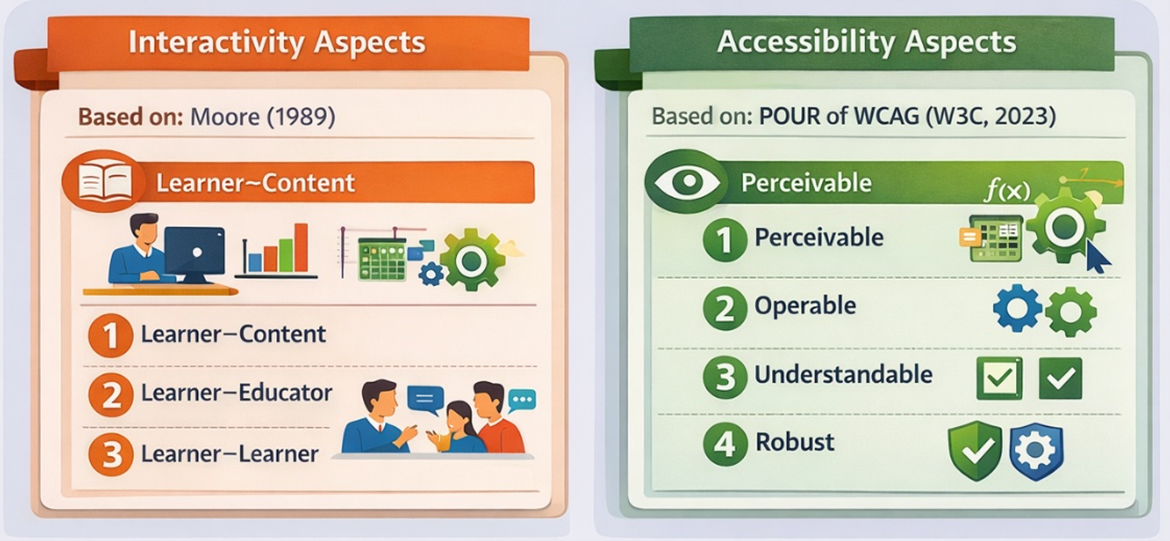
The quality of Calculus learning in higher education remains a challenge, as instructional practices tend to be predominantly procedure-oriented, thereby limiting opportunities for meaningful learning interactions and for concept visualization that supports conceptual understanding. This study aims to examine content validity and learning effectiveness in Calculus instruction through TPACK-integrated e-learning. The research employed a Research and Development (R&D) approach using the ADDIE model (Analyze, Design, Develop, Implement, and Evaluate. The developed instrument consisted of 20 items encompassing interactivity aspects across three dimensions and accessibility aspects based on four principles. Content validation was conducted by three experts using Aiken’s V index. The results indicated that all instrument items were content-valid and were categorized as relevant to highly relevant. Furthermore, the effectiveness test results showed that the proportion of students achieving classical mastery exceeded the established threshold, and students’ learning improvement fell into the high category. Additionally, the effect size analysis shows that implementing TPACK-integrated e-learning has a very strong impact on students’ understanding. These findings confirm that TPACK-integrated e-learning is not only valid and effective but also has a substantial impact on enhancing the quality of Calculus learning in higher education.
##plugins.themes.bootstrap3.article.details##

This work is licensed under a Creative Commons Attribution-ShareAlike 4.0 International License.
The author is responsible for acquiring the permission(s) to reproduce any copyrighted figures, tables, data, or text that are being used in the submitted paper. Authors should note that text quotations of more than 250 words from a published or copyrighted work will require grant of permission from the original publisher to reprint. The written permission letter(s) must be submitted together with the manuscript.References
Aiken, L. R. (1985). Three coefficients for analyzing the reliability and validity of ratings. Educational and Psychological Measurement, 45(1), 131–142. https://doi.org/10.1177/0013164485451012
Al-Azawei, A., Serenelli, F., & Lundqvist, K. (2016). Universal design for learning (UDL): A content analysis of peer reviewed journals from 2012 to 2015. Journal of the Scholarship of Teaching and Learning, 16(3), 39–56. https://doi.org/10.14434/josotl.v16i3.19295
Anderson, T. (2008). The theory and practice of online learning. Athabasca University Press.
Ausubel, D. P. (2000). The acquisition and retention of knowledge: A cognitive view. Springer. https://doi.org/10.1007/978-94-015-9454-7
Bond, M. (2020). Facilitating student engagement through the flipped learning approach in K-12: A systematic review. Computers & Education, 151, 103819. https://doi.org/10.1016/j.compedu.2020.103819
Borba, M. C., Askar, P., Engelbrecht, J., Gadanidis, G., Llinares, S., & Aguilar, M. S. (2016). Blended learning, e-learning and mobile learning in mathematics education. Zdm, 48(5), 589–610. https://doi.org/10.1007/s11858-016-0798-4
Branch, R. M. (2009). Instructional design: The ADDIE approach. Springer. https://doi.org/10.1007/978-0-387-09506-6
Burgstahler, S. E. (2020). Creating inclusive learning opportunities in higher education: A universal design toolkit. Harvard Education Press Cambridge, MA.
Çam, Ş. S., & Koç, G. (2024). Professional development program to develop teacher educators’ technological pedagogical content knowledge. SAGE Open, 14(2), 1–14. https://doi.org/10.1177/21582440241242841
Chai, C. S., Jong, M., & Yan, Z. (2020). Surveying Chinese teachers' technological pedagogical STEM knowledge: a pilot validation of STEM-TPACK survey. International Journal of Mobile Learning and Organisation, 14(2), 203–214. https://doi.org/10.1504/ijmlo.2020.106181
Chai, C. S., Jong, M., Yin, H.-b., Chen, M., & Zhou, W. (2019). Validating and modelling teachers’ technological pedagogical content knowledge for integrative science, technology, engineering and Mathematics education. Journal of Educational Technology & Society, 22(3), 61–73.
Clark, R. C., & Mayer, R. E. (2023). E-learning and the science of instruction: Proven guidelines for consumers and designers of multimedia learning. Performance Improvement, 42(5), 41–43.
Cohen, J. (2013). Statistical power analysis for the behavioral sciences (2nd ed.). Routledge. https://doi.org/10.4324/9780203771587
Field, A. (2024). Discovering statistics using IBM SPSS statistics. Sage.
Fiorella, L., & Mayer, R. E. (2015). Learning as a generative activity: Eight learning strategies that promote understanding. Cambridge University Press. https://doi.org/10.1017/cbo9781107707085
Hake, R. R. (1998). Interactive-engagement versus traditional methods: A six-thousand-student survey of mechanics test data for introductory physics courses. American Journal of Physics, 66(1), 64–74. https://doi.org/10.1119/1.18809
Hamid, H., Nani, K. L., Wahyudi, D., Muchsin, S. B., & Ruhama, M. A. H. (2025). Mathematical self-explanation of first-year students at the state university of North Maluku through the utilization of GeoGebra. Educational Process International Journal, 17(1), e2025331. https://doi.org/10.22521/edupij.2025.17.331
Hattie, J., & Timperley, H. (2007). The power of feedback. Review of Educational Research, 77(1), 81–112. https://doi.org/10.3102/003465430298487
Haynes, S. N., Richard, D. C. S., & Kubany, E. S. (1995). Content validity in psychological assessment: A functional approach to concepts and methods. Psychological Assessment, 7(3), 238–247. https://doi.org/10.1037/1040-3590.7.3.238
Hernandez-de-Menendez, M., Escobar Díaz, C., & Morales-Menendez, R. (2020). Technologies for the future of learning: state of the art. International Journal on Interactive Design and Manufacturing (IJIDeM), 14(2), 683–695. https://doi.org/10.1007/s12008-019-00640-0
Järvelä, S., Kirschner, P. A., Hadwin, A., Järvenoja, H., Malmberg, J., Miller, M., & Laru, J. (2016). Socially shared regulation of learning in CSCL: understanding and prompting individual- and group-level shared regulatory activities. International Journal of Computer-Supported Collaborative Learning, 11(3), 263–280. https://doi.org/10.1007/s11412-016-9238-2
Johnson, D. W., & Johnson, R. T. (2014). Cooperative learning in 21st century. Anales de Psicología, 30(3), 841–851. https://doi.org/10.6018/analesps.30.3.201241
Kelly, B., Phipps, L., & Swift, E. (2004). Developing a holistic approach for e-learning accessibility. Canadian Journal of Learning and Technology / La revue canadienne de l’apprentissage et de la technologie, 30(3). https://doi.org/10.21432/t2d60s
Koehler, M. J., Mishra, P., & Cain, W. (2017). What is technological pedagogical content knowledge (TPACK)? Journal of Education, 193(3), 13–19. https://doi.org/10.1177/002205741319300303
Liu, C., & Correia, A.-P. (2021). A case study of learners’ engagement in mobile learning applications. Online Learning, 25(4), 25–48. https://doi.org/10.24059/olj.v25i4.2827
Martin, F., & Bolliger, D. U. (2018). Engagement matters: Student perceptions on the importance of engagement strategies in the online learning environment. Online Learning, 22(1), 205–222. https://doi.org/10.24059/olj.v22i1.1092
Martin, F., Sun, T., & Westine, C. D. (2020). A systematic review of research on online teaching and learning from 2009 to 2018. Computers & Education, 159, 104009. https://doi.org/10.1016/j.compedu.2020.104009
Mayer, R. (2020). Multimedia learning (3rd ed.). Cambridge University Press. https://doi.org/10.1017/9781316941355
Mishra, P., & Koehler, M. J. (2006). Technological pedagogical content knowledge: A framework for teacher knowledge. Teachers College Record: The Voice of Scholarship in Education, 108(6), 1017–1054. https://doi.org/10.1111/j.1467-9620.2006.00684.x
Moore, M. G. (1989). Editorial: Three types of interaction. American Journal of Distance Education, 3(2), 1–7. https://doi.org/10.1080/08923648909526659
Moreno, R., & Mayer, R. (2007). Interactive multimodal learning environments. Educational Psychology Review, 19(3), 309–326. https://doi.org/10.1007/s10648-007-9047-2
Orton, A. (1983). Students' understanding of differentiation. Educational Studies in Mathematics, 14(3), 235–250. https://doi.org/10.1007/bf00410540
Paas, F., Renkl, A., & Sweller, J. (2003). Cognitive load theory and instructional design: Recent developments. Educational Psychologist, 38(1), 1–4. https://doi.org/10.1207/s15326985ep3801_1
Phillips, H. N. (2023). Developing critical thinking in classrooms: Teacher responses to a reading-for-meaning workshop. Reading & Writing, 14(1), a401. https://doi.org/10.4102/rw.v14i1.401
Retnawati, H. (2016). Analisis kuantitatif instrumen penelitian (panduan peneliti, mahasiswa, dan psikometrian) [Quantitative analysis of research instruments (guide for researchers, students, and psychometricians)]. Parama publishing.
Schmid, M., Brianza, E., & Petko, D. (2020). Developing a short assessment instrument for Technological Pedagogical Content Knowledge (TPACK.xs) and comparing the factor structure of an integrative and a transformative model. Computers & Education, 157, 103967. https://doi.org/10.1016/j.compedu.2020.103967
Schmid, M., Brianza, E., & Petko, D. (2021). Self-reported technological pedagogical content knowledge (TPACK) of pre-service teachers in relation to digital technology use in lesson plans. Computers in human Behavior, 115, 106586. https://doi.org/10.1016/j.chb.2020.106586
Seale, J. (2013). E-learning and disability in higher education (2nd ed.). Routledge. https://doi.org/10.4324/9780203095942
Slavin, R. E. (1995). Cooperative learning: Theory, research and practice. Boston. Ally Bacon.
Stewart, J. (2016). Calculus: Early transcendentals (8th ed.). Cengage Learning.
Sugiyono, S. (2017). Metode penelitian bisnis: pendekatan kuantitatif, kualitatif, kombinasi, dan R&D [Business research methods: quantitative, qualitative, combination, and R&D approaches]. Alfabeta.
Sweller, J. (2020). Cognitive load theory and educational technology. Educational Technology Research and Development, 68(1), 1–16. https://doi.org/10.1007/s11423-019-09701-3
Tall, D. (1993). Students’ difficulties in calculus. In Proceedings of working group, ICME-7, (pp. 13–28).
Vygotsky, L. S. (1978). Mind in society: The development of higher psychological processes. Harvard university press.
World Wide Web Consortium. (2023). Web Content Accessibility Guidelines (WCAG) 2.2. World Wide Web Consortium (W3C). https://www.w3.org/TR/WCAG22
Zhou, X., & Tsai, C.-W. (2023). The effects of socially shared regulation of learning on the computational thinking, motivation, and engagement in collaborative learning by teaching. Education and Information Technologies, 28(7), 8135–8152. https://doi.org/10.1007/s10639-022-11527-1