
Knowledge retention of students learning mathematics with culture and technology: A study of junior high school students
##plugins.themes.bootstrap3.article.sidebar##
##plugins.themes.bootstrap3.article.main##
Abstract
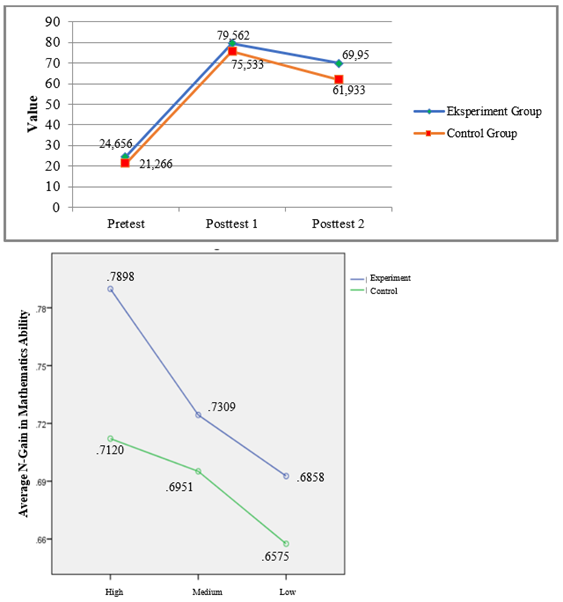
The transition from Pedagogical Content Knowledge (PCK) to Technological-Pedagogical-Content Knowledge (TPACK) underscores the need for a more meaningful integration of technology into mathematics teaching. Yet, this paradigm shift has not been accompanied by substantial gains in students' conceptual understanding and mathematical problem-solving skills, which are the central focus of the present study. The purpose of this study is 1) to describe the differences in the increase in students' mathematical ability (conceptual understanding and problem solving) in culture and technology-based learning and conventional learning, and 2) to describe the effects of both types of learning on student knowledge retention. This study is a quasi-experimental study comparing culture- and technology-based learning and conventional learning. The instrument used in this study is a mathematical ability test (pretest and posttest). Data analysis uses a difference-of-means test (N-Gain), t-test, two-way ANOVA, and MANOVA. The results show that the average increase in the culture and technology-based learning group is higher than that in the conventional learning group and is significantly different. There is a significant interaction effect between learning and mathematical ability (p<0.05, effect size λ = 0.996), the main effects of time periods pretest, posttest-1, & posttest-2 were significant (p< 0.05, effect size λ = 0.217), the main effects of mathematical ability on culture and technology based learning and conventional learning were also significant (p< 0.05, effect size λ = 0.215). These findings suggest that integrating technology and culture is an effective approach for providing a positive learning experience that promotes improved mathematical skills and longer-term knowledge retention. This sustained information retention is important for educational practice because it enables students to transfer and apply the concepts they have learned to future learning situations.
##plugins.themes.bootstrap3.article.details##

This work is licensed under a Creative Commons Attribution-ShareAlike 4.0 International License.
The author is responsible for acquiring the permission(s) to reproduce any copyrighted figures, tables, data, or text that are being used in the submitted paper. Authors should note that text quotations of more than 250 words from a published or copyrighted work will require grant of permission from the original publisher to reprint. The written permission letter(s) must be submitted together with the manuscript.References
Alptekin, Z., & Taneri, A. (2025). Technology ıntegration in pedagogical processes: digital competence and teaching practices of primary school teachers in Turkey. Discover Education, 4(1), 351. https://doi.org/10.1007/s44217-025-00646-9
Anderson-Pence, K. (2015). Ethnomathematics: The role of culture in the teaching and learning of mathematics. Utah Mathematics Teacher, 3(2), 52–60.
Averill, R., Anderson, D., Easton, H., Maro, P. T., Smith, D., & Hynds, A. (2009). Culturally responsive teaching of mathematics: Three models from linked studies. Journal for Research in Mathematics Education JRME, 40(2), 157–186. https://doi.org/10.2307/40539330
Barton, B. (2008). The language of mathematics: Telling mathematical tales. Springer. https://doi.org/10.1007/978-0-387-72859-9
Bishop, A. (1991). Mathematical enculturation: A cultural perspective on mathematics education. Springer.
Cheung, A. C. K., & Slavin, R. E. (2013). The effectiveness of educational technology applications for enhancing mathematics achievement in K-12 classrooms: A meta-analysis. Educational Research Review, 9, 88–113. https://doi.org/10.1016/j.edurev.2013.01.001
D'Ambrósio, U. (2006). Ethnomathematics: Link between traditions and modernity. Sense Publishers.
Drijvers, P., Doorman, M., Boon, P., Reed, H., & Gravemeijer, K. (2010). The teacher and the tool: instrumental orchestrations in the technology-rich mathematics classroom. Educational Studies in Mathematics, 75(2), 213–234. https://doi.org/10.1007/s10649-010-9254-5
Forgasz, H. J., & Leder, G. C. (2008). Beliefs about mathematics and mathematics teaching. In P. Sullivan & T. Wood (Eds.), Knowledge and beliefs in mathematics teaching and teaching development (pp. 173–192). Sense Publishers.
Gerdes, P. (1998). On culture and mathematics teacher education. Journal of Mathematics Teacher Education, 1(1), 33–53. https://doi.org/10.1023/A:1009955031429
Hake, R. R. (1999). Analyzing change/gain scores. Measurement and Reasearch Methodology, 1(4), 48–56.
Hidayat, W., Aripin, U., & Widodo, S. A. (2025). Integration of ethno-modelling and 3N: An innovative digital worksheet framework to enhance students' mathematical critical thinking skills. Infinity Journal, 14(4), 1019–1042. https://doi.org/10.22460/infinity.v14i4.p1019-1042
Hmelo-Silver, C. E. (2004). Problem-based learning: What and how do students learn? Educational Psychology Review, 16(3), 235–266. https://doi.org/10.1023/B:EDPR.0000034022.16470.f3
Hong, J.-C., Hwang, M.-Y., Liu, M.-C., Ho, H.-Y., & Chen, Y.-L. (2014). Using a “prediction–observation–explanation” inquiry model to enhance student interest and intention to continue science learning predicted by their Internet cognitive failure. Computers & Education, 72, 110–120. https://doi.org/10.1016/j.compedu.2013.10.004
Hoyles, C., & Lagrange, J.-B. (2010). Mathematics Education and Technology-Rethinking the Terrain. Springer. https://doi.org/10.1007/978-1-4419-0146-0
Hyde, J. S., Lindberg, S. M., Linn, M. C., Ellis, A. B., & Williams, C. C. (2008). Gender similarities characterize math performance. Science, 321(5888), 494–495. https://doi.org/10.1126/science.1160364
Koehler, M. J., Mishra, P., Kereluik, K., Shin, T. S., & Graham, C. R. (2014). The technological pedagogical content knowledge framework. In J. Spector, M. Merrill, J. Elen, & M. Bishop (Eds.), Handbook of Research on Educational Communications and Technology (pp. 101–111). Springer. https://doi.org/10.1007/978-1-4614-3185-5_9
Leton, S. I., Lakapu, M., Dosinaeng, W. B. N., & Fitriani, N. (2025). Integrating local wisdoms for improving students’ mathematical literacy: The promising context in learning whole numbers. Infinity Journal, 14(2), 369–392. https://doi.org/10.22460/infinity.v14i2.p369-392
Li, Q., & Ma, X. (2010). A meta-analysis of the effects of computer technology on school students’ mathematics learning. Educational Psychology Review, 22(3), 215–243. https://doi.org/10.1007/s10648-010-9125-8
Makgato, M., & Ramaligela, S. M. (2012). Teachers' criteria for selecting textbooks for the technology subject. African Journal of Research in Mathematics, Science and Technology Education, 16(1), 32–44. https://doi.org/10.1080/10288457.2012.10740727
Mishra, P., & Koehler, M. J. (2006). Technological pedagogical content knowledge: A framework for teacher knowledge. Teachers College Record: The Voice of Scholarship in Education, 108(6), 1017–1054. https://doi.org/10.1111/j.1467-9620.2006.00684.x
Nasir, N. i. S., Hand, V., & Taylor, E. V. (2008). Culture and mathematics in school: Boundaries between “cultural” and “domain” knowledge in the mathematics classroom and beyond. Review of Research in Education, 32(1), 187–240. https://doi.org/10.3102/0091732x07308962
National Research Council. (2012). Education for life and work: Developing transferable knowledge and skills in the 21st century. The National Academies Press. https://doi.org/10.17226/13398
OECD. (2018). The future of education and skills: Education 2030. OECD Publishing.
Pierce, R., & Stacey, K. (2010). Mapping pedagogical opportunities provided by mathematics analysis software. International Journal of Computers for Mathematical Learning, 15(1), 1–20. https://doi.org/10.1007/s10758-010-9158-6
Radford, L. (2014). Towards an embodied, cultural, and material conception of mathematics cognition. Zdm, 46(3), 349–361. https://doi.org/10.1007/s11858-014-0591-1
Rosa, M., & Orey, D. (2011). Ethnomathematics: The cultural aspects of mathematics. Revista Latinoamericana de Etnomatemática: Perspectivas Socioculturales de La Educación Matemática, 4(2), 32–54.
Ruthven, K., Deaney, R., & Hennessy, S. (2009). Using graphing software to teach about algebraic forms: a study of technology-supported practice in secondary-school mathematics. Educational Studies in Mathematics, 71(3), 279–297. https://doi.org/10.1007/s10649-008-9176-7
Samo, D. D. (2019). Higher-order thinking ability among university students: how does culture-based contextual learning with Geogebra affect it? International Journal of Innovation, Creativity and Change, 5(3), 94–115.
Samo, D. D., Darhim, D., & Kartasasmita, B. G. (2018). Culture-based contextual learning to increase problem-solving ability of first year university student. Journal on Mathematics Education, 9(1), 81–94.
Sartika, N. S., Ditasona, C., Hakim, Z., & Permatasari, P. (2025). TPACK framework: Impact on high school mathematics instruction. International Journal of Computational and Experimental Science and Engineering, 11(3), 4686–4698. https://doi.org/10.22399/ijcesen.2830
Schmid, M., Brianza, E., & Petko, D. (2020). Developing a short assessment instrument for technological pedagogical content knowledge (TPACK.xs) and comparing the factor structure of an integrative and a transformative model. Computers & Education, 157, 103967. https://doi.org/10.1016/j.compedu.2020.103967
Shulman, L. S. (2015). PCK: Its genesis and exodus. In A. Berry, P. Friedrichsen, & J. Loughran (Eds.), Re-examining pedagogical content knowledge in science education (pp. 3–13). Routledge.
Smiling, J., & Hollebrands, K. (2025). Examining the effect of active participation on the TPACK knowledge of mathematics educators in a teaching mathematics with technology MOOC. International Journal of Educational Research Open, 9, 100469. https://doi.org/10.1016/j.ijedro.2025.100469
Theophilou, E., Hernández‐Leo, D., & Gómez, V. (2024). Gender‐based learning and behavioural differences in an educational social media platform. Journal of Computer Assisted Learning, 40(6), 2544–2557. https://doi.org/10.1111/jcal.12927
Trilling, B., & Fadel, C. (2009). 21st century skills: Learning for life in our times. John Wiley & Sons.
Utami, W. B., Aulia, F., Permatasari, D., Taqiyuddin, M., & Widodo, S. A. (2022). Ketupat Eid tradition of the north coast of Java as an alternative mathematics learning media. Infinity Journal, 11(1), 177–192. https://doi.org/10.22460/infinity.v11i1.p177-192
Voogt, J., Fisser, P., Pareja Roblin, N., Tondeur, J., & van Braak, J. (2013). Technological pedagogical content knowledge – A review of the literature. Journal of Computer Assisted Learning, 29(2), 109–121. https://doi.org/10.1111/j.1365-2729.2012.00487.x
Voogt, J., & Roblin, N. P. (2012). A comparative analysis of international frameworks for 21st century competences: Implications for national curriculum policies. Journal of Curriculum Studies, 44(3), 299–321. https://doi.org/10.1080/00220272.2012.668938
Wijaya, T. T., Hidayat, W., Hermita, N., Alim, J. A., & Talib, C. A. (2024). Exploring contributing factors to PISA 2022 mathematics achievement: Insights from Indonesian teachers. Infinity Journal, 13(1), 139–156. https://doi.org/10.22460/infinity.v13i1.p139-156