
Integrating augmented reality and local wisdom in teaching exponents: A strategy to improve students’ mathematical literacy
##plugins.themes.bootstrap3.article.sidebar##
##plugins.themes.bootstrap3.article.main##
Abstract
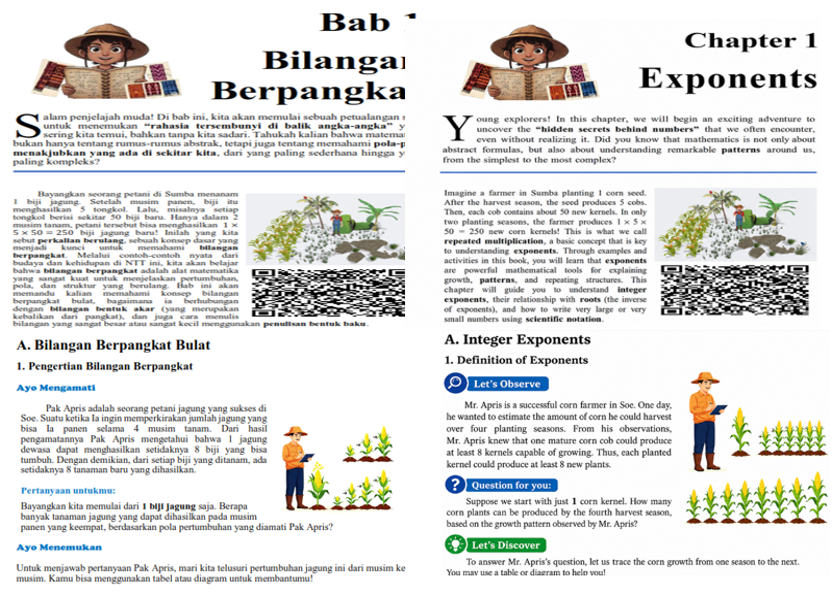
Developing mathematical literacy in exponent learning requires students to connect authentic experiences, representations, and mathematical ideas. This study developed and evaluated Augmented Reality (AR)-enhanced instructional materials using local wisdom as an authentic context and AR as a pedagogical mediator. A Research and Development design following the ADDIE model was employed. The materials were validated by 11 mathematics teachers, and the literacy assessment was reviewed by two teachers. A limited implementation involved 72 eighth-grade students from two junior secondary schools in Kupang, Indonesia. Data were collected through validation sheets, questionnaires, observations, and pretest–posttest assessments. Mean validation scores were 3.55 out of 4.00 for content, 3.60 for media, and 3.25 for the assessment instrument. Student and teacher practicality scores were 81.10% and 96%, respectively. Students’ mean mathematical literacy score increased from 58.72 (SD = 12.64) to 82.57 (SD = 11.80), t(71) = 20.63, p < 0.001, with a very large within-group effect size (Cohen’s dz = 2.43) and a moderate N-gain of 0.60. These findings indicate that integrating local wisdom and AR offers a valid, practical, and promising pedagogical mechanism for supporting mathematical literacy in exponent learning.
##plugins.themes.bootstrap3.article.details##

This work is licensed under a Creative Commons Attribution-ShareAlike 4.0 International License.
The author is responsible for acquiring the permission(s) to reproduce any copyrighted figures, tables, data, or text that are being used in the submitted paper. Authors should note that text quotations of more than 250 words from a published or copyrighted work will require grant of permission from the original publisher to reprint. The written permission letter(s) must be submitted together with the manuscript.References
Bujak, K. R., Radu, I., Catrambone, R., MacIntyre, B., Zheng, R., & Golubski, G. (2013). A psychological perspective on augmented reality in the mathematics classroom. Computers & Education, 68, 536–544. https://doi.org/10.1016/j.compedu.2013.02.017
Cai, S., Liu, E., Shen, Y., Liu, C., Li, S., & Shen, Y. (2019). Probability learning in mathematics using augmented reality: impact on student’s learning gains and attitudes. Interactive Learning Environments, 28(5), 560–573. https://doi.org/10.1080/10494820.2019.1696839
D'Ambrosio, U. (1985). Ethnomathematics and its place in the history and pedagogy of mathematics. For the learning of Mathematics, 5(1), 44–48. https://flm-journal.org/Articles/72AAA4C74C1AA8F2ADBC208D7E391C.pdf
Flavin, E., Hwang, S., & Flavin, M. T. (2025). Augmented reality for mathematics achievement: A meta-analysis of main and moderator effects. International Journal of Science and Mathematics Education, 23(7), 2305–2330. https://doi.org/10.1007/s10763-025-10546-x
Freudenthal, H. (1973). Mathematics as an educational task. Springer Dordrecht. https://doi.org/10.1007/978-94-010-2903-2
Hendriana, H., Ristiana, N., Kusaka, S., Peni, N. R. N., & Prahmana, R. C. I. (2025). Integrating indigenous number systems and indefinite units into mathematics learning: A study on Javanese language and culture. Infinity Journal, 14(3), 797–816. https://doi.org/10.22460/infinity.v14i3.p797-816
Iffah, R. D. L., Subanti, S., Usodo, B., & Nurhasanah, F. (2025). Systematic literature review: Ethnomathematics research in Indonesia. JRAMathEdu (Journal of Research and Advances in Mathematics Education), 10(1), 28–40. https://doi.org/10.23917/jramathedu.v10i1.5621
İslim, Ö. F., Namlı, Ş., Sevim, N., Özçakır, B., & Lavicza, Z. (2024). Augmented reality in mathematics education: A systematic review. Participatory Educational Research, 11(4), 115–139. https://doi.org/10.17275/per.24.52.11.4
Kappassova, S., Abylkassymova, A., Bulut, U., Zykrina, S., Zhumagulova, Z., & Balta, N. (2025). Mathematical literacy and its influencing factors: A decade of research findings (2015-2024). Eurasia Journal of Mathematics, Science and Technology Education, 21(7), em2671. https://doi.org/10.29333/ejmste/16615
Kusumanegara, M. R., Suryadi, D., & Puspita, E. (2024). Concept image siswa pada materi eksponen dan sifat-sifatnya: Sebuah kajian fenomenologi-hermeneutis [Students' concept image on the material of exponents and their properties: A phenomenological-hermeneutical study]. Journal on Mathematics Education Research (J-MER), 5(2), 125–140. https://doi.org/10.17509/j-mer.v5i2.79090
Labuem, S., Sa'dijah, C., Parta, I. N., & Sulandra, I. M. (2026). Aru ethnomathematics: Exploration of mathematical concepts in Daret Damar Jan game and its integration in mathematics learning in elementary school. Infinity Journal, 15(1), 133–158. https://doi.org/10.22460/infinity.v15i1.p133-158
Leton, S. I., Lakapu, M., Dosinaeng, W. B. N., & Fitriani, N. (2025). Integrating local wisdoms for improving students’ mathematical literacy: The promising context in learning whole numbers. Infinity Journal, 14(2), 369–392. https://doi.org/10.22460/infinity.v14i2.p369-392
Mayer, R. (2020). Multimedia learning (3rd ed.). Cambridge University Press. https://doi.org/10.1017/9781316941355
Nindiasari, H., Pranata, M. F., Sukirwan, S., Sugiman, S., Fathurrohman, M., Ruhimat, A., & Yuhana, Y. (2024). The use of augmented reality to improve students' geometry concept problem-solving skills through the STEAM approach. Infinity Journal, 13(1), 119–138. https://doi.org/10.22460/infinity.v13i1.p119-138
Nurcahyo, A., Ishartono, N., Pratiwi, A. Y. C., & Waluyo, M. (2024). Exploration of mathematical concepts in Batik Truntum Surakarta. Infinity Journal, 13(2), 457–476. https://doi.org/10.22460/infinity.v13i2.p457-476
Nursyahidah, F., Wardono, W., Mariani, S., & Wijayanti, K. (2025). Integrating technology, ethnomathematics, and realistic mathematics education in learning statistics: A learning trajectory. Infinity Journal, 14(3), 633–654. https://doi.org/10.22460/infinity.v14i3.p633-654
OECD. (2023). PISA 2022 assessment and analytical framework. OECD Publishing. https://doi.org/10.1787/dfe0bf9c-en
Prahmana, R. C. I., Risdiyanti, I., Peni, N. R. N., Kusaka, S., Khairullah, K., Ramadhani, R., Khasanah, B. A., & Pepkolaj, L. (2026). Cultural heritage as a mathematical context: Interpretation of set theory in spatial layout of Prambanan temple. Infinity Journal, 15(2), 421–438. https://doi.org/10.22460/infinity.v15i2.p421-438
Pratama, R. A., & Yelken, T. Y. (2024). Effectiveness of ethnomathematics-based learning on students’ mathematical literacy: a meta-analysis study. Discover Education, 3(1), 202. https://doi.org/10.1007/s44217-024-00309-1
Rodríguez-Nieto, C. A., Pabón-Navarro, M. L., Cantillo-Rudas, B. M., Sudirman, S., & Font Moll, V. (2025). The potential of ethnomathematical and mathematical connections in the pre-service mathematics teachers’ meaningful learning when problems-solving about brick-making. Infinity Journal, 14(2), 419–444. https://doi.org/10.22460/infinity.v14i2.p419-444
Schutera, S., Schnierle, M., Wu, M., Pertzel, T., Seybold, J., Bauer, P., Teutscher, D., Raedle, M., Heß-Mohr, N., Röck, S., & Krause, M. J. (2021). On the potential of augmented reality for mathematics teaching with the application cleARmaths. Education Sciences, 11(8), 368. https://doi.org/10.3390/educsci11080368
Setianingsih, R., Prayogo, M. R. A. Y., & Putri, A. M. Y. (2026). Multiple mathematical representations in ethnomathematics-based realistic mathematics education: A systematic literature review. International Journal of Review in Mathematics Education, 1(2), 109–121. https://doi.org/10.23917/ijrime.16307
Sevgi, S., & Akdemir Kabalcı, S. (2026). Students’ misconceptions about exponents. SAGE Open, 16(2), 17. https://doi.org/10.1177/21582440261449038
Skemp, R. R. (1978). Relational understanding and instrumental understanding. The Arithmetic Teacher, 26(3), 9–15. https://www.jstor.org/stable/41187667
Tall, D., & Vinner, S. (1981). Concept image and concept definition in mathematics with particular reference to limits and continuity. Educational Studies in Mathematics, 12(2), 151–169. https://doi.org/10.1007/bf00305619
Umbara, U., Prabawanto, S., & Anwar, A. S. (2025). Ethnomathematics study: The use of modulo concept in Kampung Naga. Infinity Journal, 14(2), 513–530. https://doi.org/10.22460/infinity.v14i2.p513-530
Umbara, U., Prabawanto, S., & Jatisunda, M. G. (2023). Combination of mathematical literacy with ethnomathematics: How to perspective sundanese culture. Infinity Journal, 12(2), 393–414. https://doi.org/10.22460/infinity.v12i2.p393-414
Umbara, U., Puadi, E. F. W., & Heriyana, T. (2026). The use of modulo in wedding party: An ethnomathematical study in Kampung Kuta. Infinity Journal, 15(1), 201–220. https://doi.org/10.22460/infinity.v15i1.p201-220
Wijaya, A., van den Heuvel-Panhuizen, M., & Doorman, M. (2015). Opportunity-to-learn context-based tasks provided by mathematics textbooks. Educational Studies in Mathematics, 89(1), 41–65. https://doi.org/10.1007/s10649-015-9595-1
Wijaya, T. T., Hidayat, W., Hermita, N., Alim, J. A., & Talib, C. A. (2024). Exploring contributing factors to PISA 2022 mathematics achievement: Insights from Indonesian teachers. Infinity Journal, 13(1), 139–156. https://doi.org/10.22460/infinity.v13i1.p139-156