
Teachers' perceptions of student learning during educational role-playing game instruction: A phenomenographic study of grades 7–9 mathematics teachers
##plugins.themes.bootstrap3.article.sidebar##
##plugins.themes.bootstrap3.article.main##
Abstract
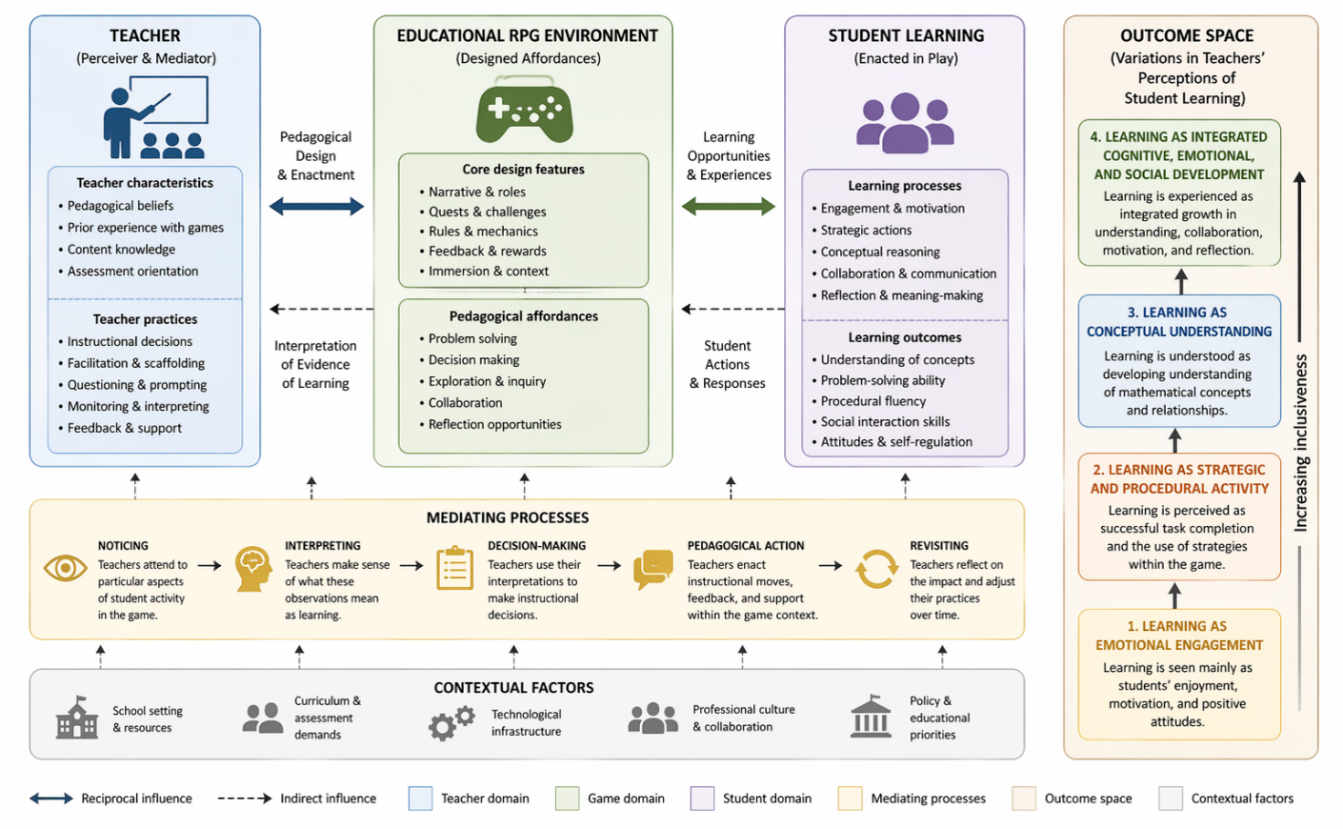
Educational role-playing games (RPGs) have been increasingly adopted in mathematics education because of their potential to support students' cognitive, affective, and social learning. However, previous studies have predominantly examined their effectiveness from the perspective of student outcomes, while relatively little is known about how teachers experience and interpret student learning during educational RPG instruction. This study aimed to explore the qualitatively different ways Grades 7–9 mathematics teachers experienced student learning in educational role-playing game environments using a phenomenographic approach. Thirty mathematics teachers participated in the broader educational RPG implementation program, from which five teachers representing diverse teaching experiences were purposively selected for in-depth phenomenographic interviews. Classroom observations, teacher reflection sheets, and student activity sheets were used to contextualize and support the interpretation of interview data. Data were analysed through iterative phenomenographic procedures to construct categories of description and an outcome space. The findings identified four qualitatively different ways teachers experienced student learning: (1) engagement and emotional involvement, (2) strategy use and procedural engagement, (3) conceptual understanding of algebra, and (4) integrated cognitive, emotional, and social development. These categories formed an outcome space representing increasing inclusiveness in teachers' ways of experiencing student learning. The study contributes to educational game research by demonstrating that the pedagogical value of educational RPGs depends not only on game design or student performance but also on how teachers recognise and interpret learning within classroom practice.
##plugins.themes.bootstrap3.article.details##

This work is licensed under a Creative Commons Attribution-ShareAlike 4.0 International License.
The author is responsible for acquiring the permission(s) to reproduce any copyrighted figures, tables, data, or text that are being used in the submitted paper. Authors should note that text quotations of more than 250 words from a published or copyrighted work will require grant of permission from the original publisher to reprint. The written permission letter(s) must be submitted together with the manuscript.References
Åkerlind, G. S. (2018). What future for phenomenographic research? On continuity and development in the phenomenography and variation theory research tradition. Scandinavian Journal of Educational Research, 62(6), 949–958. https://doi.org/10.1080/00313831.2017.1324899
Barron, B. (2003). When smart groups fail. Journal of the Learning Sciences, 12(3), 307–359. https://doi.org/10.1207/s15327809jls1203_1
Clark, D. B., Tanner-Smith, E. E., & Killingsworth, S. S. (2016). Digital games, design, and learning. Review of Educational Research, 86(1), 79–122. https://doi.org/10.3102/0034654315582065
Gee, J. P. (2003). What video games have to teach us about learning and literacy. Computers in Entertainment, 1(1), 20. https://doi.org/10.1145/950566.950595
Hamidah, I., Zulkardi, Z., Putri, R. I. I., & Pramuditya, S. A. (2025). Developing a mathematical literacy learning environment for students through educational game assistance. Jurnal Pendidikan Matematika, 19(1), 141–162. https://doi.org/10.22342/jpm.v19i1.pp141-162
Han, F., & Ellis, R. A. (2019). Using phenomenography to tackle key challenges in science education. Frontiers in psychology, 10, 01414. https://doi.org/10.3389/fpsyg.2019.01414
Hiebert, J., & Grouws, D. A. (2007). The effects of classroom mathematics teaching. In F. K. Lester Jr. (Ed.), Second handbook of research on mathematics teaching and learning: A project of the national council of teachers of mathematics (pp. 371–404). Information Age Publishing.
Kajiwara, Y., Matsuoka, A., & Shinbo, F. (2023). Machine learning role playing game: Instructional design of AI education for age-appropriate in K-12 and beyond. Computers and Education: Artificial Intelligence, 5, 100162. https://doi.org/10.1016/j.caeai.2023.100162
Mandala, A. S., Anwar, L., Sa'dijah, C., & Zulnaidi, H. (2025). Development of mobile augmented reality-based geometry learning games to facilitate spatial reasoning. Infinity Journal, 14(2), 323–348. https://doi.org/10.22460/infinity.v14i2.p323-348
Marton, F. (1986). Phenomenography—A research approach to investigating different understandings of reality. Journal of thought, 21(3), 28–49. https://www.jstor.org/stable/42589189
Marton, F., & Booth, S. (1997). Learning and awareness. Lawrence Erlbaum Associates.
Mercer, N., & Howe, C. (2012). Explaining the dialogic processes of teaching and learning: The value and potential of sociocultural theory. Learning, Culture and Social Interaction, 1(1), 12–21. https://doi.org/10.1016/j.lcsi.2012.03.001
Pan, Y., Ke, F., & Xu, X. (2022). A systematic review of the role of learning games in fostering mathematics education in K-12 settings. Educational Research Review, 36, 100448. https://doi.org/10.1016/j.edurev.2022.100448
Plass, J. L., Homer, B. D., & Kinzer, C. K. (2015). Foundations of game-based learning. Educational Psychologist, 50(4), 258–283. https://doi.org/10.1080/00461520.2015.1122533
Pramuditya, S. A., Noto, M. S., & Azzumar, F. (2022). Characteristics of students' mathematical problem solving abilities in open-ended-based virtual reality game learning. Infinity Journal, 11(2), 255–272. https://doi.org/10.22460/infinity.v11i2.p255-272
Pramuditya, S. A., Noto, M. S., & Handayani, V. D. (2021). Desain didaktis konteks fabel berbasis pemahaman matematis siswa pada materi aljabar [Didactic design of fable context based on students' mathematical understanding of algebra material]. Jurnal Elemen, 7(1), 68–83. https://doi.org/10.29408/jel.v7i1.2730
Pramuditya, S. A., Noto, M. S., & Syaefullah, D. (2018). The educational game design on relation and functionmaterials. Journal of Physics: Conference Series, 1013, 012138. https://doi.org/10.1088/1742-6596/1013/1/012138
Pramuditya, S. A., Widiyasari, R., & Fitriadi, P. (2025). Enhancing 3D geometry learning: A differentiated educational game approach. Infinity Journal, 14(4), 1043–1064. https://doi.org/10.22460/infinity.v14i4.p1043-1064
Qian, M., & Clark, K. R. (2016). Game-based Learning and 21st century skills: A review of recent research. Computers in human Behavior, 63, 50–58. https://doi.org/10.1016/j.chb.2016.05.023
Rittle-Johnson, B., Schneider, M., & Star, J. R. (2015). Not a one-way street: Bidirectional relations between procedural and conceptual knowledge of mathematics. Educational Psychology Review, 27(4), 587–597. https://doi.org/10.1007/s10648-015-9302-x
Vygotsky, L. S. (1978). Mind in society: Development of higher psychological processes. Harvard university press.
Wang, L.-H., Chen, B., Hwang, G.-J., Guan, J.-Q., & Wang, Y.-Q. (2022). Effects of digital game-based STEM education on students’ learning achievement: a meta-analysis. International journal of STEM education, 9(1), 26. https://doi.org/10.1186/s40594-022-00344-0
Webb, N. M., Franke, M. L., Ing, M., Wong, J., Fernandez, C. H., Shin, N., & Turrou, A. C. (2014). Engaging with others’ mathematical ideas: Interrelationships among student participation, teachers’ instructional practices, and learning. International Journal of Educational Research, 63, 79–93. https://doi.org/10.1016/j.ijer.2013.02.001
Wouters, P., van Nimwegen, C., van Oostendorp, H., & van der Spek, E. D. (2013). A meta-analysis of the cognitive and motivational effects of serious games. Journal of educational psychology, 105(2), 249–265. https://doi.org/10.1037/a0031311
Zhong, L. (2022). Incorporating personalized learning in a role-playing game environment via SID model: A pilot study of impact on learning performance and cognitive load. Smart learning environments, 9(1), 36. https://doi.org/10.1186/s40561-022-00219-5