
Mediating role of teacher numeracy in shaping conceptual mathematics teaching perceptions: Evidence from early elementary teachers
##plugins.themes.bootstrap3.article.sidebar##
##plugins.themes.bootstrap3.article.main##
Abstract
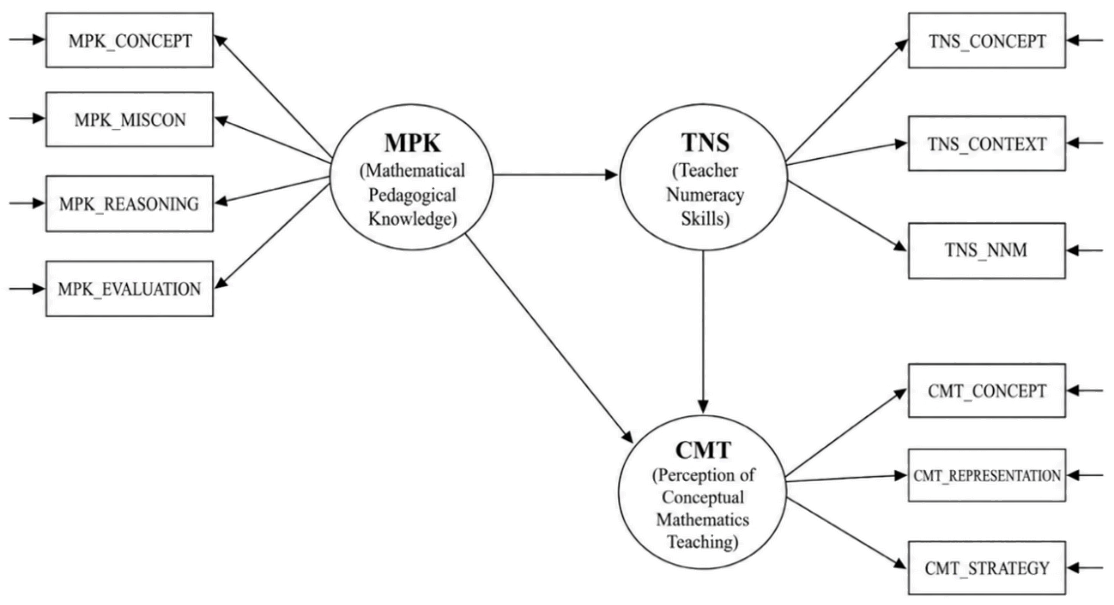
Strengthening mathematics learning that emphasizes conceptual understanding places teachers at the center of students' learning success. However, the mechanisms through which teacher competence shapes perceptions of conceptual mathematics teaching remain insufficiently explored, particularly among early elementary school teachers. This study investigated the relationships among mathematical pedagogical knowledge, teacher numeracy skills, and perceptions of mathematical conceptual teaching, as well as the mediating role of teacher numeracy skills. A quantitative survey was conducted involving 885 early elementary school teachers from various regions of Indonesia. Data were collected through an online questionnaire and analyzed using Structural Equation Modeling with a two-step approach. The results showed that mathematical pedagogical knowledge had significant positive effects on teacher numeracy Skills (β = 0.698, p < 0.001) and perceptions of mathematical conceptual teaching (β = 0.172, p < 0.001). Teacher numeracy skills also positively influenced perceptions of mathematical conceptual teaching (β = 0.355, p < 0.001) and partially mediated the relationship between mathematical pedagogical knowledge and perceptions of mathematical conceptual teaching (indirect effect β = 0.248, p < 0.001). This study provides a novel contribution by demonstrating that teacher numeracy skills function not merely as an independent professional competency but as an explanatory mechanism through which mathematical pedagogical knowledge is translated into teachers' perceptions of conceptually oriented mathematics instruction. These findings suggest that teachers' perceptions of conceptually oriented mathematics instruction are shaped not only by pedagogical knowledge but also by their ability to apply mathematics meaningfully in contextual situations. The study highlights the importance of strengthening both pedagogical and numeracy competencies in teacher education and professional development programs.
##plugins.themes.bootstrap3.article.details##

This work is licensed under a Creative Commons Attribution-ShareAlike 4.0 International License.
The author is responsible for acquiring the permission(s) to reproduce any copyrighted figures, tables, data, or text that are being used in the submitted paper. Authors should note that text quotations of more than 250 words from a published or copyrighted work will require grant of permission from the original publisher to reprint. The written permission letter(s) must be submitted together with the manuscript.References
Aderinoye-Rabiu, R. A., Bello, A. B., Usman, A. A., Falebita, O. T., & Oloyede, G. O. (2025). Assessing the influence of primary mathematics educators' content knowledge and pedagogical content knowledge on teaching effectiveness. Pedagogical Research, 10(3), em0240. https://doi.org/10.29333/pr/16665
Agbata, B. C., Obeng-Denteh, W., Kwabi, P. A., Abraham, S., Okpako, S. O., Arivi, S. S., Asante-Mensa, F., & Adu Gyamfi, W. K. (2024). Everyday uses of mathematics and the roles of a mathematics teacher. Science World Journal, 19(3), 819–827. https://scienceworldjournal.org/article/view/24035
Almusaed, A., Almssad, A., & Yitmen, I. (2025). Survey research and sampling techniques. In A. Almusaed, A. Almssad, & I. Yitmen (Eds.), Practice of research methodology in civil engineering and architecture: A comprehensive guide (pp. 561–593). Springer Nature Switzerland. https://doi.org/10.1007/978-3-031-97393-2_17
Association of Mathematics Teacher Educators. (2020). Standards for preparing teachers of mathematics. Emerald Group Publishing.
Ayeh, I. G. (2025). Students' mathematics conceptual challenges: Exploring students' thinking, understanding, and misconceptions in functions and graphs. European Journal of Science and Mathematics Education, 13(3), 191–206. https://doi.org/10.30935/scimath/16596
Badan Kebijakan Pendidikan Dasar dan Menengah. (2026). Hasil tes kemampuan akademik 2025-2026 [Academic ability test results 2025-2026]. Kemendikdasmen. https://tka.kemendikdasmen.go.id/hasiltka/
Badan Standar Kurikulum dan Asesmen Pendidikan. (2026). Naskah akademik gerakan numerasi nasional [Academic manuscript of the national numeracy movement]. Kemendikdasmen. https://sindara.gurudikdas.kemendikdasmen.go.id/detail-artikel/149
Basid, A., Sutrisno, E., & Aliyeva, L. R. (2024). Analysis of the effect of contextual problem solving on students’ mathematical reasoning ability. International Journal of Science and Mathematics Education, 1(3), 24–33. https://doi.org/10.62951/ijsme.v1i3.258
Brühwiler, C., & Vogt, F. (2020). Adaptive teaching competency: Eff ects on quality of instruction and learning outcomes. Journal for educational research online, 12(1), 119–142.
Charalambous, C. Y., Hill, H. C., Chin, M. J., & McGinn, D. (2020). Mathematical content knowledge and knowledge for teaching: exploring their distinguishability and contribution to student learning. Journal of Mathematics Teacher Education, 23(6), 579–613. https://doi.org/10.1007/s10857-019-09443-2
Chen, W. (2025). Problem-solving skills, memory power, and early childhood mathematics: Understanding the significance of the early childhood mathematics in an individual’s life. Journal of the Knowledge Economy, 16(1), 1–25. https://doi.org/10.1007/s13132-023-01557-6
Coffey, P., & Sharpe, R. (2023). An investigation into the teaching of numeracy in subjects other than mathematics across the curriculum. International Journal of Mathematical Education in Science and Technology, 54(5), 860–887. https://doi.org/10.1080/0020739X.2021.1978570
Delgado-Rebolledo, R., & Zakaryan, D. (2020). Relationships between the knowledge of practices in mathematics and the pedagogical content knowledge of a mathematics lecturer. International Journal of Science and Mathematics Education, 18(3), 567–587. https://doi.org/10.1007/s10763-019-09977-0
Demir, M. (2025). Preschool teachers' pedagogical knowledge, awareness and perspectives of early childhood mathematics education. Early Years, 1–17. https://doi.org/10.1080/09575146.2025.2524616
Demir, S. (2022). Comparison of normality tests in terms of sample sizes under different skewness and Kurtosis coefficients. International Journal of Assessment Tools in Education, 9(2), 397–409. https://doi.org/10.21449/ijate.1101295
Depaepe, F., Verschaffel, L., & Star, J. (2020). Expertise in developing students’ expertise in mathematics: Bridging teachers’ professional knowledge and instructional quality. Zdm, 52(2), 179–192. https://doi.org/10.1007/s11858-020-01148-8
Díez-Palomar, J., & Hoogland, K. (2025). Discussing "Numeracy" beyond the scientific community: How adult learners define numeracy and what challenges arise from that for the coming future. In Proceedings of the Fourteenth Congress of the European Society for Research in Mathematics Education (CERME14), (4th ed., pp. 05201982).
Díez-Palomar, J., Ramis-Salas, M., Močnik, I., Simonič, M., & Hoogland, K. (2023). Challenges for numeracy awareness in the 21st century: Making visible the invisible. Frontiers in Education, 8, 1295781. https://doi.org/10.3389/feduc.2023.1295781
Dolapcioglu, S., & Doğanay, A. (2022). Development of critical thinking in mathematics classes via authentic learning: An action research. International Journal of Mathematical Education in Science and Technology, 53(6), 1363–1386. https://doi.org/10.1080/0020739X.2020.1819573
Dole, S., & Geiger, V. (2020). Numeracy across the curriculum: Research-based strategies for enhancing teaching and learning. Routledge.
Fukaya, T., Nakamura, D., Kitayama, Y., & Nakagoshi, T. (2025). A systematic review and meta-analysis of research on mathematics and science pedagogical content knowledge: Exploring its associations with teacher and student variables. Teaching and Teacher Education, 155, 104881. https://doi.org/10.1016/j.tate.2024.104881
Gatignon, H. (2010). Confirmatory factor analysis. In H. Gatignon (Ed.), Statistical analysis of management data (pp. 59–122). Springer. https://doi.org/10.1007/978-1-4419-1270-1
Geiger, V., Goos, M., & Forgasz, H. (2015). A rich interpretation of numeracy for the 21st century: A survey of the state of the field. Zdm, 47(4), 531–548.
Geiger, V., Yasukawa, K., Bennison, A., Wells, J. F., & Sawatzki, C. (2020). Facets of numeracy: Teaching, learning and practices. In J. Way, C. Attard, J. Anderson, J. Bobis, H. McMaster, & K. Cartwright (Eds.), Research in mathematics education in Australasia 2016–2019 (pp. 59–89). Springer Singapore. https://doi.org/10.1007/978-981-15-4269-5_4
Gleasman, C., & Kim, C. (2020). Pre-service teacher’s use of block-based programming and computational thinking to teach elementary mathematics. Digital Experiences in Mathematics Education, 6(1), 52–90. https://doi.org/10.1007/s40751-019-00056-1
Golzar, J., Noor, S., & Tajik, O. (2022). Convenience sampling. International Journal of Education & Language Studies, 1(2), 72–77. https://doi.org/10.22034/ijels.2022.162981
Gonzalez, O., Valente, M. J., Cheong, J., & MacKinnon, D. P. (2023). Mediation/indirect effects in structural equation modeling (2nd ed.). The Guilford Press.
Goos, M., Geiger, V., & Dole, S. (2012). Numeracy across the curriculum. Australian Mathematics Teacher, 68(1), 3–7. https://files.eric.ed.gov/fulltext/EJ974975.pdf
Grigaliūnienė, M., Lehtinen, E., Verschaffel, L., & Depaepe, F. (2025). Systematic review of research on pedagogical content knowledge in mathematics: Insights from a topic-specific approach. ZDM – Mathematics Education, 57(4), 777–794. https://doi.org/10.1007/s11858-025-01684-1
Hasbi, H., Moeljadi, M., Noermijati, N., & Rofiq, A. (2021). Effect of strength of the external environment and Islamic business ethics on the performance of Islamic finance companies with intellectual capital mediation. Management Science Letters, 11, 993–1002. https://doi.org/10.5267/j.msl.2020.9.043
Hatisaru, V. (2023). Mathematical connections established in the teaching of functions. Teaching Mathematics and its Applications: An International Journal of the IMA, 42(3), 207–227. https://doi.org/10.1093/teamat/hrac013
Haylock, D. (2024). Mathematics explained for primary teachers. SAGE Publications Ltd.
Herbert, S. (2021). Overcoming challenges in assessing mathematical reasoning. Australian Journal of Teacher Education (Online), 46(8), 17–30. https://doi.org/10.14221/ajte.2021v46n8.2
Hidayat, W., Widodo, S. A., & Syahrizal, T. (2023). The statistical thinking skill and adversity quotient of English pre-service teacher. International Journal of Evaluation and Research in Education, 12(1), 421–432. https://doi.org/10.11591/ijere.v12i1.24302
Hoogland, K. (2023). The changing nature of basic skills in numeracy. Frontiers in Education, 8, 1293754. https://doi.org/10.3389/feduc.2023.1293754
Hussein, Y. F., & Csíkos, C. (2023). The effect of teaching conceptual knowledge on students’ achievement, anxiety about, and attitude toward mathematics. Eurasia Journal of Mathematics, Science and Technology Education, 19(2), em2226. https://doi.org/10.29333/ejmste/12938
Irshid, M. M. B., Khasawneh, A. A., & Al-Barakat, A. A. (2023). The effect of conceptual understanding principles-based training program on enhancement of pedagogical knowledge of mathematics teachers. Eurasia Journal of Mathematics, Science and Technology Education, 19(6), em2277. https://doi.org/10.29333/ejmste/13215
Jöreskog, K. G., & Sörbom, D. (1993). LISREL 8: Structural equation modeling with the SIMPLIS command language. Scientific Software International.
Kasa, Y., Areaya, S., & Woldemichael, M. (2024). Mathematics teachers' beliefs about mathematics, its teaching, and learning: The case of five teachers. Pedagogical Research, 9(2), em0191. https://doi.org/10.29333/pr/14172
Kitchen, R. (2022). The power of their ideas: Leveraging teachers’ mathematical ideas in professional development. International Journal of Mathematical Education in Science and Technology, 53(7), 1835–1858. https://doi.org/10.1080/0020739X.2020.1847337
Kleickmann, T., Richter, D., Kunter, M., Elsner, J., Besser, M., Krauss, S., Cheo, M., & Baumert, J. (2015). Content knowledge and pedagogical content knowledge in Taiwanese and German mathematics teachers. Teaching and Teacher Education, 46, 115–126. https://doi.org/10.1016/j.tate.2014.11.004
Kline, R. B. (2023). Principles and practice of structural equation modeling (5th ed.). The Guilford Press.
Kohen, Z., & Orenstein, D. (2021). Mathematical modeling of tech-related real-world problems for secondary school-level mathematics. Educational Studies in Mathematics, 107(1), 71–91. https://doi.org/10.1007/s10649-020-10020-1
König, J., Blömeke, S., Jentsch, A., Schlesinger, L., Nehls, C. F. n., Musekamp, F., & Kaiser, G. (2021). The links between pedagogical competence, instructional quality, and mathematics achievement in the lower secondary classroom. Educational Studies in Mathematics, 107(1), 189–212. https://doi.org/10.1007/s10649-020-10021-0
Kyle, G., Landon, A. C., Pilgreen, D., & Golebie, E. (2026). Measurement instruments. In K. L. Pope, R. Arlinghaus, L. M. Hunt, A. J. Lynch, & B. T. van Poorten (Eds.), Understanding recreational fishers: Disciplinary and interdisciplinary approaches for fisheries management (pp. 355–385). Springer Nature Switzerland. https://doi.org/10.1007/978-3-031-99739-6_12
Lee, H.-J., & Vongkulluksn, V. W. (2023). Enhancing mathematics teacher professional learning through a contextualized professional development program. Teacher Development, 27(1), 92–115. https://doi.org/10.1080/13664530.2022.2134195
Leong, K. E., Chew, C. M., & Suzieleez Syrene, A. R. (2015). Understanding Malaysian pre-service teachers mathematical content knowledge and pedagogical content knowledge. Eurasia Journal of Mathematics, Science and Technology Education, 11(3), 363–370. https://doi.org/10.12973/eurasia.2015.1346a
Liljedahl, P., Rösken, B., & Rolka, K. (2021). Changes to preservice elementary teachers’ beliefs about mathematics and the teaching and learning of mathematics: How and why? Journal of Adult Learning, Knowledge and Innovation, 4(1), 20–30.
Lines, T., Burdick, C., Dewez, X., Aldridge, E., Neal-Williams, T., Walker, K., Akhlaghi, H., Paul, B., & Taylor, D. M. (2022). Nature and extent of selection bias resulting from convenience sampling in the emergency department. Emergency Medicine Journal, 39(4), 325–330. https://doi.org/10.1136/emermed-2021-211390
Little, T. D., Rioux, C., Odejimi, O. A., & Stickley, Z. L. (2022). Parceling in structural equation modeling: A comprehensive introduction for developmental scientists. Cambridge University Press. https://doi.org/10.1017/9781009211659
Mainali, B. (2021). Representation in teaching and learning mathematics. International Journal of Education in Mathematics, Science and Technology, 9(1), 1–21. https://doi.org/10.46328/ijemst.1111
Marasabessy, R. (2021). Study of mathematical reasoning ability for mathematics learning in schools: A literature review. Indonesian Journal of Teaching in Science, 1(2), 79–90. https://doi.org/10.17509/ijotis.v1i2.37950
McChesney, K., & Aldridge, J. M. (2021). What gets in the way? A new conceptual model for the trajectory from teacher professional development to impact. Professional Development in Education, 47(5), 834–852. https://doi.org/10.1080/19415257.2019.1667412
Md-Ali, R., Karim, H. B. B. A., & Yusof, F. M. (2016). Experienced primary school teachers' thoughts on effective teachers of literacy and numeracy. Malaysian Journal of Learning and Instruction, 13(1), 43–62. https://doi.org/10.32890/mjli2016.13.1.3
Memon, M. A., Thurasamy, R., Ting, H., & Cheah, J. H. (2025). purposive sampling: a review and guidelines for quantitative research. Journal of Applied Structural Equation Modeling, 9(1), 1–23.
Munaji, M., Rohaeti, T., Mutadi, M., Sumliyah, S., & Kodirun, K. (2025). A literature review of flexibility in interactive mathematics classrooms: the role of teachers and students. Journal of Education and Learning (EduLearn), 19(2), 597–605. https://doi.org/10.11591/edulearn.v19i2.21501
Murtafiah, W., Lestari, N. D. S., Yahya, F. H., Apriandi, D., & Suprapto, E. (2023). How do students' decision-making ability in solving open-ended problems? Infinity Journal, 12(1), 133–150. https://doi.org/10.22460/infinity.v12i1.p133-150
Murtafiah, W., Lukitasari, M., Lestari, N. D. S., Zayyadi, M., & Widodo, S. A. (2022). Decision making students winning microteaching contest in design lesson plan and its implementation in mathematics learning. Cypriot Journal of Educational Sciences, 17(6), 2045–2060. https://doi.org/10.18844/cjes.v17i6.7497
Ncube, M., & Luneta, K. (2025). Concept-based instruction: Improving learner performance in mathematics through conceptual understanding. Pythagoras-Journal of the Association for Mathematics Education of South Africa, 46(1), a815. https://doi.org/10.4102/pythagoras.v46i1.815
Niyazul Hague, M. (2024). The role of multiple representations and attitudes in enhancing statistical and mathematical learning citation. Smart. Internet. Things, 1(4), 298–312. https://doi.org/10.22105/siot.vi.52
Nwosu, C. E. (2025). Designing visually interactive learning modules to promote secondary school students' critical thinking in mathematics. Journal of Science Education, 15(2), 156–162. https://ojs.universityedu.org/index.php/jose/article/view/23
Obilor, E. I. (2023). Convenience and purposive sampling techniques: Are they the same? International Journal of Innovative Social & Science Education Research, 11(1), 1–7.
OECD. (2019). PISA 2018 insights and interpretations. OECD Publishing.
OECD. (2019). PISA 2018 results: Combined executive summaries, volume I, II & III. OECD Publishing.
OECD. (2023). PISA 2022 results (volume I): The state of learning and equity in education. OECD Publishing. https://doi.org/10.1787/53f23881-en
Onoshakpokaiye, E. O., & Eyetan, V. (2026). Strategic framework for enhancing mathematical understanding in young learners. Journal of Early Childhood Development and Education, 3(1), 8–14. https://doi.org/10.58723/junior.v3i1.516
Pardede, M., Karo-Karo, S., Gulo, Y., & Gultom, F. (2024). The effect of teacher competence on student learning outcomes. Jurnal Penelitian Pendidikan IPA, 10, 679–684. https://doi.org/10.29303/jppipa.v10iSpecialIssue.7374
Polman, J., Hornstra, L., & Volman, M. (2021). The meaning of meaningful learning in mathematics in upper-primary education. Learning Environments Research, 24(3), 469–486. https://doi.org/10.1007/s10984-020-09337-8
Prediger, S., Dröse, J., Stahnke, R., & Ademmer, C. (2023). Teacher expertise for fostering at-risk students’ understanding of basic concepts: conceptual model and evidence for growth. Journal of Mathematics Teacher Education, 26(4), 481–508. https://doi.org/10.1007/s10857-022-09538-3
Reyna, V. F., & Brainerd, C. J. (2023). Numeracy, gist, literal thinking and the value of nothing in decision making. Nature Reviews Psychology, 2(7), 421–439. https://doi.org/10.1038/s44159-023-00188-7
Rittle-Johnson, B., & Siegler, R. S. (2022). The relation between conceptual and procedural knowledge in learning mathematics: A review. In C. Donlan (Ed.), The development of mathematical skills (pp. 75–110). Psychology Press.
Rohaeti, E. E., Hendriana, H., & Irfan, M. (2023). Doing mathematics intelligently and having good character through Simpatik learning. Infinity Journal, 12(1), 179–192. https://doi.org/10.22460/infinity.v12i1.p179-192
Rosita, C. D., Setiyani, S., & Cartini, N. (2025). Integrated problem based learning differentiated instruction: An effort to improve students' literacy numeracy skills. IndoMath: Indonesia Mathematics Education, 8(1), 33–43. https://doi.org/10.30738/indomath.v8i1.131
Rosita, C. D., Setiyani, S., Muhidin, I., & Sagita, L. (2026). Enhancing junior high school students’ numeracy through differentiated contextual worksheets. Infinity Journal, 15(2), 545–570. https://doi.org/10.22460/infinity.v15i2.p545-570
Saha, M., Islam, S., Akhi, A. A., & Saha, G. (2024). Factors affecting success and failure in higher education mathematics: Students' and teachers’ perspectives. Heliyon, 10(7), e29173. https://doi.org/10.1016/j.heliyon.2024.e29173
Schoenfeld, A. H. (2020). Reframing teacher knowledge: A research and development agenda. ZDM - Mathematics Education, 52(2), 359–376. https://doi.org/10.1007/s11858-019-01057-5
Schoenfeld, A. H. (2022). Why are learning and teaching mathematics so difficult? In M. Danesi (Ed.), Handbook of cognitive mathematics (pp. 1–35). Springer. https://doi.org/10.1007/978-3-030-44982-7_10-1
Sintema, E. J., & Marbán, J. M. (2020). Pre-service secondary teachers’ mathematical pedagogical content knowledge self-concept related to their content knowledge of functions and students. International Electronic Journal of Mathematics Education, 15(3), em0598. https://doi.org/10.29333/iejme/8327
Sudargini, Y., & Purwanto, A. (2020). The effect of teachers pedagogic competency on the learning outcomes of students. Journal of Industrial Engineering & Management Research, 1(4), 1–8.
Sujatha, S., & Vinayakan, K. (2023). Integrating math and real-world applications: A review of practical approaches to teaching. International Journal of Computational Research and Development (IJCRD) Impact, 8(2), 2456–3137. https://ijcrd.dvpublication.com/uploads/676bcc1c4d4ee_304.pdf
Sujati, H., Sajidan, S., Akhyar, M., & Gunarhadi, G. (2020). Testing the construct validity and reliability of curiosity scale using confirmatory factor analysis. Journal of Educational and Social Research, 10(4), 229–237. https://doi.org/10.36941/jesr-2020-0080
Szabo, Z. K., Körtesi, P., Guncaga, J., Szabo, D., & Neag, R. (2020). Examples of problem-solving strategies in mathematics education supporting the sustainability of 21st-century skills. Sustainability, 12(23), 10113. https://doi.org/10.3390/su122310113
Thakkar, J. J. (2020). Structural equation modelling: Application for research and practice. Springer. https://doi.org/10.1007/978-981-15-3793-6
Torres-Peña, R. C., Peña-González, D., Lara-Orozco, J. L., Ariza, E. A., & Vergara, D. (2025). Enhancing numerical thinking through problem solving: A teaching experience for third-grade mathematics. Education Sciences, 15(6), 667. https://doi.org/10.3390/educsci15060667
Urgo, K., & Arguello, J. (2025). Search as learning. Foundations and Trends in Information Retrieval, 19(4), 365–556. https://doi.org/10.1561/1500000084
Vinner, S. (2020). Concept development in mathematics education. In S. Lerman (Ed.), Encyclopedia of mathematics education (pp. 123–127). Springer. https://doi.org/10.1007/978-3-030-15789-0_29
Viro, E., Lehtonen, D., Joutsenlahti, J., & Tahvanainen, V. (2020). Teachers' perspectives on project-based learning in mathematics and science. European Journal of Science and Mathematics Education, 8(1), 12–31. https://doi.org/10.30935/scimath/9544
Wakhata, R., Balimuttajjo, S., & Mutarutinya, V. (2023). Building on students' prior mathematical thinking: Exploring students' reasoning interpretation of preconceptions in learning mathematics. Mathematics Teaching Research Journal, 15(1), 127–151.
Westwood, P. S. (2021). Teaching for numeracy across the age range: An introduction. Springer. https://doi.org/10.1007/978-981-16-3761-2
Widdiharto, R., Prahmana, R. C. I., Isaeni, N., Widodo, S. A., Mayangwuri, S., & Pramudiani, P. (2025). The theoretical framework of GEMBIRA learning model: An impactful insight for Indonesian numeracy movement. Union: Jurnal Ilmiah Pendidikan Matematika, 13(3), 721–733. https://doi.org/10.30738/union.v13i3.20353
Widodo, S. A., Dahlan, J. A., Harini, E., & Sulistyowati, F. (2020). Confirmatory factor analysis sosiomathematics norm among junior high school student. International Journal of Evaluation and Research in Education (IJERE), 9(2), 448–455. https://doi.org/10.11591/ijere.v9i2.20445
Wijaya, T. T., Hidayat, W., Hermita, N., Alim, J. A., & Talib, C. A. (2024). Exploring contributing factors to PISA 2022 mathematics achievement: Insights from Indonesian teachers. Infinity Journal, 13(1), 139–156. https://doi.org/10.22460/infinity.v13i1.p139-156
Wood, P. (2008). Confirmatory factor analysis for applied research. The American Statistician, 62(1), 91–92. https://doi.org/10.1198/tas.2008.s98
Xie, S., & Cai, J. (2021). Teachers’ beliefs about mathematics, learning, teaching, students, and teachers: Perspectives from Chinese high school in-service mathematics teachers. International Journal of Science and Mathematics Education, 19(4), 747–769. https://doi.org/10.1007/s10763-020-10074-w
Yang, X., & Kaiser, G. (2022). The impact of mathematics teachers’ professional competence on instructional quality and students’ mathematics learning outcomes. Current Opinion in Behavioral Sciences, 48, 101225. https://doi.org/10.1016/j.cobeha.2022.101225
Yang, X., Kaiser, G., König, J., & Blömeke, S. (2020). Relationship between pre-service mathematics teachers’ knowledge, beliefs and instructional practices in China. ZDM - Mathematics Education, 52(2), 281–294. https://doi.org/10.1007/s11858-020-01145-x
Yurekli, B., Stein, M. K., Correnti, R., & Kisa, Z. (2020). Teaching mathematics for conceptual understanding: Teachers’ beliefs and practices and the role of constraints. Journal for Research in Mathematics Education, 51(2), 234–247. https://doi.org/10.5951/jresematheduc-2020-0021
Zhang, H., & Tian, M. (2025). Unpacking the multi-dimensional nature of teacher competencies: A systematic review. Scandinavian Journal of Educational Research, 69(5), 1004–1025. https://doi.org/10.1080/00313831.2024.2369867