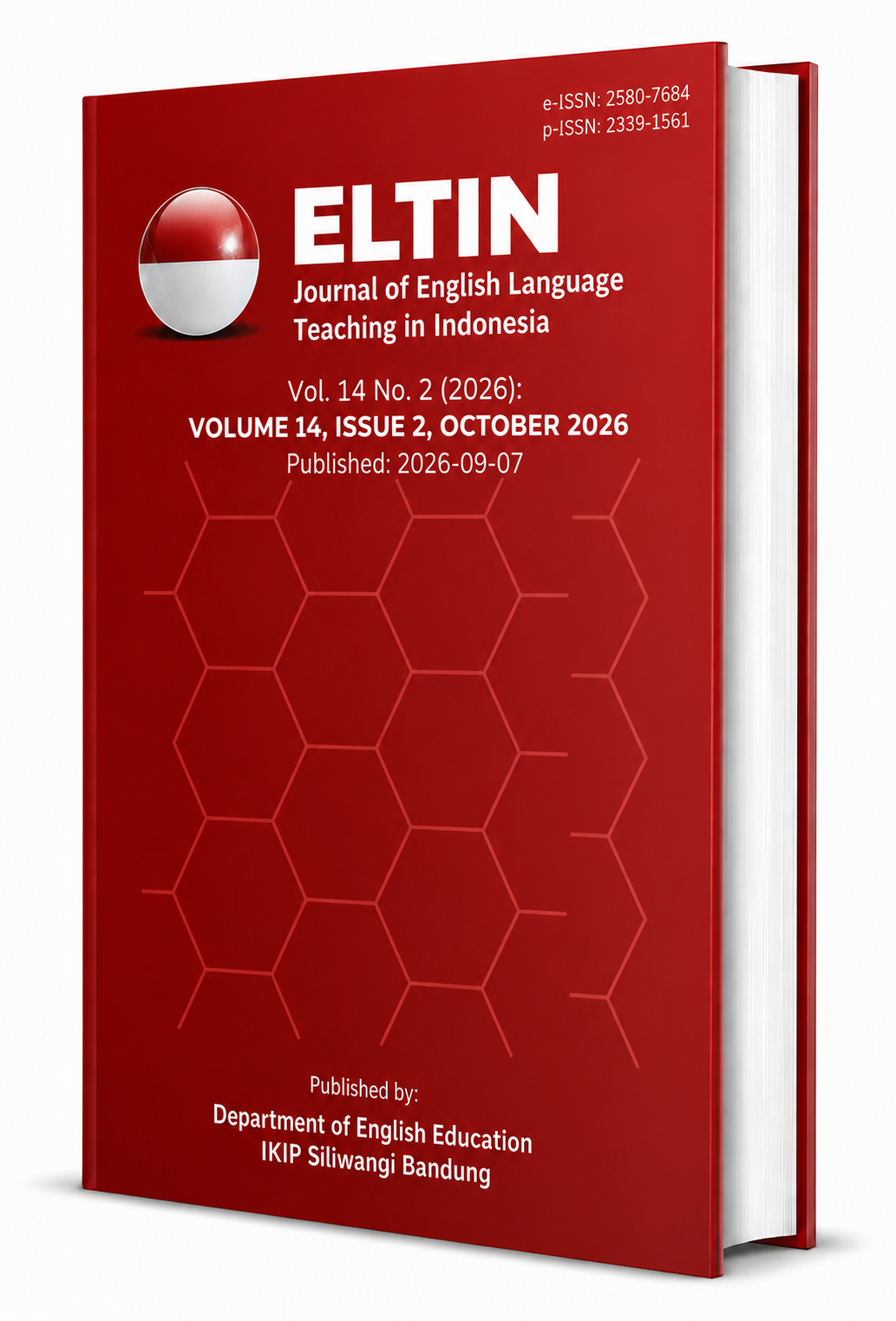
CHATGPT FOR EFL GRAMMAR AND VOCABULARY: ITS EFFECTIVENESS AND STUDENTS’ PERCEPTIONS
DOI:
https://doi.org/10.22460/eltin.v14i2.p373-382Keywords:
Grammar Mastery, chatgpt, Vocabulary mastery, Artificial Intelligence, efl learningAbstract
Grammar and vocabulary are fundamental components of English proficiency, yet many Indonesian EFL learners continue to struggle with mastering these skills. The growing use of artificial intelligence in education has positioned ChatGPT as a potential tool for enhancing language learning through interactive and personalized feedback. This study investigates the effectiveness of ChatGPT in enhancing grammar and vocabulary mastery among 10th grade students at a secondary school in Samarinda and explores students’ perceptions of its use. A mixed-method design was employed, involving 24 students selected through total sampling and assigned to experimental and control groups using cluster random sampling. The study employed pre-tests and post-tests for quantitative data collection and semi-structured interviews to obtain qualitative insights. The findings indicate that students who received ChatGPT-assisted instruction achieved significantly higher grammar and vocabulary scores compared to those taught using traditional methods. In addition, students demonstrated significant improvement within the experimental group from pre-test to post-test. Qualitative findings reveal positive student perceptions, highlighting increased motivation, confidence, and engagement in learning English. These results suggest that ChatGPT can serve as an effective supplementary tool for grammar and vocabulary instruction in EFL classrooms.
References
Akhter, S. (2021). Exploring the significance of speaking skill for EFL learners. sjesr, 4(3),
1-9.
Akramy, S. A., Noori, A. Q., Orfan, S. N., & Hashemi, A. (2022). Effective techniques of
teaching vocabulary in Afghan EFL classrooms. Asian-Pacific Journal of Second
and Foreign Language Education, 7(1), 23. https://doi.org/10.1186/s40862-022-
00151-8
Aldowsari, B. I., & Aljebreen, S. G. (2024). The Impact of Using a ChatGPT-based
application to Enhance Saudi Students’ EFL Vocabulary Learning. International
Journal of Language and Literary Studies, 6(4), 380–397.
https://doi.org/10.36892/ijlls.v6i4.1955
Ali, Y. A., Ali, M. M. A., Yanbu, W. A., Abbas, S., & Hamid, S. (2025). The influence of
ChatGPT on English grammar among ESL learners. International Journal on
Studies in Education (IJonSE), 7(3), 482–494. https://doi.org/10.46328/ijonse.1928
Alsadoon, R. (2021). Chatting with AI Bot: Vocabulary Learning Assistant for Saudi EFL
Learners. English Language Teaching, 14(6), 135. https://doi.org/10.5539/elt.v14n6p135
Alsaedi, N. (2024). ChatGPT and EFL/ESL Writing: A Systematic Review of Advantages
and Challenges. English Language Teaching, 17(5), 41.
https://doi.org/10.5539/elt.v17n5p41
Cohen, L., Manion, L., & Morrison, K. (2002). Research methods in education. Routledge.
Creswell, J. W. (2023). Research Design Qualitative Quantitative and Mixed Methods
Approaches 6th ed John W Creswell (6th ed.). Sage.
Daskan, A. (2023). The challenges of grammar learning and teaching and students’
perceptions in EFL classes–Tishk International University, Erbil case. International
Journal of Social Sciences & Educational Studies, 10(3), 367-380.
https://doi.org/10.23918/ijsses.v10i3p367
Dinh, C. T. (2025). Undergraduate English Majors’ Views on ChatGPT in Academic
Writing: Perceived Vocabulary and Grammar Improvement. FWU Journal of
Social Sciences, 19(1), 1–11. https://doi.org/10.51709/19951272/Spring2025/1
Durazno Abril, B. V., Díaz Carlosama, K. M., & Zambrano Pachay, J. F. (2025). Exploring
the Effect of ChatGPT as an Educational Tool to Improve Vocabulary Acquisition
in the English Language. Ciencia Latina Revista Científica Multidisciplinar, 9(1),
4874–4886. https://doi.org/10.37811/cl_rcm.v9i1.16190
Etikan, I. (2016). Comparison of Convenience Sampling and Purposive Sampling.
American Journal of Theoretical and Applied Statistics, 5(1), 1.
https://doi.org/10.11648/j.ajtas.20160501.11
Fernández Cerero, J., Montenegro Rueda, M., Román Graván, P., & Fernández Batanero, J.
M. (2025). ChatGPT as a digital tool in the transformation of digital teaching
competence: A systematic review. Technologies, 13(5),
205.https://doi.org/10.3390/technologies13050205
Haggag Mohamed Haggag, B. (2023). A program based on chat generative pre-trained text
transformer (Chatgpt) for enhancing EFL majors' descriptive paragraph writing skills
and their English grammar use. مجلة کلية التربية (أسيوط), 39(6), 1-29.
Kucuk, T. (2024). ChatGPT Integrated Grammar Teaching and Learning in EFL Classes: A
Study on Tishk International University Students in Erbil, Iraq. Arab World English
Journal, 1(1), 100–111. https://doi.org/10.24093/awej/chatgpt.6
Luu, D. K. C., & Bui, D. B. H. (2025). The Utilization of Chat-GPT 3.5 for Vocabulary
Learning: A Study on Students’ Perceptions. AsiaCALL Online Journal, 16(1), 226–
252. https://doi.org/10.54855/acoj.2516111
Normawati, A. (2023). How EFL learners perceive grammar in speaking and
writing. Journal of English Educational Study (JEES), 6(1), 23-30.
Raja, F. U. (2018). Comparing traditional teaching method and experiential teaching method
using experimental research. Journal of Education and Educational Development, 5(2), 276-288.
Shaikh, S., Yayilgan, S. Y., Klimova, B., & Pikhart, M. (2023). Assessing the Usability of
ChatGPT for Formal English Language Learning. European Journal of Investigation
in Health, Psychology and Education, 13(9), 1937–1960.
https://doi.org/10.3390/ejihpe13090140
Son, J.-B., Ružić, N. K., & Philpott, A. (2025). Artificial intelligence technologies and
applications for language learning and teaching. Journal of China Computer-Assisted
Language Learning, 5(1), 94–112. https://doi.org/10.1515/jccall-2023-0015
Vita Losi, R., Putra, E., Ali, N., & Silvana Dewi, A. (2024). Investigating Artificial
Intelligence (AI) as a Vocabulary Learning Tool: Students’ Perception to Use
ChatGPT. North Sumatra Jl. Jend. Gatot Subroto KM, 3, 561–566.
Wu, T., He, S., Liu, J., Sun, S., Liu, K., Han, Q. L., & Tang, Y. (2023). A Brief Overview
of ChatGPT: The History, Status Quo and Potential Future Development. IEEE/CAA
Journal of Automatica Sinica, 10(5), 1122–1136.
https://doi.org/10.1109/JAS.2023.123618
Xiao, Y., & Zhi, Y. (2023). An Exploratory Study of EFL Learners’ Use of ChatGPT for
Language Learning Tasks: Experience and Perceptions. Languages, 8(3).
https://doi.org/10.3390/languages8030212
Yuliawati, L. (2021). The Effects of Vocabulary and Grammar Mastery on Students’
Writing Skill. Journal of English Language Learning (JELL), 5(2), 113–118.
Downloads
Published
Issue
Section
License

This work is licensed under a Creative Commons Attribution-ShareAlike 4.0 International License.
The author is responsible for acquiring the permission(s) to reproduce any copyrighted figures, tables, data, or text that are being used in the submitted paper. Authors should note that text quotations of more than 250 words from a published or copyrighted work will require grant of permission from the original publisher to reprint. The written permission letter(s) must be submitted together with the manuscript.